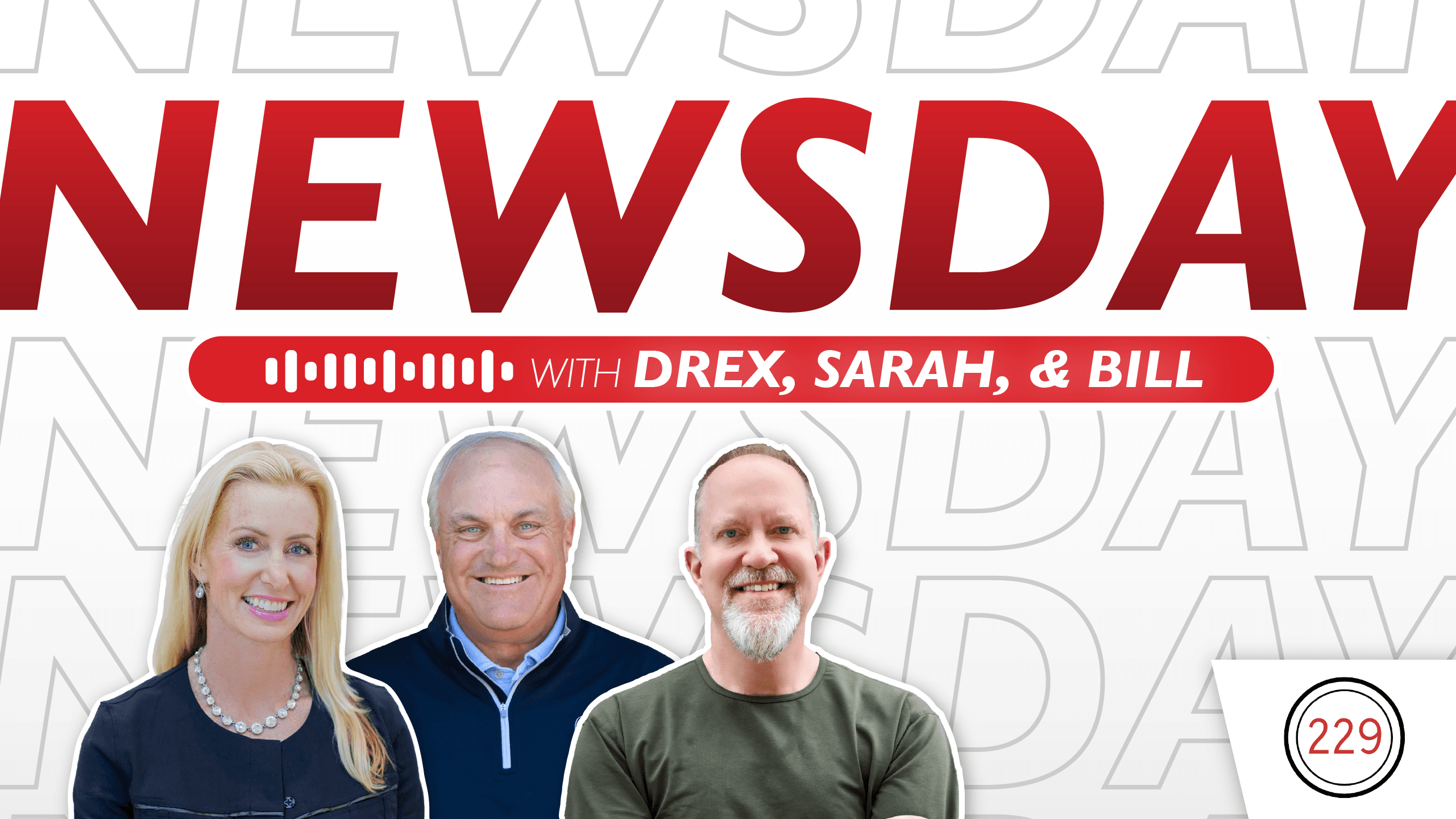
Exploring AI Wellness Coaches and Epic Leadership Stepdowns | Newsday With This Week Health
 Apple Podcasts
Questions Answered in This Episode
- How should board members safely use AI to review confidential health system materials?
- Can AI wellness coaches consolidate your health data better than your doctor?
- What happens to your data when you connect health records to fitness apps?
- Should you trust terms of service that change without your knowledge?
- What comes next at Epic after Su Mi's leadership departure?
About This Episode
Drex and Sarah join to discuss how board members are quietly using personal AI tools to review confidential health system materials, and most organizations have no policy for it. From there, the conversation gets personal. Sarah shares how she uses her AI agent as a real-time wellness coach, adjusting nutrition and habits on the fly. Drex unpacks his experience with WHOOP and asks the question every wearable user should be asking: when you clicked accept, who actually owns your data? Then the conversation shifts to Epic's Su Mi, his decision to step away, and what it reveals about identity, purpose, and the cost of never stopping
Key Points:
02:38 Secure Tools and Training
06:56 Wellness Coach in Your Pocket
12:02 Epic Leadership Shift
17:15 Purpose and Closing Thoughts
Donate: Alex’s Lemonade Stand: Foundation for Childhood Cancer


Transcript
This transcription is provided by artificial intelligence. We believe in technology but understand that even the smartest robots can sometimes get speech recognition wrong. The Power of No and a New Perspective on Ambient| The 229 Podcast with Everett Weiss, MD [00:00:00] Speaker: I'm Bill Russell, creator of this week Health, where our mission is to transform healthcare one connection at a time. Welcome to Newsday, breaking Down the Health it headlines that matter most. Let's jump into the news. Drex DeFord: hey, everyone. H- how's it going? Sarah's with me. It's news day. We don't have Bill today. What are we gonna do, Sarah? No Bill. Sarah Richardson: I don't know. We are going to, uh, have a dialogue that is based on challenging each other a bit, yet,no grand intro before your name. I don't have anything fancy to say about you- except I hope you had a great 4th of July. Drex DeFord: For folks that are listening to this, it'll be a little, little bit after the 4th of July. I was in Seattle and, I had a dog that was kind of, panicking most of the weekend. So I had to, had to take care of Jackpot. But you were in Philadelphia. Sarah Richardson: We were in Philadelphia and it was hot, and it was such a fun weekend. Unbeknownst [00:01:00] to us, the Paraguay and France teams stayed at our hotel. Drex DeFord: Oh. Sarah Richardson: So we were in this, like, super, super secure hotel with all kinds of fancies. Just, like, people everywhere. And so we kept joking, like, "Wow, I feel famous for a day," 'cause we had to- like, literally go in secret entrances and, and whatnot. So it was pretty cool to get wrapped up in the,festivities of World Cup, along with all the other, uh, great reflections upon, uh, what 250 years of, of being a country means for us. Drex DeFord: Yeah. It's been, uh, it's been a great fun weekend with World Cup and, we, the USA game is tonight because we're recording this on Monday the 6th. So we'll, um, we'll see how that goes. Sarah Richardson: No red cards for you today. No, Drex DeFord: no .Red cards. Thank you very much. Uh, let's start with, there's a story about shadow AI, and we talk about,we talk a lot about shadow AI and the sort of situation that we're in right now in health systems where folks can sign up [00:02:00] for stuff on their own. They're doing stuff on their own. They're doing it on their phone. They're doing it on their personal machines. They're moving stuff out of the health system into their own, their own AI application. They're building their own applications. All that stuff's going on, but there was a really interesting story this week about, um, boards and the way that board members are using AI to look at and review the material that they're being provided by their health systems, by their organizations. So what do you think about that? Sarah Richardson: I, I think two, or I believe two things about it that are interesting. The first one is that I sit on a board for one of our partners. Mm-hmm. And they regularly will send out reminders to everybody that, "Hey, by the way, board prep doesn't mean you load our deck into an AI tool." Mm-hmm. "And if you want to use AI, here are the tools we recommend," or, "Here's how you need to get that information." So it's a little bit about sharing the, the space that's safe for people to use it, because they're gonna load this confidential [00:03:00] information. And so what are the secure tools that enable your healthcare organization as well as your board? And that may force a conversation internally about what are the sanctioned tools inside of our health systems. The other piece is that education for your board. I've done a couple presentations now for women's business leaders in US healthcare, specifically towards how do you sit as a board member and responsibly and effectively utilize AI, and the types of questions you should be asking, inclusive of which model should I be using- Drex DeFord: Hmm. Mm-hmm ... Sarah Richardson: to be a valuable board member. Drex DeFord: Yeah, I, I mean, this is definitely one of those things that I hadn't really spent a lot of time thinking about it. I, I know how I behave and I know how I work, and I'm often taking big documents or large PDFs or other things, and I load it into my assistant and say, "Can you give me the Reader's Digest version?" Um- Yep ... our, my assistant is closed. It's locked down. It's restricted just to me, and so I feel very comfortable that when I do [00:04:00] that, I'm not exposing stuff to the entire world. Uh, back to your education point, like, I don't know a lot of board members maybe don't, they don't know how that works or what the situation is. So I think there's probably a lot more board members than we think that are using AI to give me the synopsis of all this material. What should I be thinking about? Where should I be asking questions? What doesn't look like it's completely up to snuff? Like, those kinds of questions are very important, and you should be reviewing material for that, but there's definitely a right way and a wrong way. And so the conclusion, I guess, the punchline in all of this is that if you haven't talked to your board about this, you absolutely should. If you don't have tools the board can use, you should definitely be talking about what's the right way and what's the wrong way to do this. Sarah Richardson: Well, if you assume that people appreciate the intent of the education, because the [00:05:00] usage of AI is no different than when, what? 25 years ago we were giving password security presentations. What applies at work applies at home- Mm-hmm ... when it comes to usage of certain tools, and so good practice for AI applies to your personal life as much as it does to the companies that you're serving. Drex DeFord: Yeah. Um, I'm gonna move on to another story. Uh, it's, uh, been very interesting for me to watch you- ... um, from, uh, from afar, and sometimes, uh, sitting right next to you at the airport. The way that you interact with your AI and your assistant, um, around health issues, and the conversations that you have, the information that you let it have. Uh, there's an article this week about, uh, there's a couple of articles this week that kind of conspire together to sort of talk about how, uh, a lot of folks are using their AI assistant now to kind of consolidate health records and gather insights that connections they may not, they might not make on their own, or [00:06:00] that their providers not, may not make for them. Talk about what you're doing and kind of some of the stuff you see coming out of these articles. Sarah Richardson: Yes, because what I find so fascinating is how much care is happening outside of the conversations you may be having with your PCP or even a specialist. Drex DeFord: Well, you just wrote an article about this too on LinkedIn. It was really, it was actually really insightful. Sarah Richardson: Well, what I really appreciated about, 'cause I like to write things that I'm curious about, go figure, and then I love the responses. And you get responses quite often from people who also have a lens with that perspective. And actually one of the c- the, uh, comments from David Finn, who you and I have both known for years, was about the importance of, AI literacy and how, and, and Ernie Hood wrote that too, is how do we keep the literacy of what's happening in technology and medicine, uh, at the same pace of the way that people are experiencing it? Otherwise, you just create more and more divides. this. I'm not famous. It was- My Drex DeFord: AI agent ... " Sarah Richardson: Hey, here's what I've eaten today. I've had no, [00:07:00] other than walking around the airport, what's the ultimate snack right now on the plane?" And of course I have my bag packed with all the different foods. And it said, "Eat two ounces of turkey jerky and one ounce of your trail mix, and make sure you stay hydrated because you still have two hours left on this flight." Perfect. Now, that doesn't necessarily need to go into my medical record, and yet it's part of the whole wellness journey of how do you stay healthy in all environments, and the types of things that you're feeding into there. And so that type of daily dialogue about, "Hey, today's a 12-hour workday. What's the optimum way that I can maximize my wellness today?" And most of that information would get- I guess queried once or twice- uh, maybe on an internet browser. Well, now all of that history is inside of my agent who, you know, reminds me of doing certain things like, "Hey, have you had enough exercise this week? Hey, have you taken, you know, all of your vitamins on the right protocols?" But it can adjust for you. I do share that, by the way, with a holistic practitioner, uh, some of the, the details of, like, um, [00:08:00] travel adjustments. Drex DeFord: Mm. Sarah Richardson: But it's really, you basically have a wellness coach for all aspects of nutrition, exercise, sleep, whatever you're doing in one place, and it can be fed by your wearables, and you've got a new wearable too. Drex DeFord: Yeah. So I'm a, I'm a WHOOP guy now, and it's kind of been interesting that inside of the WHOOP application there's actually an AI assistant, and the AI assistant regularly talks to me, coaches me on, you know, "You didn't get enough sleep last night." This is our, this is our main, uh, complaint- ... conversation is like, "You sleep great when you sleep, but you don't sleep enough." And, uh, so okay, that, that... after a while it does start to get to you and you start to say, "Okay, maybe I will go try to go to bed earlier. I will try to turn off the screens earlier." But I mean, it's, it's really interesting. The, the other interesting thing in WHOOP, which is a- the thing that a lot of these articles are alluding to, is that, um, you can now connect to your outside health system or health [00:09:00] systems, outside doctors, because a lot of folks have multiple health systems and multiple doctors, uh, in their universe. You can connect to those folks and you can bring those records, those health records into the application. So, um, you know, back in the day we had, uh, you know, Google Health, which had a personal health record, and, you know, Microsoft, uh, I don't remember what Microsoft's was called. But it was a personal health record. Those existed in a day where it was complicated to bring that data in, and now it's become way, way less so, and so we start to see these applications like WHOOP which are now sort of offering the opportunity to, "Tell us where your health records are. We'll bring that data in too, and then we'll use that to help connect the dots and, and, uh, and, and make recommendations and tell you things that you should know. And by the way, if you wanna do a blood test, we also have a blood test that we can send you out to Quest Labs, and they'll take blood, and w- we'll get a bunch of those [00:10:00] markers, and we'll use that to help you make health decisions." So these things that you think of as just, like, exercise trackers, they're becoming way more than that. Sarah Richardson: Okay, but and how do you keep it from becoming the next 23andMe? Like when you look at- I do- Like how are you ... So when I, like 'cause you of all people, protecting your information as all these pieces start coming through your app and even your device, what are your recommendations for knowing how secure your information is? Drex DeFord: Yeah, there, there's a lot of things I think that I still need to learn about my WHOOP app and like what did I sign up for when I clicked the accept and continue button, uh, around, uh, you know, the terms of service. I think that's probably one of the key critical things for all these things is that if you're, if you're using your assistant and you've got a closed assistant, it's a just your assistant, it's not, you know, training on that data for the rest of the world, uh, double-check those terms of service. And those terms of service [00:11:00] change over time too, so everything may be fine now and then on Wednesday, hey, we've updated our terms of service, and now suddenly things that you thought were private are gonna be used as training data. So you kind of have to stay on top of it all the time, which drives a lot of people to say, "I'm not going to use any of these capabilities. I'm just gonna keep them to myself." I have not connected my external health records to my WHOOP yet. Uh, it's an interesting conversation. I'm sure I'll eventually dig into this and see what's, what's what. But, uh, you see a lot of folks ... Well, I mean, we've done this for a while now. Social media has sort of driven us into this position of like we give up a lot of information in exchange for the free service, which, you know, uh- means maybe that we're the, we're the service. I don't know. Sarah Richardson: So maybe at this point you're actually paying to give somebody else your data to use for their benefit, so you're bas- you're getting, like, a double ding-ding on that one. Mm-hmm. Which, that's a technical term, by the way, [00:12:00] double ding-ding. Drex DeFord: The old double ding-ding. Hey, there was something else we were gonna talk about when we, uh, did our pre-game, and I can't remember what it was now. What was the last thing we wanted to bring up? Sarah Richardson: Epic is losing Su Mi. Drex DeFord: Oh, yeah. Sarah Richardson: He has decided to step away to take care of his family. Right. Which obviously opens a succession question, uh, for Judy. But also it's really at a time, uh, that big tech and the platform fight, they're, those are peaking. Um, but what I loved about, I guess, his exit interview is that it's, it's really about, uh, honoring what has happened over the last, you know, 20-plus years, this decade, and also the ability to step away to take care of family, and that it was a conscious choice to be able to do that, and what a great message that sends to people that says, in the age of all these converging technologies and capabilities, the thing that we do all of what we do for is to be with our families. Mm-hmm. And to have that [00:13:00] be, uh, a reason to do what he is doing is pretty darn honorable in, in, in my view, for sure. Drex DeFord: Yeah. I, I agree. I, there's, um... I wonder, a lot of people don't step out because they don't have the resources to be able to sort of step out and, and take care of business. Um, but even for folks who, uh, do have the resources and still struggle with this, like, "I have a thing I need to take care of right now, I don't wanna step away," do you think it's because they're afraid that the tech is changing too fast and they'll lose out? Do you think it's that they're afraid people will forget them, their network will forget them? What, what do you, what do you think holds people back from taking that deep breath and saying, "I need a sabbatical for my mental health, for my physical health, for my f- my family who's going through something, uh, you know, crucial right now"? Because my gut tells me from the interviews that I've- Mm ... you know, read with them, the notes that people have sent me, like, it's not, "I'm leaving and that's it, I'm [00:14:00] gone forever," it's just, "I'm a, I'ma take some time." And there's not necessarily, I think, a defined end to that time. Sarah Richardson: Well, it's twofold. I mean, you and I travel worldwide for fun, and when you see how other cultures experience longevity or time together, there's a reason that there's a two or three-hour lunch built in in some parts of Europe. There's a reason they take a siesta and go to dinner at, at 9:00 or 10:00 PM. The quality of life is the driver, not your productivity or your output. Drex DeFord: Mm. Sarah Richardson: And we have never embraced that here in the US, at least from all my experiences. I mean, we, we just power through more and more and more, and we look at can we be more and more productive versus how do I utilize maybe some of these new technologies to give myself more time back? I'm finding I just work more, by the way, with, with Claude. And then the other aspect is irrelevance. When people retire, if they don't have this grand plan post-retirement from the work they've been doing [00:15:00] their whole career, they fall into the state of irrelevance, which can create, like, loneliness and, and, and chronic, uh, health issues. So being able to step away, feel like you're still relevant, and know you can step back into something as well- We could do a better job at making people feel like they're making good choices and not sacrifices when they decide to step away from their corporate career or do something a little bit different. That should be honored more than it is today, um, not seen as a trade-off. It's a, it's a current life decision for myriad reasons. I wish I had taken more time off when I had an ailing parent. I didn't because I was caught up in the, in the engine of corporate America. I was lucky enough I had a boss who did give me time to spend with her, but honestly, I should have just taken more like six months off at that point. Drex DeFord: Yeah. It's, um... You know, when you work all the time and your life is about work, [00:16:00] your, your personality, your self-worth gets wrapped into the job, and that when you walk away from that job or, I mean, you know, you get relieved from that job, you're a former something. Bill talks about this all the time. You're a former CIO or a former CXO. Um, you lose a big part of yourself, I think. Uh, you know, for a lot of folks, that's the, "That's who I am. Now who am I? I don't have any hobbies or I don't have any great hobbies. I don't... I'm not connected to a bunch of other stuff." Uh, f- folks get lost. We s- we see it a lot, um, you know. Uh, most folks know I'm a retired military officer. A lot of folks, uh, you know, that stay for 30 years in the military retire, and they, uh, pass away within a few years because the stress of not being part of a team that is driving relentlessly all the time is actually more stressful than being part of a team that's driving relentlessly all the time, [00:17:00] that, that loss, that disconnection. You're s- you see that? I mean, I know you coach a lot of folks and you talk to a, a lot of others. Um, you see that kind of same- situation for, for, for folks that you're talking to? Sarah Richardson: Yeah, I'll share that, uh, because we did spend 4th of July weekend in Philly, and we went to this fantastic old Irish pub to watch one of the matches for World Cup. And the bartender, 82 years old, his birthday is July 9th, and the reason we kept chatting with him, even though this place is packed, like way over capacity with all these people, he served in Korea- Mm ... and he has worked as a bartender at this pub for 52 years. Right. And he was as youthful and spry as anybody else behind that bar probably half his age or even younger. And he's like, "Man, I get to meet people from all over the world every single day, and this is one of the most fulfilling and fun things I have ever done." So whatever you do, having purpose behind it. And you can have a [00:18:00] grand career. You can serve in the military, serve your country at war, and come home and be like, "Hey, I'm gonna make you the best black and tan you've ever had." And by the way, you know, all these, all these kids he s- said around, around here, he says the one thing he remembers is people who are nice. And so he ended up hanging out with us a, a little bit. Place is packed, and he's chatting with, with me and Dan because guess what? We were asking him questions about him. We were being nice. And, uh, I guess what it always comes back to is if you have a kindness aspect and a lens into helping others be the best versions of themselves, then isn't that what it's all about anyway? Drex DeFord: That is, that is what it's all about. Uh, okay. That's it for, um, Newsday. Thanks for being here, and thanks for being a part of us. Thanks, Sarah, for being, uh, on the show. I d- I feel like I drove today. I, I didn't really mean to. I'm Sarah Richardson: so- Sometimes that happens ... I'm, I'm, I'm s- always happy being your co-pilot. Drex DeFord: Okay. That's it for Newsday. That's all for now. , Speaker: That's Newsday. Stay informed between episodes with our Daily Insights email. And remember, every healthcare leader [00:19:00] needs a community they can lean on and learn from. Subscribe at this week, health.com/subscribe. Thanks for listening. That's all for now.