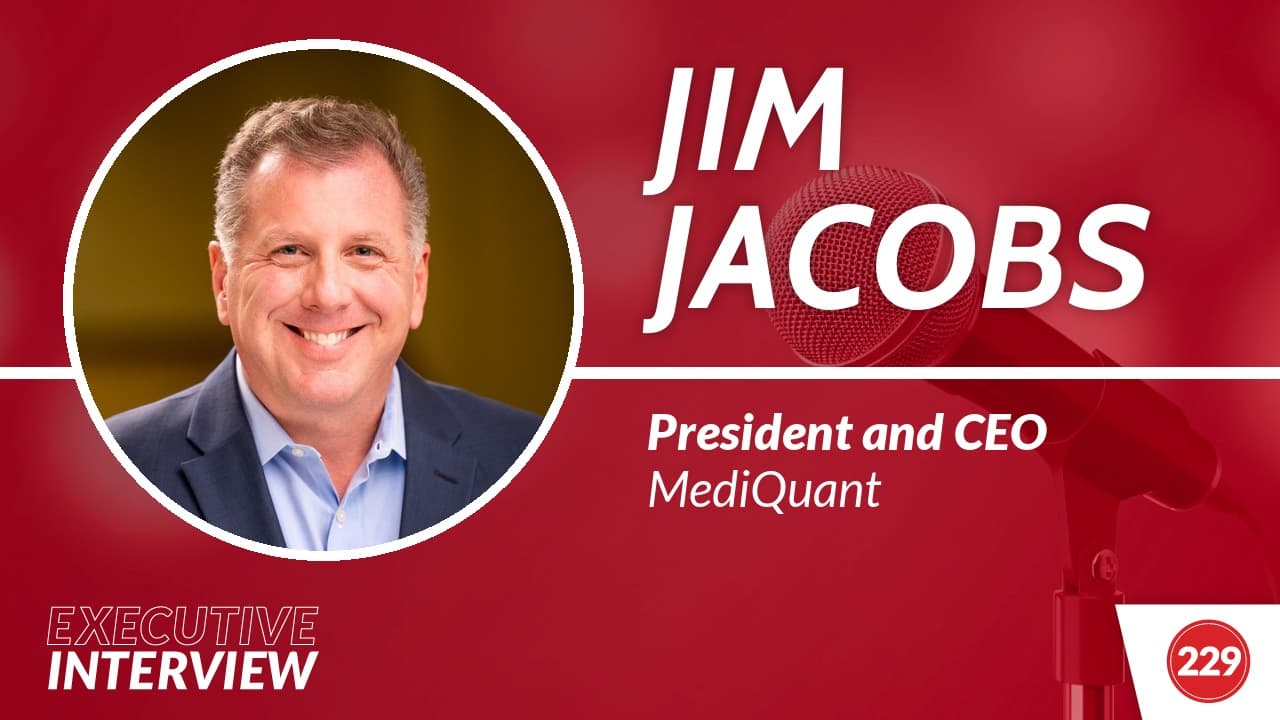
Last 3 Years Outgrew the Previous 20 | Executive Interview with Jim Jacobs
 Apple Podcasts
Questions Answered in This Episode
- What does cold storage cost the day a team has to open the file?
- Why did the last 3 years of data outgrow the previous 20?
- What does it cost to leave an old system running?
- Why does turning an old system off become a fight?
- What does a clean archive project include?
About This Episode
October 14, 2026: Jim Jacobs, President and CEO at MediQuant, sits with Bill Russell. Cold storage looks cheap until a team has to open the file. The last 3 years of MediQuant's own archive are greater than the previous 20-odd years, back to 1999. Bill asks what it costs a health system to leave an old system running.
Jim has seen the monthly bill go up after too much data moved to the cheap tier. The use case has to be planned before the data moves. Older revenue-cycle data can sit for retention. Imaging, DICOM, and sleep studies are a different cost decision. Leaving an old system on has a second login, a repeated test, and unpatched software when a team stops paying maintenance.
Guest: Jim Jacobs (MediQuant)
Key Points:
0:00 Margin Pressure on Both Lines
2:46 Not All Data Is Equal
3:25 MediQuant
5:09 Get Out Your Checkbook
9:28 Last 3 Years
11:48 What It Costs to Leave a System On
14:14 Just Turn It Off
16:56 A Good Engagement
19:08 Close
Donate: Alex's Lemonade Stand: Foundation for Childhood Cancer
Thank You to Our Episode Partner



Transcript
This transcription is provided by artificial intelligence. We believe in technology but understand that even the smartest robots can sometimes get speech recognition wrong.
Last 3 Years Outgrew the Previous 20 | Executive Interview with Jim Jacobs
[00:00:06] Bill: All right, this is another Interview in Action. Today, I am joined by Jim Jacobs, CEO of Mediquant. And Jim, you and I are going to talk about the financial realities and pressures that are hitting healthcare organizations.
[00:00:20] Bill: as we head into 2027, and some of the things that you're hearing and we're seeing on the IT side that might be able to alleviate some of that pressure. Hey, welcome to the show, by the way.
[00:00:32] Jim: Thanks so much for having me.
[00:00:34] Bill: I'm looking forward to the conversation. We've been doing regional staff roundtables, and one of the things that keeps coming up is the economic pressures in two directions. One is the pressure from the top. We have A lot of money coming out of the system as a result of OB3, the big beautiful bill, and just how this administration is approaching.
[00:00:59] Bill: Medicaid and other things, and so there's a lot of money coming out of the system, and so top lines are being pressured pretty significantly. Also, that bottom line, there's an awful lot of pressure. There's RAM prices, there's…
[00:01:12] Bill: Software costs are escalating pretty significantly, and it's put a significant focus back on IT organizations and what they're going to do to be a part of Helping health systems to deliver on the promise.
[00:01:30] Bill: And, also be a part of reducing the cost. I want to start with, and I know it's not the sexiest of topics, but
[00:01:40] Bill: We have allowed application and data proliferation across healthcare, and that is notoriously has been increases complexity, increases cost over time. I'm curious what you're hearing as you're going out out there and having that conversation. Has that been identified as
[00:02:01] Bill: An area of opportunity to reduce expenditures.
[00:02:06] Jim: It has. And so and and thankfully, it has. And I agree. I've been in health care a long time, and I swear every year we talk about how margin pressure gets worse, but this year really has been a significant margin pressure issue, and you described it well with the two pressure points.
[00:02:26] Jim: CIOs are being pressured to find ways to save money, like everyone else in the organization, and there's… you know, other than labor, you run out of a lot of options, and the hospital in particular, you run into the IT systems pretty quickly. And so, the question's being asked, what do you do about that?
[00:02:46] Jim: The other side of that coin is data lifecycle management, and what I mean by that is that not all data is created equal, so many places just store the data equally. So, there's plenty of older revenue cycle data. that's a candidate for cold storage, for example. You may still keep it for retention requirements, you may still keep it for legal reasons and whatnot.
[00:03:11] Jim: But then there's other types of data, so not all data is created equal.
[00:03:15] Jim: So we're finding that hospitals are wanting to look at the problem you just mentioned from multiple different dynamics, no doubt about it.
[00:03:56] Bill: Well, let's work our way up. Let's work from data and then up to applications. When we look at data, I mean, again, I'm pretty old, I've got the gray hair to show. I mean, we used to just do, you know, basic ladders and tiers on our storage architecture, so we would buy the EMC
[00:04:15] Bill: storage array and the EMC storage array had it built into the logic that if something hadn't been accessed, they would move it down, move it down. But even then, it would still be on an EMC storage array.
[00:04:28] Bill: And there are far cheaper ways to store that long-term, moving that off, and those kinds of things. And now we have cloud storage, and I would assume the same kind of thing applies to cloud storage. That's still a monthly bill that just keeps coming.
[00:04:42] Bill: You know, every, every time, or does… or do we have things that just naturally move things to cold storage, or is this something that, organizations need to understand and get in front of?
[00:04:58] Jim: They need to understand it and get in front of it, is our point of view. So I'll give you an example. Some of the cloud providers have got really low prices for cold storage. But, boy, the day you want to touch it, get out your checkbook. So, they do not get you…
[00:05:16] Jim: going in, but they get you coming out. And so, if you don't think through and really understand the use cases, and understand how the data might be used, it's not as simple as when was the last time it was accessed. That's where there has to be, we believe, to really save money.
[00:05:38] Jim: a thoughtful approach to what we're talking about. We've seen case studies where too much data went into cold storage, and the monthly bill actually went up, because then people were accessing… so imagine a release of information that's now in cold storage, and it turns out to be a 500-page patient chart, or whatever.
[00:05:58] Jim: And now you're pulling a lot of information out, all of a sudden. The cloud providers are just, you know, printing money at that point because of the lack of planning around what the dynamics will be about what the real use cases are. AI adds a twist to that.
[00:06:17] Jim: Because more and more models, LLMs, can use older data, right? So now there's a thought around what should we really put in cold, how long. And that's where, you know, our hope is to spend time with our customers and even evangelizing and working workshops with you guys on how do you go about organizing the thoughts around what is the data, what's the most important data.
[00:06:43] Jim: you know, layer into that sleep studies and DICOM images, you're now talking about significant cost expense that is worth spending time strategizing on.
[00:06:56] Bill: So, are we seeing hybrid data storage… Solutions where essentially some of it's on-prem, some of it's in cloud, and cold storage could potentially even be on-prem.
[00:07:09] Jim: Haven't seen that as much, but we've definitely seen the hybrid multi-tier in the cloud. Some of the hospital systems have got such large data presence in the clouds themselves, even the… They're government agencies that use the cloud providers for some of their largest systems.
[00:07:27] Jim: They are getting good rates. What we're finding, if you go back a long time ago, a lot of CIOs had their own literal data centers. There was a big swing away from that.
[00:07:37] Jim: there are now hospital systems that have so much data in the cloud providers, they're getting better rates than a lot of other vendors can get, and so there is a tendency to put more data back into what you and I would have called on-prem, but it's the hospital systems Cloud provider on-prem, if you will, not literally physically back in the hospital data center.
[00:08:00] Bill: You know, it's interesting, and one of the… one of the. summits that we had, one of the CIOs got up and shared a chart. He goes, you know, I mapped this out. where our storage costs are going. And it was a… it was a dramatic curve, because they… they… you know, they have all this imaging, plus they had just done digital pathology and other things, and he was showing this curve, and he goes, you know.
[00:08:24] Bill: much like the federal deficit, where you get over 100% of GDP and that kind of stuff for the year. He goes, that's the tipping point. And he said, right here, and it was, like, only two and a half, three years out, he goes, that's the tipping point for us. That's when our storage costs
[00:08:40] Bill: I think our storage costs will be equal to our EHR costs for everything, or… or it was, like, the total cost of IT. He had another line on there where it's total cost of IT and total cost of storage. He actually had a line that crossed the total cost for IT today
[00:08:59] Bill: in just storage. And, I mean, if nothing else gets you to think, man, we need to get in front of this and really understand it, I would think that would do it.
[00:09:10] Jim: Totally. I would ask that person to get on every podium and guest speaking engagement to sound the alarm, because it's happening very fast. So if I look at data storage. We have an on-prem and our own hosted solution, and the data we host
[00:09:28] Jim: We were started in 1999. The last 3 years' data equals… is greater than all of the data for the previous 20-odd years of the company's history. So if you talk about our curve is actually very steep in terms of total storage. Now, we've added DICOM capability.
[00:09:49] Jim: Which is very large data sets as well. It's sort of discrete data sets anymore, this tiny piece, then you get the images, and then DICOM, and then sleep studies.
[00:10:00] Jim: And it's exploded. So, there's no doubt about it that getting in front of this to manage it and manage it down, and what I hope people do is take a thoughtful approach to it, not just a simple step it down, or if it hasn't been touched in 3 years, or…
[00:10:17] Jim: Because we're also in the business of helping these hospital systems not get trapped in some, you know, now if they're going to use any of it, they're going to get clobbered.
[00:10:26] Jim: with data storage costs. There's even some data center providers competing with the large vendors now that only offer hot storage, but they offer it at a far lower rate than some of the large cloud providers. So that's an interesting dynamic to me, which is you have… they said, forget it, we're not gonna do
[00:10:45] Jim: all this fancy, if you touch it, if you don't touch it, it's one price, but their rates are lower than what a blended rate would be at the large cloud providers. Now, you know, I want to make sure, you know, it's always, you know, who's funding them, have they got, you know, have they got the right business model?
[00:11:03] Bill: Got to make sure they're going to be around for 10, 20 years.
[00:11:07] Jim: Yeah, they HIPAA compliant, all those kind of things, and, you know, they are, and there's some that are very deep in healthcare. So, I enjoy that just from the competitive side of how this industry just keeps moving forward. You know, what keeps me motivated is change, and I will say that my career in healthcare has never failed me in that aspect once.
[00:11:31] Bill: Well, let's move up the stack to the applications and talk legacy technology. Why do you think it's so… probably a two-part question, if I thought about it. Why is it so difficult for Health systems, to turn an old system off, And… What does keeping it alive really cost the health system?
[00:11:53] Jim: Yeah, those are great questions. I'll start with your second question, if you don't mind, which is, Sure. If you think holistically, start with a patient. So if a patient's… part of a patient's record is still in an old system, you're asking a clinician to remember two logins.
[00:12:10] Jim: Right? There are plenty of systems that have gone live with Epic, but they didn't buy every module in Epic, or they at least haven't rolled out every module in Epic. And not integrating that data You're making it hard for clinicians, you're making it hard for patients. And obviously, the core data is going to be in Epic, but… or whatever the… whatever they're using, but… You want it with too many places that data resides.
[00:12:33] Jim: So there's a cost there, opportunity cost. Plus, a lot of clinicians I know will not remember two passwords. They're just gonna use one, and then they're gonna… Redo the test, or redo whatever they need, and now you've duplicated some cost.
[00:12:47] Jim: that wasn't necessary. There's a risk to patient safety, if you really get down to it, of not having that data together. There's the cost of hardware or storage, of licenses, of maintenance, depending on what the vendor is that you're talking about. You know, how…
[00:13:06] Jim: stable is that vendor. We've seen hospital systems stop paying annual maintenance to save money, and now they're not getting security patches. So now they've got unpatched security vulnerabilities. I don't even know how to put a number on what a cyber risk is when you have lots and lots of older systems. And the older systems could be
[00:13:28] Jim: you know, SQL-based. We still run into AS400 systems, we still run into plenty of other much older systems, but they have current data. There's ERP systems that we archive on a regular basis that are AS400-based.
[00:13:44] Jim: Then there's just the internal aspect of what does it cost to keep it running? Do we have to keep certain employees around, or SMEs? You know, what is our approach to dealing with that? So cost comes in many, many forms when it talks about leaving systems running that you could do otherwise with. Why is it so hard?
[00:14:06] Jim: I think that stems culturally from many organizations just expect CIOs to go figure it out and do it. It's a software application, just turn it off. When you get down to it, you'll find end users who still like the system, or they're still using it, and so now they're going to resist. So you have… you have a cultural piece of
[00:14:25] Jim: of… has the executive team joined arms and said, this is a decision we've made? That's where app rationalization can help, because you can get… you can get data to have the discussion with the end users, and not… it's the CIO being a bully. That's not a great place to put a CIO, because they're trying to be helpful. So if you help demonstrate cost to get buy-in.
[00:14:48] Jim: You know, we've had customers who… the way they passively resist is they want us to rewrite all the reports that were in the old system, because they like the way all those reports were, and I get it, but it's like, that's an IP violation for us to go write the exact software that you're moving away from, and so we can't do that.
[00:15:08] Jim: But I do understand if someone's cheese got moved, and they weren't a part of the discussion, they can get upset about that. It can cause them problems in their own workflow.
[00:15:20] Jim: Then a lot of the strategies just aren't thought through. You know, let's just take all the discrete data and throw it in a bunch of PDFs, and they can figure it out. Or we're not going to think about how do you link it to the go-forward systems. Like, how does this fit into a release of information workflow? How does this actually fit into when a clinician's getting ready to do rounds.
[00:15:40] Jim: How do they know what Jim Jacobs' previous charts were? And that should be simple for them. It should be integrated in a workflow. It should be integrated where they don't have to know two logins. And so. lack of thinking it through, and then I'd say one other is… Many hospital systems are under-resourced,
[00:16:01] Jim: And so, it's not just an IT to do. You need a SME, someone who understood the system, to sign off. Did the data move over correctly? Is it reliable? Is it accurate? And so… That's, again, where something like app rationalization or some form of planning comes into saying, you know, we are going to need
[00:16:19] Jim: the VP of RevCycle, or a PFS director, or, you know, somebody's gonna have to carve out some time during this project and put hands on the keyboard, and look at it, and help us validate, or let's bring in an outside firm, but doing neither becomes a problem, because then you're saying, did we validate the data? Did we get it right? Did it line up?
[00:16:42] Jim: Because it can't be wrong. That data has to be correct as it comes across.
[00:16:48] Bill: Right. Well, let's close with this question. I mean, so I want to ask this a little differently, because I think it'll give us more color. Give us an idea of, you know, a… client engagement with Mediquant. I mean, think through a client that utilizes you guys really well and effectively. What does that look like? What have they been able to do? How do they utilize your services, and what does that partnership look like?
[00:17:13] Jim: Well, thank you for that question. It starts from the beginning of everyone having good expectations. Making sure that there's… there's involvement from the groups that are going to be involved.
[00:17:27] Jim: that there's… there's good planning about what's gonna happen, because we might be reliant on another vendor, like, the software vendor they're leaving is… might have to give us the data, right? They're not gonna let anybody else touch the system, so they have to… so is everybody aligned on when that's gonna happen, how we do that?
[00:17:46] Jim: we want good project management support, but, you know, in a number of cases, I want to be the executive sponsor. I have other lieutenants who, you know, the customers have my cell phone number, and we sit down, we talk about what's there. You know, there's an escalation point if you need it, because sometimes there's misunderstandings or things. But we want to be on their side of the table, Helping make sure we're actually saving money.
[00:18:10] Jim: And then we want to meet on a quarterly basis to say, are we meeting the goals? Are we meeting the objectives? Because things do change. Sometimes it's on their side, sometimes it's on our side, so good communication really becomes a key to a successful project, because it's, we are fighting the good fight, we are trying to get things done.
[00:18:29] Jim: And, things don't always line up like you want, and so making sure there's a phone call that can happen to talk about what's going on. As you well know, it's… English language is vague, and so trying to, you know, send a joke through a text message is not a good idea, so just sit down with somebody and say, hey, this is what I thought was happening, what are you seeing?
[00:18:51] Jim: what's actually happening. That's the best engagements we get. We have customers we've had for more than 15 years, and they're still working with us on more projects, they're still working through issues, and that's where we have our best relationships.
[00:19:07] Bill: That's fantastic. Well, Jim, I wanna thank you. Thanks for coming on the show. Thanks for sharing your experience of what's going on in the industry. Really appreciate it.
[00:19:17] Jim: Thanks, Bill. I appreciate the time.