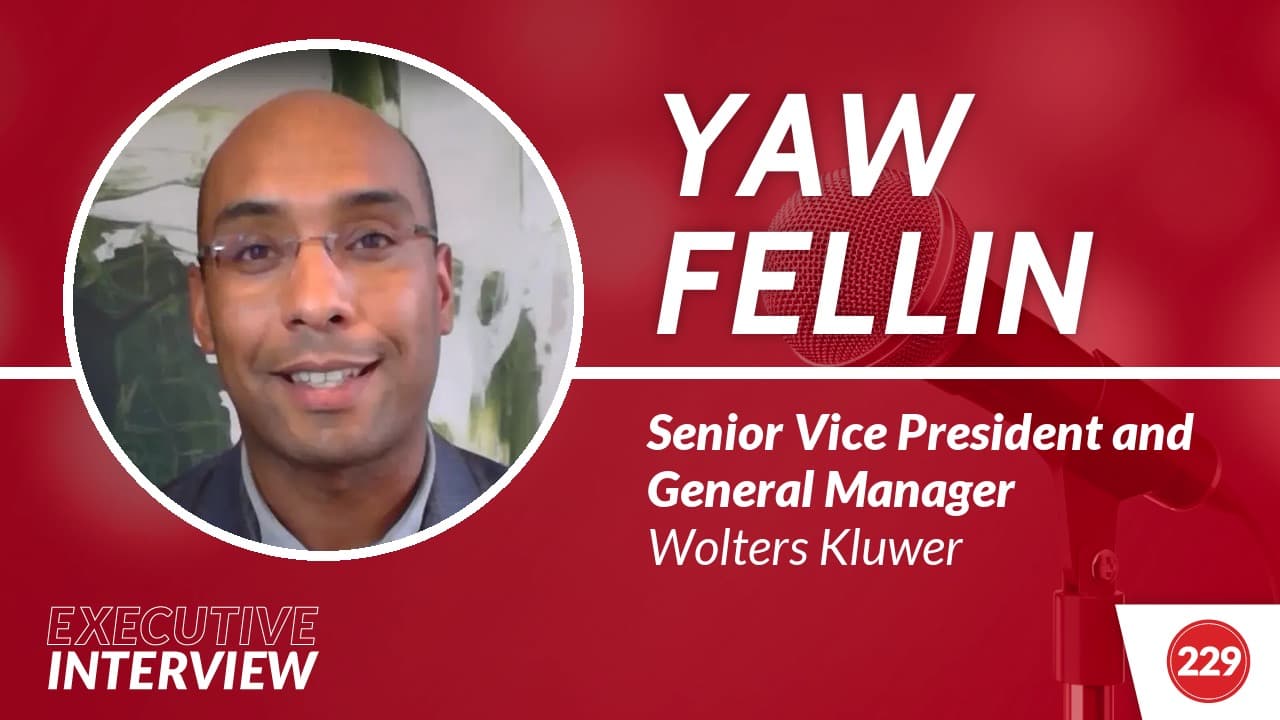
7,500+ Experts. One Version of Clinical Truth | Executive Interview with Yaw Fellin
 Apple Podcasts
Paused
7,500+ Experts. One Version of Clinical Truth | Executive Interview with Yaw FellinExecutive Interview
Questions Answered in This Episode
- What does a CIO put in place so every agent lands on one version of clinical truth?
- Where does the evidence have to sit once clinicians stop coming to UpToDate for the answer?
- What did the system find on the chart that the clinician had missed?
- How does a clinician know the answer is trusted?
- What scaffolding keeps the thinking with the person?
About This Episode
October 7, 2026: Yaw Fellin, Senior Vice President and General Manager, Clinical Decision Support and Provider Solutions at Wolters Kluwer Health, sits with Bill Russell. Clinicians used to come to UpToDate for an answer. He is building that evidence into the workflow, including Epic's Art, with 7,500-plus expert contributors behind it. Bill asks what a CIO puts in place so every agent lands on one version of clinical truth.
At Becker's, a clinician using one of the large AI suites thought she knew every medication that patient was on. The system found one in the chart that was not on her radar. She changed the care plan.
Yaw's answer for a CIO is governance first, then room to experiment, as long as the experiments stay safe and get narrowed to the systems that can hold that layer. The closer is cognitive scaffolding: support a resident and a clinician who has been at it for 20 years, and leave the thinking with the person.
Guest: Yaw Fellin (Wolters Kluwer)
Key Points:
0:00 7,500+ Experts, One Clinical Truth
1:32 From a Destination to the Workflow
3:54 Wolters Kluwer
4:17 Evidence Inside Art
13:08 How the Clinician Knows
16:45 What a CIO Puts in Place
20:00 Translation in Five Years
22:50 Cognitive Scaffolding
25:17 Close
Donate: Alex's Lemonade Stand: Foundation for Childhood Cancer
Thank You to Our Episode Partner



Transcript
This transcription is provided by artificial intelligence. We believe in technology but understand that even the smartest robots can sometimes get speech recognition wrong.
7,500+ Experts. One Version of Clinical Truth | Executive Interview with Yaw Fellin
[00:00:06] Bill: Alright, it's the 229 Podcast, and today we have an executive interview. I'm joined by Yaw Fellin, the Senior Vice President. And General Manager of Clinical Decision Support and Provider Solutions at Wolters Kluwer Health, where you oversee up-to-date suite of products. There's a lot going on. Y'all, welcome back to the show. This is at least the second time you've been on the show, right?
[00:00:30] Yaw: Yeah, no, it's great to be back, and you know, obviously, we've been doing a lot of work with 229. Actually, I have my yellow hat, Bill.
[00:00:38] Bill: Oh, that's awesome.
[00:00:41] Bill: Thanks, hi.
[00:00:41] Yaw: I don't look as… I don't look as good as you in it, but I've got the yellow.
[00:00:44] Bill: I think that's because people have gotten used to seeing me in it. In fact, somebody saw me out in the wild without it the other day, and they were just like. I didn't even know that was you. I'm like, yeah, my natural head is not yellow in nature.
[00:00:58] Bill: Yeah, I appreciate you guys being a part of it. We had the bike ride, we had the golf tournament this year, and in 4 years, we're up over $650,000 for pediatric cancer, and I really appreciate it. It's partners like you guys coming alongside.
[00:01:14] Bill: this really generous community that makes it, that makes it work. A lot of things going on at UpToDate. I mean, I'm gonna start… I think I'm gonna start just right at the beginning. So, historically, UpToDate has been somewhere clinicians would go for answers.
[00:01:32] Bill: And it seems like you're changing that model, moving from a destination clinician's visit to a layer of intelligence that comes to them inside the workflow. So it's serving them where they live, as opposed to saying, hey, come to us, and we'll give you answers, and then you can go back to where you you're working. I'd love to hear more about what you guys are doing and how that's playing out.
[00:01:56] Yaw: Yeah, no, I think you've got it spot on, you know, UpToDate has always been around evidence-based clinical decision support. And actually, if you go back to the founder of UpToDate, Bud Rose, I think the initial vision was
[00:02:14] Yaw: really more around, kind of, peer-to-peer consultation, right? So, how do you take the best and the brightest clinicians when they have questions and need answers? You know, that used to be a pick up the phone or, you know, find somebody in the lounge moment to get insights.
[00:02:33] Yaw: you know, Bud, took that into a product, and, and Bill, you're spot on. Like, generally, that has been a product where,
[00:02:42] Yaw: you know, clinicians come to UpToDate to have their questions answered. And so, you know, you could think of that almost as, like, a poll-based system, right? They're coming to UpToDate for an answer. And the place we've been very, very focused, it's kind of two key themes. One is How do we get Deeply into workflows.
[00:03:06] Yaw: and work in both, I would say, kind of a pull and a push, you know, methodology. And then the second, which has really been spurned by, you know, some of the advances in technology, specifically AI, Is… how do we start to…
[00:03:25] Yaw: Bring the clinical intelligence, so the clinical reasoning, the evidence-based content, you know, all of the work of our, you know, 7,000-plus expert contributors. Into these modern technology systems. And that's where we've really developed this concept of a clinical intelligence layer
[00:03:45] Yaw: And where we're, you know, very actively deploying that, you know, both with, I would say, hospital and health system partners, but also with other industry partners as well.
[00:04:18] Bill: So, let's go into the life of a clinician. Let's talk about what it actually feels like for a clinician.
[00:04:27] Bill: and I don't know if I want to start with AI, but AI is such an integral part of the workflows now. I mean, we see where Epic's going with AI, we see AI being layered in here. What can AI now do in the workflow that meaningfully reduces
[00:04:44] Bill: the… we keep talking about the cognitive burden, right? So the clinician, rather than simply giving clinicians another source of information to process.
[00:04:55] Bill: Talk to me about what it feels like for the clinician to engage with the up-to-date content through the workflows and some of the new tools that are available that I think just fall under the category of AI integrated.
[00:05:13] Yaw: Yeah, no, very happy to. So first, you know, full disclosure, I am not a clinician. I've, you know, spent my career, you know, partnering and serving clinicians, and so I'll answer this, you know, through the vantage point of the conversation that I'm having with our customers and with clinicians. And, you know, what we…
[00:05:38] Yaw: here, kind of, most passionately, is, you know, clinicians get out of bed every day to serve patients. And to improve their care, and ultimately to generate clinical outcomes. And, you know, you could imagine a whole host of things. I think these often get bundled as cognitive burden.
[00:06:02] Yaw: that slow clinicians down, right? Some of that could be administrative tasks that are non-clinical, but that are still necessary to operate a hospital or a health system. Some of that, which is an area we've always shined, is just the amount of new research and studies and being able to stay up to date, if you will, on the evidence base.
[00:06:25] Yaw: the volume of information is overwhelming. And then I think some of that burden really comes down to can I do the thing that I want to do? in an easy way in the workflow that I'm natively in.
[00:06:41] Yaw: And so if you take Epic and, you know, at UGM, you know, we announced a big, expanded partnership with Epic. You know, the core of that partnership is how do we take the evidence-based content from up-to-date and the, you know, the rich information that physicians rely on or clinicians rely on to make decisions.
[00:07:04] Yaw: and get that natively embedded into Epic workflows, like art. And so if you think, you know, historically, you know, a clinician may have had to go into a pop-up window or use the up-to-date link within Epic to, you know, kind of surface The insight or answer the clinical decision support questions that they might have. you know, now a clinician that's using art.
[00:07:29] Yaw: natively is going to get, you know, those insights, and their questions answered. And generally, what we see in some of these AI approaches And I think it's a good push, Bill, not to overemphasize the AI piece, but part of what we see the technology allow you to do is You know, number one.
[00:07:51] Yaw: it makes it much more seamless to just ask the questions that you have. It allows it to be conversational, it allows it to be in the workflow.
[00:07:59] Yaw: But two, it's also a good way to prompt questions or to prompt ideas, you know, that you might not have thought of, right? So, you know, AI can do a good job of saying, oh, we noticed, you know, that your patient is on these 6 drugs.
[00:08:16] Yaw: You know, did you know that there's a contraindication or a reaction? Actually, speaking with a clinician at Becker's the other day, that was using one of the big, AI suites, and she said, you know, I thought I knew every medication that this patient was on, and lo and behold, it had found something in the chart that wasn't on my radar.
[00:08:37] Yaw: And ultimately, I was able to, you know, make a change in that patient's care plan that's gonna better the outcome. So.
[00:08:45] Yaw: to me, that's the promise of what we're doing, and the importance of, you know, really figuring out how to get embedded in the workflow in the right ways that lowers, you know, I would say all different types of cognitive burden or challenges in providing care.
[00:09:03] Bill: Yeah, I think something bigger is really happening here. It's… historically, the consumer has been human. And now we're, we're, we're making this information available to… to agents, right? To Agent Factory, to Microsoft agents, to other agents that might be available. I was doing some work this morning.
[00:09:25] Bill: And, you know, my agents are connected up to a lot of the different things within our company, and they said, well, you want me to review these 52 contracts? I'm like. Sure.
[00:09:37] Bill: And, you know, and like, you know, 2 minutes later, it had reviewed all 52 contracts and gave me the similar language between… and I used that as an example to say… I remember… I remember being in front of a room, and this woman said… we were talking about interoperability, it was a…
[00:09:56] Bill: It was at the Healthcare Evolution Summit. I was on a panel, and it got kind of antagonistic. This was early… this was over a decade ago, and interoperability wasn't that great, and this woman stood up and said, hey, my child Has, you know, multiple complications and chronic disease. And she had these binders with her, and these binders were, like, this thick.
[00:10:19] Bill: And she's like, every time I go to see a doctor, I have to take these binders, and the doctor has to review these binders. And that's what some medical records look like, they're that deep and that thick. And when you talk about your 9,000 contributors and all that, I mean, the medical journals and the findings and all those things, it's that deep.
[00:10:37] Bill: For, for a clinician to, to sit down and… and really go through those binders, go through the you know, the knowledge that's available to them, and find something. So, we now have these agents, which are…
[00:10:56] Bill: these super researchers, these super… whatever, and making that available in the workflow, I think, is… it's… is…
[00:11:05] Bill: is massive. I mean, it's a massive move forward for these clinicians to be able to have that access to that information, and to find those… that minutiae, like the doctor you talked about who found that… that… that one thing, because those one things really matter here.
[00:11:22] Yaw: they really matter, and I think it also speaks to the importance of, clinical intelligence, right? And… You know, when you have these agents or these, you know, kind of extra technical resources working on your behalf. What you want them to be infused with.
[00:11:42] Yaw: Is the same type of clinical reasoning and clinical thinking skills of, you know, essentially the best and the brightest Clinicians in the world. And so, if you look at the models and the systems that we're building, you know.
[00:11:58] Yaw: We're focused not just on how do you make sure that when you ask an agent, or when you ask our application a question, that you get back an answer that is correct and valid. But we're also focused on how do you take those clinical reasoning and clinical skill models and deploy them into different Agentic tasks. And To me, that's the balancing act, is, you know, basically how do you make your agents
[00:12:23] Yaw: smarter and better. You know, I say the other thing I hear from customers is that a lot of you know, early AI systems, you know, operate kind of at a… they compare it almost to residents, right? Like, hey, I might have a really talented resident, and I will ask them to do these 10 things, and I might have a resident that's still kind of making their way along, and I might only ask them to do 2 things.
[00:12:46] Yaw: And, you know, I would say our goal with clinical intelligence is, in the systems that we deploy, you know, we want them to be at an expert clinician level. And we really want them to be deployable in ways that, you know, take a huge burden off of the shoulders of the clinicians that they're supporting.
[00:13:08] Bill: Well, the foundation for all of this is trust. Right. It's, it's, we talk about the foundation for AI has to be data, data has to serve. But the… the knowledge that exists because of the contributors that you have is the… is the evidence base that is…
[00:13:30] Bill: has been trusted for, you know, for a very long time in healthcare, and now we're looking for these agents to scour the record, scour the knowledge, and whatnot, and we have to trust that. How does the clinician
[00:13:47] Bill: know where the answer came from and why the AI reached the conclusion that it reached. I think that's going to be one of the key… key things for really establishing and maintaining trust.
[00:14:01] Yaw: Yeah, to me, it's two things, right? So, one is almost that… transparency and, you know, provenance, if you will, that you're talking about, Bill, which is, like, how do you know Where the agent or the system got the answer from. And that, you know, at its most basic, you know, that typically comes down to, are you sourcing things well?
[00:14:24] Yaw: But there are more, I would say, deeper ways to understand that, right? It's, you know, can you show the logic trail of thinking? In our system, our expert AI system, we show the assumptions that that we're making on behalf of a clinician, right? Because when you type in a question.
[00:14:42] Yaw: As a human, you might not always put all of the things into that question that you were thinking or that were in the back of your mind, and so we actually prompt people to say, well, you know, we're assuming this patient isn't pregnant.
[00:14:56] Yaw: or we're assuming, you know, that you're talking about these types of pediatric conditions. And that's a good way to be both transparent, but also to give, you know, end users a way to adjust the questions or the prompts that they're putting in. So I think that's a huge part of it. The other piece that I…
[00:15:16] Yaw: that I spend a lot of time thinking about is, well, how do you get to an outcome of trust? Ultimately, trust is built off How well have you delivered over time? And the history of UpToDate is 30 years of delivering high… highly accurate.
[00:15:34] Yaw: evidence-based information, right? What our editorial team spends all day, every day, doing is making sure that when we write a topic, when we synthesize the evidence, when we give it an evidence grade. That you can rely on that being accurate. And…
[00:15:55] Yaw: you know, the way I like to think about the trust that we have is that that's an earned trust. Because folks have been able to come into the, you know, the content, get valuable insights from it, but ultimately also know that what they're getting is an accurate recommendation from an expert clinician. And so…
[00:16:16] Yaw: that, to me, will always be important, and I think the bar now is how do you make sure that in these AI systems, which can make mistakes, by the way, you're still getting that level of accuracy that you've relied on in a more, You know, kind of,
[00:16:38] Bill: Deterministic, I think, is the.
[00:16:40] Yaw: Thank you. That was the word that escaped me in a more deterministic model. It's perfect.
[00:16:45] Bill: Yeah, we don't want to end up with different versions of clinical truth. I mean, that's dangerous, right? And so we have all these agents going out there. There has to be a layer in there that is trusted. That's just… it's validated, it's trusted, and no matter what AI agent you're using, if that… if that layer is,
[00:17:08] Bill: is there to, to really validate against all along the way. You're… I mean, what we want is one version of clinical truth. Every time a question's asked. I mean, is… is there something CIOs should be putting in place now to ensure that they end up with one version of clinical truth?
[00:17:35] Yaw: You know, It's such a great question. I mean, the… the easy, biased answer is we're doing a great job on clinical intelligence, and you know, we'd love to partner with CIOs across the country. I would say the much harder Part of this bill is,
[00:17:58] Yaw: This comes down to a couple of things, in my opinion. One is governance. Right? Which is… as a CIO, Is your governance process… You know, identifying
[00:18:14] Yaw: The elements that, are gonna, you know, bring trust, transparency, strength, you know, kind of a singular version of clinical intelligence into your system. And so I do think governance is kind of foundational to this. I think the other balancing act for CIOs is,
[00:18:35] Yaw: How do you have the right level of experimentation? And the ability to move at pace with new innovation.
[00:18:47] Yaw: You know, while also, you know, not getting too far ahead of your skis, if you will. And, it was interesting, I was in a conversation at Becker's, just about the number of different, you know, pilots or point solutions that are out there right now. I actually think that's a good thing. We should be running a lot of experiments.
[00:19:07] Yaw: to figure out what works. You just have to make sure that those experiments are done, you know, safely. And that ultimately what you're doing is you're winnowing down to the best of breed, you know, systems that can get you to that singular layer.
[00:19:24] Yaw: You know, candidly, our goal is to win that race. You know, we do feel like we have something that's unique in terms of clinical intelligence. And we're trying to… you know, deploy that as ubiquitously as possible with, I would say, hospital and health systems, but also with industry partners.
[00:19:44] Yaw: So that, you know, ultimately CIOs, you know, whether they're partnered with us or whether they're working with a partner of ours, can rely on that clinical intelligence layer. You know, kind of across the ecosystem that they're trying to build and deploy.
[00:20:00] Bill: Yeah, I'd like to… I'd like to end by looking a little forward, and, you know, 5 years from now. What will seem antiquated about the way clinicians access clinical intelligence from maybe what they're doing today?
[00:20:19] Yaw: Oh, man. 5 years is,
[00:20:22] Bill: an eternity these days. I mean, we can… We could say, we could say one year now, and it would be like, man. But, you know, it's, it's, it's, I'm not sure we saw the machines accessing the information even 2 years ago, and now… now we're having machines do the research and pull it in for us.
[00:20:46] Bill: I'm curious if it's just going to be… You know, it's just gonna be totally integrated, and maybe not only at the… on the clinician side, but almost on the patient side as well, where it's just like, we're looking at the same thing on both sides.
[00:21:02] Yaw: Yeah, maybe I'll put this out there as a hope, and again, I'll always try and you know, be humble. I don't know that I'm the best predictor of 5 years down the line, but I think one concept that could be very antiquated 5 years from now, and it's a broad concept. It's basically the concept of translation.
[00:21:23] Yaw: I feel like there are so many things that get translated today, right? You know, you… you translate, you know, different clinical services or actions taken into billing codes, or you translate
[00:21:42] Yaw: you know, a clinician's guidance into language for a patient, or you translate patient information from English to Spanish. And generally, while I think we've gotten a lot better at supporting all of those translations, there's still a lot of friction when you're moving You know, from… Either one language or one way of thinking to another.
[00:22:05] Yaw: And, you know, if I just look at the pilots and the, And the successful, kind of, implementations that we're seeing, not just with our products, but across the industry.
[00:22:19] Yaw: you know, I think translation will be a lot more seamless. It already has become more seamless, but you still have to think about it. I'd like to think in 5 years, you know, you're not really thinking about those translations, you're just doing your work, and you know, whether it's agents or whether that just happens kind of seamlessly in the background, it's kind of taken care of for you.
[00:22:40] Bill: That's fantastic. Y'all, I wanna… I wanna thank you for your time. Is there… is there anything I didn't ask that you…
[00:22:47] Bill: This is my, this is my catch-all.
[00:22:50] Yaw: You know, I'll put, maybe one last big… thought out there, which is just… I do think… When we're talking about clinical decision support. And this comes up a lot when we're talking about
[00:23:10] Yaw: you know, residents, medical students, you know, the younger generation. The term that we've been hearing from our customers. Is it's really important that we're building a set of cognitive scaffolding, or core, you know, clinical reasoning skills for this next, generation. And…
[00:23:33] Yaw: you know, we talked a lot about clinical intelligence. I would just say, Bill, like, to go a cut deeper on clinical intelligence, I think it's, you know, those intelligence systems need to be… designed to support
[00:23:44] Yaw: the workflow and needs of people that have been practicing for 10 or 15 or 20 years, and are, you know, highly experienced in their field. And then we also need to be designing systems that support, you know, kind of the younger generation, and avoid you know, what I would say are some of the pitfalls, which is we don't want
[00:24:04] Yaw: you know, clinicians completely offloading, you know, all of the cognitive thinking that it takes to provide great patient care. We just want to be supportive of that process, and so I think, you know.
[00:24:19] Yaw: one of the other core themes in clinical intelligence is how do we have the right cognitive scaffolding so that ultimately we're up-leveling everybody's skills as we go. That's probably the other big thing that we spend a lot of time thinking about that we didn't touch on just yet.
[00:24:35] Bill: Yeah, it would be interesting to go into, training the next generation of clinicians and education. I hear a lot of conversations around that, of, you know, what is… what does that even look like? What does… what does being a resident look like? What does… There's a lot of, a lot of thought going into that, and a lot of,
[00:24:57] Bill: It's gonna be interesting to see how that… how that transitions, but it's not only in medicine, it's everywhere, like…
[00:25:04] Yaw: That is housing.
[00:25:05] Bill: How is this… how are we, you know, how are we going to… work in an environment that's changing and giving us tools that are more powerful than anything, anything we've had before, be really interesting. Y'all, I want to thank you for your time, and thank you for, coming back on the show, and thanks for, wearing the old hat. Appreciate that as well.
[00:25:28] Yaw: Yeah, no, thanks for having me, Bill, and you know, also just appreciate the opportunity to give back. So, thank you for, everything you're doing as well.
[00:25:38] Bill: Take care.