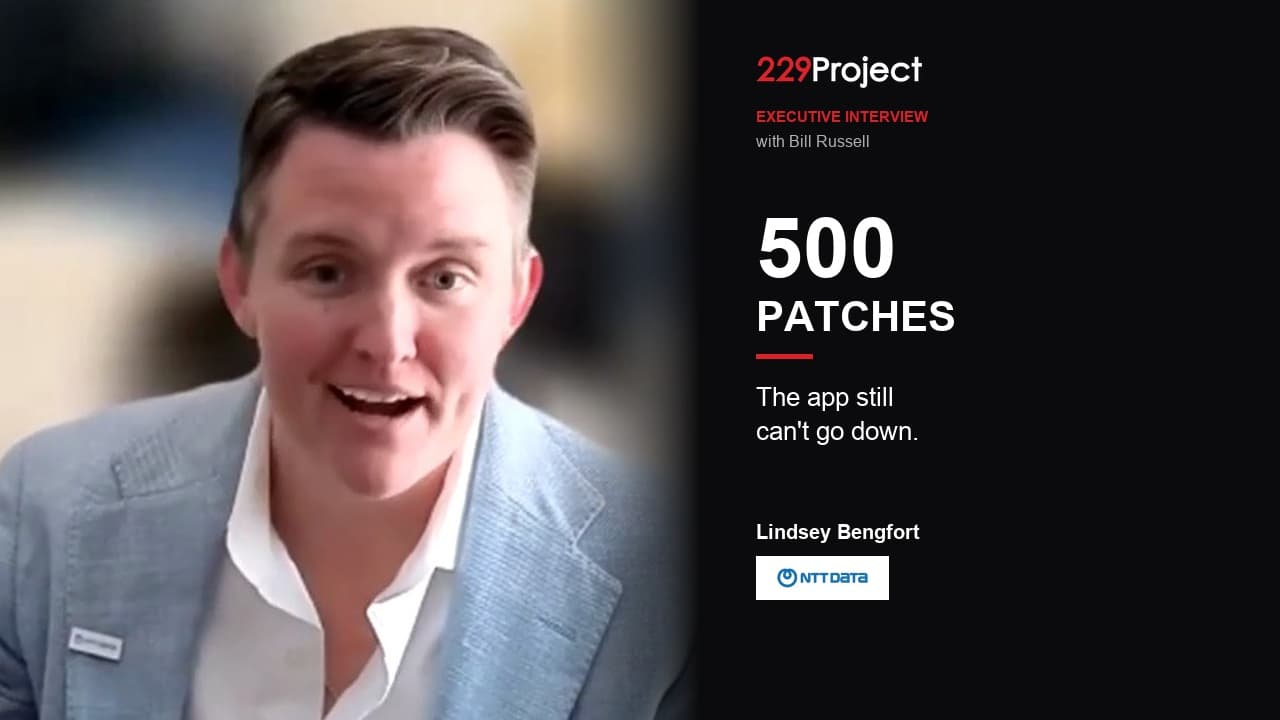
500 Patches. The Hospital App Still Can't Go Down.
 Apple Podcasts
Questions Answered in This Episode
- When money, AI, and security are all loud, how do you get the room back to patients?
- If you do not have a security point of view, do you still get the meeting?
- What do you do with 500 patches on one hospital-critical application when the app cannot go down?
- Are garage attackers with an open model already in your threat mix?
- If every vendor ships an AI feature, who owns the brain over the agents?
About This Episode
August 26, 2026: Lindsey Bengfort (Managing Director, Healthcare, NTT Data) sits down with Bill Russell. She buckets what she hears every week into three anxieties: financial, tech/AI, and security. Security used to get skipped in the room. Not now. If you do not have a point of view, you do not get invited. From there: 500 patches on one hospital-critical application, garage-level attackers with open models, and an onslaught of AI features inside the vendors you already own. Lindsey's picture: you keep stacking band-aids. You never stitch the wound. Closes on three places a health system can take cost out without taking it out of patients.
Guest: Lindsey Bengfort (NTT Data)
Key Points:
04:48 Three Anxieties
08:29 Security Is Table Stakes
09:44 500 Patches on One Hospital App
10:38 Garage Attacks
12:53 Band-Aids on a Cut
17:12 Three Ways to Take Cost Out
Bring color and joy to a child’s day: https://augustsartists.networkforgood.com/projects/166901-everyday-giving
Keep up to date on the latest in health IT:
https://thisweekhealth.com/news/
Thank You to Our Episode Partner



Transcript
This transcription is provided by artificial intelligence. We believe in technology but understand that even the smartest robots can sometimes get speech recognition wrong.
500 Patches. The Hospital App Still Can't Go Down.
[00:00:05] Bill: It's an executive interview. And today I am excited to be joined by Lindsey Bengfort with the managing director of healthcare in the US for NTT Data. And Lindsey, welcome to the show. Thanks Bill. Thanks for having me. Well, I'm looking forward to this conversation.
[00:00:20] Bill: I mean, you have a broad set of clients that you're working with all across the country. NTT Data covers so many services. In fact, just real quick.
[00:00:30] Bill: I mean, what are some of the typical projects that NTT Data is doing in the industry right now? No, it's a great question, Bill. Lindsey: And if you had an hour, it would still probably take a little longer to come up.
[00:00:43] Lindsey: I was a huge client of your services because you guys were acquired the Dell services Bill: that I had and I worked with your boss, PV, back in the day. And my gosh, we used to do for everything. So I would imagine you're still doing that and more. Lindsey: And more, Bill, that's interesting thing.
[00:01:03] Lindsey: So I'll kind of do a little bit of very short history lesson that provides the context into how we got into all of the things that we do today. So about 150 years ago, NTT was started in Japan. And it started out as really a telco company.
[00:01:20] Lindsey: And through World War II continued to kind of build that very strong base. If you've ever heard of Docomo, it's the AT&T of Asia Pacific, right? That's part of our broader organization. But that's really where NTT started.
[00:01:35] Lindsey: And as they continued to grow over the 100 plus years, they got into data centers. So dimension data was a big acquisition that they had. They got into other services components in more of Mia and the Amia and the APEC region, right?
[00:01:52] Lindsey: But they wanted to break into North America. And they were struggling to do that just organically. And so they looked, they started looking for different acquisitions they can make to help break into that North America space. There are two main acquisitions that happened over the last 25 years. One was Keane Consulting you may have heard of.
[00:02:09] Lindsey: And the second was, as you just mentioned, Bill Dell Services, right? Which prior to that was actually a processor. So a lot of your viewers are probably very familiar with Perot Systems. And so that was a major acquisition that NTT made just shy of 10 years ago.
[00:02:28] Lindsey: And they did it because of the large footprint we had specifically in the healthcare space. So we had a very large healthcare organization and footprint here. And that was really valuable to them. And so that was, again, one of the reasons that they acquired us.
[00:02:44] Lindsey: And I say, us because that's the legacy that I came through the organization with. And so that encompasses now, right? To your question, what all do we do? So all of that traditional IT services of infrastructure applications, data analytics, security, consulting, IAM consulting all the way through things like hardware software, right?
[00:03:08] Lindsey: So we've got a var as part of organization. Any telecommunications we do? We're actually the third largest data center footprint in the world, right? So we can really span across everything. So again, if we were to do a deep dive, we'd be here alongside.
[00:03:27] Lindsey: But we really are truly the only true end to end IT services provider on the planet. We don't traditionally use a lot of partners just because we have so much capability within our own organization. All right, I want to talk to you about what's going on Bill: in the industry, but just so data center, I would assume you have NOx, SOX.
[00:03:46] Lindsey: Do you do near-shoring, off-shoring? We do. So we'll do near-shore, off-shore, on-shore. We're actually developing a new concept called NO-shore, right?
[00:03:57] Lindsey: As we develop AI and we develop these solutions, utilizing that type of technology. So we actually bucket it into four different buckets. And yeah, we do absolutely everything, but you just mentioned NOx, SOX, all things infrastructure, all things security.
[00:04:12] Lindsey: And then when we talk about healthcare-specific, which I know you want to get into, we've got capabilities with EHR specifically with a revenue cycle management, clinical service test, things that are very specific and tailored just to our healthcare clients.
[00:04:28] Bill: Well, let's talk about what's going on in healthcare. Where do you find the conversation is going these days? Lindsey: I'm going to leave it open-ended, because otherwise I'm going to steer this in a direction. What kind of conversations are you hearing out Bill: in the out as you're meeting with your clients and talking with others in the industry?
[00:04:48] Bill: So I bucket it, Bill, in three different categories Lindsey: in terms of what I, day to day, talk to about with healthcare clients. And one is financial anxiety. There's a ton of financial anxiety in our industry today.
[00:05:01] Lindsey: You've got regulations and new legislations going into, going into practice now coming up in January, Bill: which has a lot of people worried, right? Lindsey: And then you just look at the cost of tech continuously on the rise, you look at the cost of labor, continuously on the rise.
[00:05:21] Lindsey: Health systems are always being squeezed and that pressure is only building, right? So we talk a lot about financial anxiety. And then we talk a lot about tech anxiety, right? Especially through the lens of AI. Where is AI going? Am I too late?
[00:05:37] Lindsey: Am I too early? Is it real? Is it not real? Tons of anxiety and questions around, how do we harness AI to drive meaningful value for an organization? And then the third bucket is just around security anxiety, right?
[00:05:51] Lindsey: We always say it's not a matter of, if it's a matter of when, and that's especially true in health care. So we talk a lot about is my security posture, right? Where are my holes? What am I not seeing? What am I not thinking about?
[00:06:04] Lindsey: And those are the three key areas, Bill, that, again, we have conversations day in and day out. And we have solutions that go into each of those areas, but at the end of the day, it's about how can we keep these three components at a minimum, right? So then they can be focused on the thing that actually matters, which is patient outcomes. You know, it lends you out. I'm going to agree with you a thousand percent.
[00:06:30] Bill: That's what we're hearing in our meetings. Primarily, the, I mean, it, primarily it's AI, and then it's the financial, so AI is happening in the, in the context of the financial realities, the pressures on the top line, Lindsey: and the pressure on the top bottom line as well.
[00:06:50] Bill: The third one is interesting. So I'm going to go in reverse order here. I'm going to go, I'm going to start with security and then move backwards. Security is interesting because we had a security partner in one of our CIO meetings. And his comment to me was he was shocked that they didn't talk more about security.
[00:07:07] Lindsey: And I said, you know, it's interesting to me Bill: because I don't think it has moved down in priority. I don't think it's moved anywhere other than of highest importance to most CIOs because they cannot afford to have a breach or at least allow a breach to move laterally across their network.
[00:07:31] Bill: However, there's just, I mean, when the, when financial realities are happening, it doesn't tend to be the primary conversation. Are we having that conversation in the context Lindsey: of the financials mostly or are we seeing new attacks and new new systems sort of emerge in this, Bill: in this world of AI or both?
[00:07:56] Lindsey: So in my experience, it actually has moved up that chain of conversation. So I would agree with you in that a year ago, 18 months ago, it was a little further down and there wasn't as much excitement. We'll call it around that particular topic, but I think with AI coming out like it has and with Mythos happening and Project Glasswing, it is, there's been this renewed sense of, hey, this is not only like a priority, but it's almost to the point that where it's, this is table stakes, right?
[00:08:29] Lindsey: So it doesn't always get the explicit callouts that say AI does or, you know, I need a crazy amount of cost reduction. It's more like if you don't have a security positioning or point of view, then I don't even wanna talk to you, right?
[00:08:45] Lindsey: It feels like now everything we talk about, whether it's clinical service desk, whether it's R, C, M, whether it's, you know, epic management, if security's not embedded in that in every aspect, then you're not even getting invited, right?
[00:09:00] 9 minutes Lindsey: You're not even gonna be thought of as a legitimate partner. So it's table stakes today, but then you start to double click on that and you start to see, okay, with Mythos and Project Glasswing, there are extreme vulnerabilities that are out there in every major application, in every major software.
[00:09:20] Lindsey: And that whole project, which we are, some of our partners are directly involved in, so we're involved in some respect through that partnership, we're able to see what are some of these areas that organizations are going to need to harden, here very shortly, so how do you prioritize that? So out of like Project Glasswing, right?
[00:09:43] Lindsey: If they come out with 500 different patches for a single critical application, right? That's running a hospital, then you're going to have to understand how to prioritize that. You have to understand how do I schedule that out because you can't have that application go down, right?
[00:09:58] Lindsey: So all of these things are areas of topic that we're hearing more and more of, and they're looking to partners like us and other partners in the marketplace to say, how can I fix my security posturing?
[00:10:12] Lindsey: Right, there always going to be holes in the house, but how do I make sure I close those gaps as much as possible? So I can avoid the worst case scenario, which are big massive breaches. Yeah, you know, it's interesting as we talk about this. I think how we do patching cannot be considered Bill: like a one-off task anymore.
[00:10:30] Bill: It's got to be considered part of a comprehensive security strategy. And then the second is, the thing that worries me a little bit, and this is going to sound silly, but it's the garage attacks. I mean, we know the nation states attack, we know that organized crime attacks Lindsey: and those kind of things, but it's the garage attacks.
[00:10:47] Lindsey: I mean, it wouldn't take much for me Bill: to right now go over there, hit a prompt and say, hey, what are the local health systems for me? Oh, it's this, it's like, all right, go see if you can get in and find something. Lindsey: And there's, there's harnesses, but there's also open source models Bill: that I could start playing around with as well.
[00:11:07] Bill: Absolutely. Lindsey: And those and the release of AI, even with, you know, with me, those, right? They're not even releasing that to the public because it is so just dangerous in the hands of, like you said, people just end their garage, right?
[00:11:22] Lindsey: Wanting to mess around and see what they can do. But there are still very powerful models out there. And so harnessing AI for bad is still a very easy thing for bad actors to do, whether those like you said are large nation state bad actors or just local regionalized one off, right? But it's also easy for us to, Bill: to utilize as well to help identify and identify and insure of some of those holes.
[00:11:47] Lindsey: I want to do exactly, exactly. I want to, we're not going to specifically talk about the financials, but we'll talk about AI in this context as well. Bill: How, so, you know, we hear what I'm finding.
[00:12:01] Bill: What I'm finding is the, the use of AI is unevenly distributed across healthcare right now. We're seeing a majority of it is just coming through the existing partners.
[00:12:13] Bill: Oh, you know, work day has it and service now has it and epic has it and whatnot. Lindsey: And that in itself is probably a practice. Bill: Like how do you implement these things in the context of a larger AI strategy?
[00:12:28] Bill: And then there's a whole, there's very few people. There's a lot of individuals, but there's very few organizations with a concern and strategy for how are we going to utilize AI and how are we thinking about agents? Lindsey: I find people are, there's an onslaught of AI features coming in, but not necessarily a holistic strategy for AI.
[00:12:51] Lindsey: Yeah, it's, it's a very valid point. I like to use the analogy of band-aids, right? You have a, you have a, a cut on your leg and you're just putting band-aid over band-aid over band-aid over band-aid, right? But you're not actually fixing the core problem. You probably need stitches or whatever it may be, right?
[00:13:06] Lindsey: And so when you just start layering these different technologies on top of each other, how do you see like to your point across the board, what's actually working, what's not working? Is it doing the right things? Is it not? Is it governable? Can I audit back what it's done? All of those components.
[00:13:24] Lindsey: And so you have to look at a full landscape and truly understand what are the functionalities for each and what are they actually doing? So I'll give you an example of something we're doing at NTT and I'll give it to you through the lens of revenue cycle management.
[00:13:40] Lindsey: So we look at revenue cycle management as essentially nine different phases, right? There are nine phases everywhere from patient registration, an eligibility checks, all the way through collections, right? And so there are different platforms and AI agents for each of those that a lot of different organizations sell in the market, right?
[00:14:02] Lindsey: But there isn't one that sits over the top and does exactly what you just said, which is functions as sort of the brain of all these different agents and all the different activities that they're taking across that NTT spectrum. And so one of the things that we've developed is what we call Neuro-stat.
[00:14:18] Lindsey: And it is an intelligence layer that sits over top nine different agents that have explicit instruction to go and make and perform actions in each of those areas. The difference is it's not just doing the one thing over and over and over, the brain's actually controlling it from end to end.
[00:14:37] Lindsey: And so it learns faster, it has more context, it's able to make decisions and know when to pull the human into the loop to make sure that you're able to not get stuck in any particular area of that revenue cycle, right? And so by doing that, we're able to drive immense value and really help healthcare organizations combat what they're doing on the payerside, which is exactly that, right?
[00:15:04] Lindsey: And so we're harnessing AI, we're able to audit it, we're governing it, and we're doing it into end, as opposed to, like you said, these come small pockets of AI here, AI there. And so we do that within revenue cycle, but we're also doing that, I'm explaining that into other areas for our business.
[00:15:23] Lindsey: Yeah, this AI chief of staff, I think is going to be one of the more, an AI agent overseeing agents is going to be interesting, because what we're seeing in these newer models Bill: with these advances recently is their ability to check work becomes incredibly valuable because it can find its own flaws.
[00:15:43] Bill: Like it used to be, we had to find the flaws and say, no, no, you didn't quite understand. Now you have this chief of staff who's looking at everybody's work and going, Lindsey: no, no, that's not right. Or I'm going to, Bill: that's, thank you for that.
[00:15:54] Bill: I'm going to dish this over to this agent, which is an expert in our financials, and they're going to run that analysis. 16 minutes And so you have this separation of duties, which is what we do every day in healthcare. We have a separation of duties and we have. Yeah, I think it's interesting, Lindsey: the things that we're doing, is it's not necessarily agent to agent, the key differential of what some of the things we're doing is this concept of a brain, right?
[00:16:20] Lindsey: So it doesn't actually go and do anything, but it controls and it checks and it manages the agents, the AI agents that are actually going on performing things. And so by having this brain and the ontology design the way that it is, it's able to have inputs from multiple sources, not just data sources from a client, but also data sources from payers, right?
[00:16:43] Lindsey: From legislation that's being passed, and it can learn like that. And so when it makes a mistake, and then we correct that mistake, it learns, right? And as things change, because things change all the time.
[00:16:56] Lindsey: Technology changes, legislation changes, as those things change, the brain is already plugged into that. It's already learning, and it keeps up to date. And so it's very, very interesting to watch that developing, get deployed out in the market.
[00:17:10] Lindsey: So Lindsey, last question, Bill: factory ways that health systems can reduce their costs today. Lindsey: Well, okay, only three, yeah. The way I look at it bill is it's an impairment. And at the bottom of that pyramid, for us, it's revenue cycle for Hospitals.
[00:17:29] Lindsey: Because not only can you drive out costs, but you can drive up revenue, that then gives you other budget, that you can then reinvest into other transformational projects. So I think revenue cycle becomes really your base, to start from.
[00:17:45] Lindsey: And then it's really looking at the technology stack, from an infrastructure and an application standpoint. In today's world, are you doing the right things? Do you want to be, say, owning your own data center? 18 minutes Or do you want to be focused on other and more strategic initiatives, and find a lower cost provider that can help you do that? Same goes for app rationalization.
[00:18:09] Lindsey: Every organization in a health system, once they're an applicant, they like it, it's theirs, they're used to it, they don't want to change. So having the political capital and strengthen internally as an organization to say, no, we're going to rationalize this down, we're going to standardize this, and do it on infrastructure that makes sense. That's, I think, that next layer up.
[00:18:29] Lindsey: And then thirdly, just because I can only pick three, I think it's then, how do you harness that data? How do you harness that data to continue to unlock value? So how do you use your data from a data analytics standpoint and then ultimately AI?
[00:18:44] Lindsey: How do you use that to drive more meaningful insight into your environment, into your patient population, into your clinic population, and how do you continue to find those areas to not just drive out costs, but to ensure that the patient experience and the patient outcomes don't get negatively impacted? Lindsey, I want to thank you for your time.
[00:19:08] Bill: One of the things I always appreciate about NTT Data is you have so many arrows in that quiver that you can just, you can have extensive conversations and bring you guys into a lot of different areas. So I appreciate the work you're doing. I'm looking forward to catching up at our next event. Yep, we'll see you there, Bill. Thanks a lot for the time.