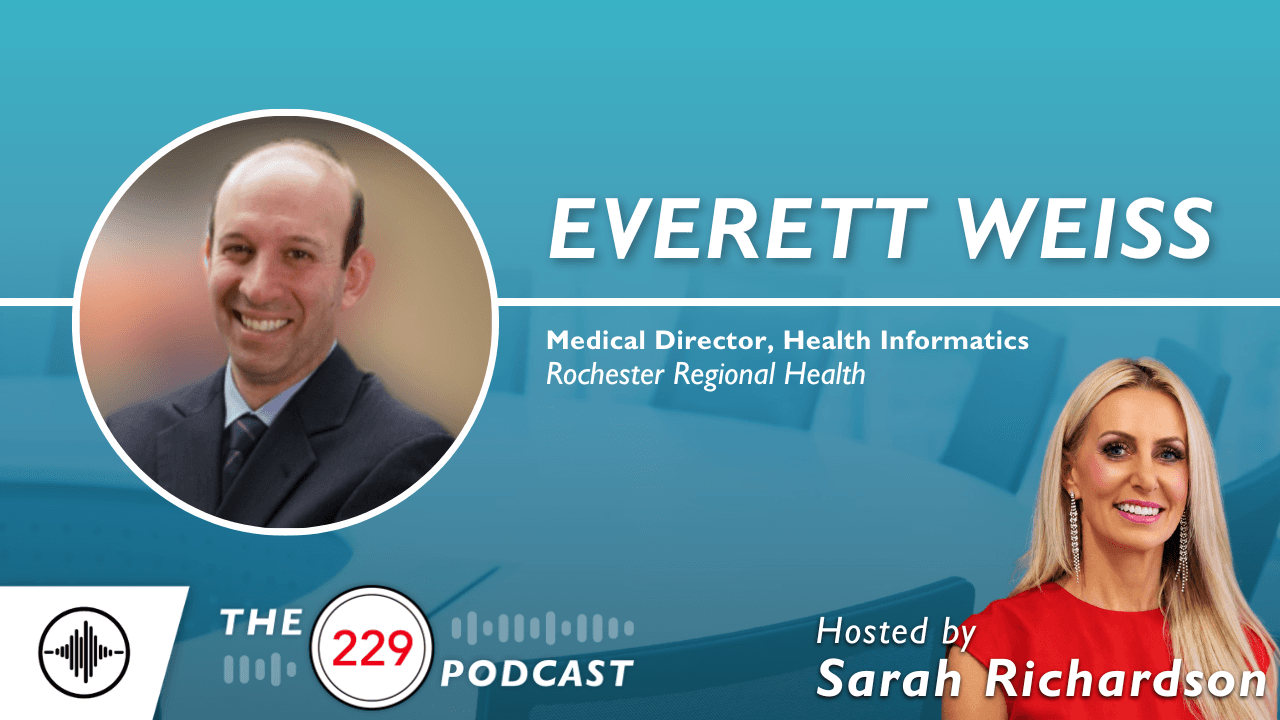
The Power of No and a New Perspective on Ambient | The 229 Podcast with Everett Weiss, MD
 Apple Podcasts
Questions Answered in This Episode
- How do you say no to everything when your organization insists everything is number one?
- Can EHR optimization alone reduce clinician burnout, or is technology just the symptom?
- What breaks trust faster between clinical and operational leadership than broken promises?
- How do you apply AI thoughtfully to solve specific problems instead of chasing endless possibilities?
- When a clinician looks up from ambient scripting to engage their patient, what just changed?
About This Episode
July 16, 2026: Dr. Everett Weiss, Medical Director, Health Informatics at Rochester Regional Health, has been a clinician, a vendor, and a health system informatics leader -- and that full arc is exactly what makes this conversation different. In this episode of Flourish, Sarah Richardson sits down with Dr. Everett to unpack why clinician burnout is a systemic problem long before it's a technology problem, what a holistic wellness program looks like when it's built by someone who's lived on every side of the equation, and what really happens when a provider looks up from a keyboard for the first time in years.
Keep up to date on the latest in health IT:
https://thisweekhealth.com/news/
Key Points:
04:01 Wellness Beyond HR
08:27 Power of No
10:47 AI With Purpose
17:59 Closing Advice and Wrap
Donate: Alex’s Lemonade Stand: Foundation for Childhood Cancer
Thank You to Our Episode Partner



Transcript
AI agents are quickly becoming one of the fastest-growing identity types in healthcare. They're reviewing images and coordinating care, supporting scheduling, and accessing patient data across multiple systems. The challenge isn't the AI, it's governing what these digital identities can access and do and share. If an AI agent improperly discloses patient information, the OCR won't care whether it was a person or a machine. You'll still be accountable. CYDERES helps health systems give every AI agent the right access, the right context, and the right governance before it's allowed to act. Find out more at thisweekhealth.com/cyderes Hi, I am Sarah Richardson, principal at this Week Health and the 2 2 9 Project and a former healthcare IT executive. I spent a lot of time in rooms with the leaders shaping this industry at dinners, round tables, and events across the country. And every so often someone says something that stops the whole table. You can feel the room shift and everyone leans in. That's the conversation I wanna keep going. Welcome to the 2 2 9 Project podcast. Let's get into it. Hey, welcome to the 229 podcast. I am Sarah Richardson, a principal here at This Week Health, and so grateful to have Dr. Everett Weiss with us. He's the medical director, health informaticist, Rochester Regional Health with a phenomenal background. But one of the things I love the most is how you have leaned so much into, uh, clinician wellness programs and really built around mindfulness along with EHR optimization. Well, Sarah, thank you so much for, for having me, and really great to be here. I met you at our CMIO vet in Dallas earlier this year, and I just loved everything you've been doing for this industry. And I thought, "This is gonna be such a fantastic conversation." Because you've been a clinician, a vendor, uh, and now a health system informatics leader, I would love for our audience to know more about what that arc has taught you that you simply just couldn't stay in one lane. You had to explore more options about your profession. Yeah, well, I, I consider it to be actually a, a real privilege to have had the opportunity to work in so many different environments and to really experience healthcare from so many different perspectives. And I think that that really helps shape the lens from which I, I do the work that I do. And as I interact with, uh, both my colleagues and peers, my, my ph- the physicians at our hospital, the nurses, um, the, the front desk staff who, you know, engage with our patients, and then of course, the, the patients themselves and all of the vendors, you know, that we, that we engage with, um, it really gives you that perspective of, you know, how does such a complex industry come together? And what are, what is everyone really looking for, and what are they trying to achieve, and how do we start to think about pulling all these pieces together? And there's no simple answer to that, but to have had that opportunity to work in the vendor space, to, to work, you know, at, at health systems, and, and work in product, uh, it, it, it really shapes that, that perspective. Well, it gives you a point of view about the whole continuum of how things should work and, and where to really make those incremental changes that are necessary for a well-oiled machine to show up the way that you want it to every day. Yeah, I think, you know, I, I, I think when we think about the, the big picture, you know, what are we trying to accomplish? And I think the thing that really unites health systems and, and digital health vendors is that we're really trying to improve health. We're really trying to improve, you know, people's lives. And that is such a noble calling, and that's what really drives all of us. And so at the end of the day, you know, we always talk about, you know, these great things that we are able to do, and we talk about the should we, can we, you know, debate. And at the end of the day, there's so many things to try to tackle. And having that deep understanding of what that purpose is and how things really come to fruition, and what do we need to do for the physicians? What do we need to do for our nurses? What do we need to do on behalf of our patients? Um, how do we deliver that, and how do we deliver that in a meaningful way? And how do we do it at low cost, you know, so that we can actually do more and do it better for, um, for the health system as a whole? The, the ability to know how and, you know, different angles of the health system are thinking about these things really comes to shape that perspective. Well, and what I love about what you're sharing is that many of us feel like we've been doing this for a long time, 'cause maybe we have. Like, I don't know, 32 years for me. I don't know how long it's been for you. And yet we're still nascent in the journey of how all these pieces come together, about how wellness and burnout become part of a conversation that is greater than one, one piece of the puzzle. Because you have co-developed a wellness program built around EHR usability and mindfulness. And most wellness programs are HR initiatives. Yours is more of a clinical informatics intervention, as I like to think about it. How did you get there? Well, I think the, the first thing to understand is, is, to, to your point, why are things so nascent? And it's because the field is ever-evolving and ever-changing, and I think it's, um, important that we remind ourselves that the problems of yesterday are gonna be very different than the problems of tomorrow, and we have to be very flexible and agile in our approach to, to those things. The other thing is, is just to recognize that, you know, we didn't get here overnight. This has been a buildup over time, and the, the pressure and the stress to, to do right by our patients and, and for our communities is tremendous. And we, especially providers, you know, in our, in this industry, we care very deeply about that. And so we burden that on our shoulders. And so as we want to do more and more and more in an increasingly complex industry and healthcare system, uh, that becomes even more important and more difficult. So the approach that we really wanted to, to take when we started to look at wellness and red- reduction of burnout was, what are all of the factors and angles? And I think an important thing to really recognize is that burnout isn't just about technology. Sometimes technology is the easy thing because it's tangible and it's easy to point to and say, "This is difficult." Sometimes the harder things are the everyday things, the operational things. And so we actually took a holistic approach to, to understanding wellness and really trying to understand, you know, what are the different things that we as an organization can do, and how do we have that impact, that meaningful impact on, on our providers? So when we looked at the EHR, we were looking at that as somewhat as the symptom of a larger problem that we were trying to tackle. And there's been a lot of studies that have actually shown that when you look at the causes of burnout among providers within health systems, technology actually ends up being a very small factor, and it's usually a symptom of all of the processes that are being asked of, of all of our providers across the system. So it was really the start of asking the question of, what is it that we want to try to fix? Where can we have the biggest impact? And understanding that we're really talking about humans. We're talking about people. We're talking about people who have lives outside of healthcare, and what it is that is meaningful to them, and how do we help them achieve that meaning through their day-to-day lives? I am so glad that you mentioned it's just not the technology burden, because it's easy to point to a specific space when it's so many factors. That really does probably create a trust environment or require trust because the... I think about it being like a persistent trust gap between clinical leadership, operational leadership. There's so many factors that go into it, and you've lived literally on both sides of it. What do you see that breaks that trust faster than anything else? And also, how do you rebuild it in your organization? Promising something and then not delivering. And I think that we've been trying. I think our intent has always been good. We care for each other. We're a, we're a community of providers who obviously are caring for our patients, and it's really in the last five to 10 years where we really turned the camera around and looked at ourselves and said, "Well, how are we caring for each other? How are we helping each other?" And so when we make these promises to each other that we're going to take care of each other, but then we ask more of each other from an organizational standpoint, and I hope we're gonna talk about the power of the word no, but when we ask everyone to say yes to everything, um, it, it becomes this thing that really tears down the trust the fastest because how can we actually take care of each other when we're just doing more and more and more? Well, to your point, the power of no goes a little bit into the whole space of shared accountability. So it sounds great in the strategy deck, but when you put it into practice and you have to really operationalize that, budgets get tight, everybody's protecting their lane, there's 10 number ones. Where does the power of no fit into something like a shared accountability model? first and foremost, right, the, the definition of priority is one, number one. We can't have 10 number ones, and that's wherein lies the problem because we are always saying that everything is important. And there are a lot of things that are really, really important, but when we can actually focus on what that number one, maybe that number two and number three is, but call them out as number two and number three and then say we don't have bandwidth to do other things, we really do a couple of different things. Number one, we really help people focus and we help them be at their most productive selves. And when you have an organization that is extraordinarily focused on a mission critical strategic imperative, you get things done. The other thing is, is that everyone is now working together instead of competing with each other for that bandwidth, for those resources because then everything has to get done and everything has to get done yesterday. So I think the first thing is, is just a recognition that, you know, organizations, we do have priorities. We set strategic, uh, you know, objectives and aims, and we're trying to achieve things in any given year. And with the rapid change in technology, I mean, some of those timeframes are getting shorter and shorter and shorter, but we can still say that within the next six months, this is our focus. And it's really amazing. I, you know, we don't like to look fondly back at, at the pandemic, but the pandemic was a perfect example of when we all came together and we all of a sudden had a number one, number two, and a number three focus. And organizations got stuff done, and we came together and we felt very good about, you know, that, that work. So I think that is probably one of the, the first places that we, we ought to be looking. Well, and it set a precedent for us in the ability to do things well if we do one to two, even three things at a time. But then now, since '22, we've had this influx of, of AI, honestly, and the pace of change affecting that. It's moving faster than most governance frameworks can keep up. And, I mean, you've been, again, clinician, informatics leader, patient advocate. Where do you draw the line on pace and understanding how to best- Help an organization truly prioritize what needs to happen next? Well, I think the thing to remember is, is that AI is a tool to help us deliver solutions to problems that we are trying to solve. And so the most important thing that we have to ask ourselves is, what problem are we trying to solve? When we ask that at an organizational level, when we ask that at a department level, when we ask that even at an individual level, we all of a sudden gain that focus that we so desperately are craving that's gonna help us to, to be the most productive and also take care, take care of ourselves. So I think that, when we look at AI, AI is the solution and it can do many, many things, but the real question that we have to pay attention to is, what problem are we solving that maybe AI can be the solution for? And then applying AI in those specific use cases. The possibilities of AI are really, really promising, and they're endless. Um, and this is what's creating all the buzz and the excitement about this new technology. And you're absolutely right. It is exponentially growing in its capabilities and its capacity, and we should be learning and understanding how that can be applied to the problems that are most critical to us today. At what level of it do you apply to what scenario? It's kind of like how much medicine do you really need to give a person for a specific ailment? Because you completed a, like, 300-plus provider Ambien scribing pilot. That's a bit of that usage of, of the AI universe. When you watch a clinician use it for the first time, when they look up from the keyboard, when they're able to connect more thoughtfully with the patient, it's one application of obviously what we've been talking about. What does that moment mean to you personally? What have you seen in terms of it creating a better balance for the provider's intent to go into medicine in the first place? Yeah, it ... You know, I think first and foremost, when I talk to providers, um, I think the thing that motivates me the most when people ask you that, what, what drives you in the morning? It is hearing the stories of how you have impacted them. And for me, I think one of the greatest things about Ambien Digital Scribes, um, to date has really been how providers have come back to the joy of medicine. And that's not just platitude. We're actually hearing how this technology ... The, the providers are saying this is the first technology in their entire career that has had a meaningful impact on their day-to-day. And it's not just saying that as a very abstract. You have providers who actually say that they are reunited with their families. They're spending more time with their families. I've had providers say, "You know, I actually had lunch for the first time with my colleague- Um, and, and so we talk about, you know, all of these metrics and key performance indicators, and we talk about, you know, documentation burden and time, time reduction, and even pajama time. Um, but what I find to be actually most meaningful is, is how it has actually reduced cognitive burden and how it's returned providers to what they enjoy most about practicing medicine, because it's not about pajama time. In fact, what Ambient Digital Scribes has done for many providers is offer more flexibility to providers to be able to do things during the day that they want to do so that they can push some of that work, you know, in, in the evening. It's not about reducing that time, it's about increasing the time to do the things that matter most on a ... for those individual providers. And when you hear those individual stories, whether it's in the middle of the day, whether it's right after work, whether it's in the evening, um, those are the things that really, um, you know, bring a tear literally to, to my eye and really give the value to the work that we do. Well, and you're the epitome of a regional system with a community identity. I mean, Rochester Regional is known for its local identity. How does that help shape the way you think about the technology strategy in the way that you just described, in addition to meeting your patients where they are? Yeah. Well, listen, um, I think that first and foremost, we, we exist and we are here for our community, and that gives us pride. I mean, that is baked into our organization's values and mission statement, right? We are here for our community. And this technology is actually helping us to deliver on that promise. And we know this. We say this to ourselves all the time, but finally, we're at a place we're actually living this where we can say that if you take care of yourself, you can actually better take care of your patients and your community. And we're ... We now have a technology, an example of technology, that is finally being put into the hands of our providers and our health systems to be able to help them to take care of themselves, bring them that joy in practicing medicine, which only benefits our patients. Um, so it's a win-win-win for the organization, the providers, and our community Well, in your environment, I remember being a kid and, you know, our family doctor would be at the Little League games because his kids also played. And so the places you would see the doctor weren't just in the office when you were sick. I mean, heck, I've got some really bad scars on my hand from getting literally stitched up at his kitchen table. I'd like to believe that's what some of these new technologies bring back into community environments, that you might run into your doctor at the grocery store or the Little League game because that's what holistically communities were always about anyway. Yeah. It's this, it's this interesting dichotomy, right? Because we, we talk about the humanity of medicine, and that's what people really crave. And people are very anxious that technology is gonna remove the humanity. It's gonna replace us, and it's going to, you know, be the thing that, you know, patients are, are going to. And, and there is some truth to that because convenience is really important in an increasingly busy, you know, world. But what's really fascinating is, is that technology can be used to bring back the humanity of medicine. And I think that that has to be something when we're evaluating different technologies and different solutions, that that's the thing that we are asking ourselves: How does this actually really improve the provider-patient relationship? How does this make a difference in, in all- everyone's lives? And if it can do that, then this is something that maybe we need to put all of our chips on the table for. Oh, you, like, teed up the last question so perfectly. It's almost like you knew it was coming, Everett. Because if you could go back and give your earlier self one piece of advice, this is not about informatics strategy, it's probably about the personal cost of doing this work well, what would it be? If I had to go back and tell myself one thing, it would be to make sure that you, one, stay true to yourself, and two, make time for yourself. Because you will be at your best when you do the things that you love, when you pursue the things that you enjoy and that you're really passionate about. And you need that time to be able to recharge to be that best for everyone else I love that perspective, and thank you for bringing that forward from a physician's perspective. But also for everybody listening to the show, take care of yourself first, and give yourself that opportunity to grow and learn without realizing that you have to burn yourself to the ground before you have a chance to fulfill the things that you went into any profession to achieve. Absolutely. Always great to see you and chat with you. Likewise. Again, I've seen you three times this year. I think I probably get to do it again at UGM and maybe some other events. But again, to our listeners, uh, thank you for the time, Dr. Weiss, uh, and Rochester Regional Health for what you provide to the community. Fantastic conversation about wellness and how to avoid burnout in the future, and also where technology does and doesn't fit into the equation sometimes. So thanks again for being on the show. Thank you so much, Sarah. What a pleasure to be here. And for all of you listening, that's all for now. Thanks for listening. The conversations happening in healthcare it right now are too important to stay in the room, and that's exactly why we bring them here. If today's episode made you think, share it with someone who needs to hear it. Subscribe to the 2 29 Project podcast at this week, health.com/subscribe and come find us at the next event 2 29 project.com. These conversations are better when more of us are in them. See you next time.