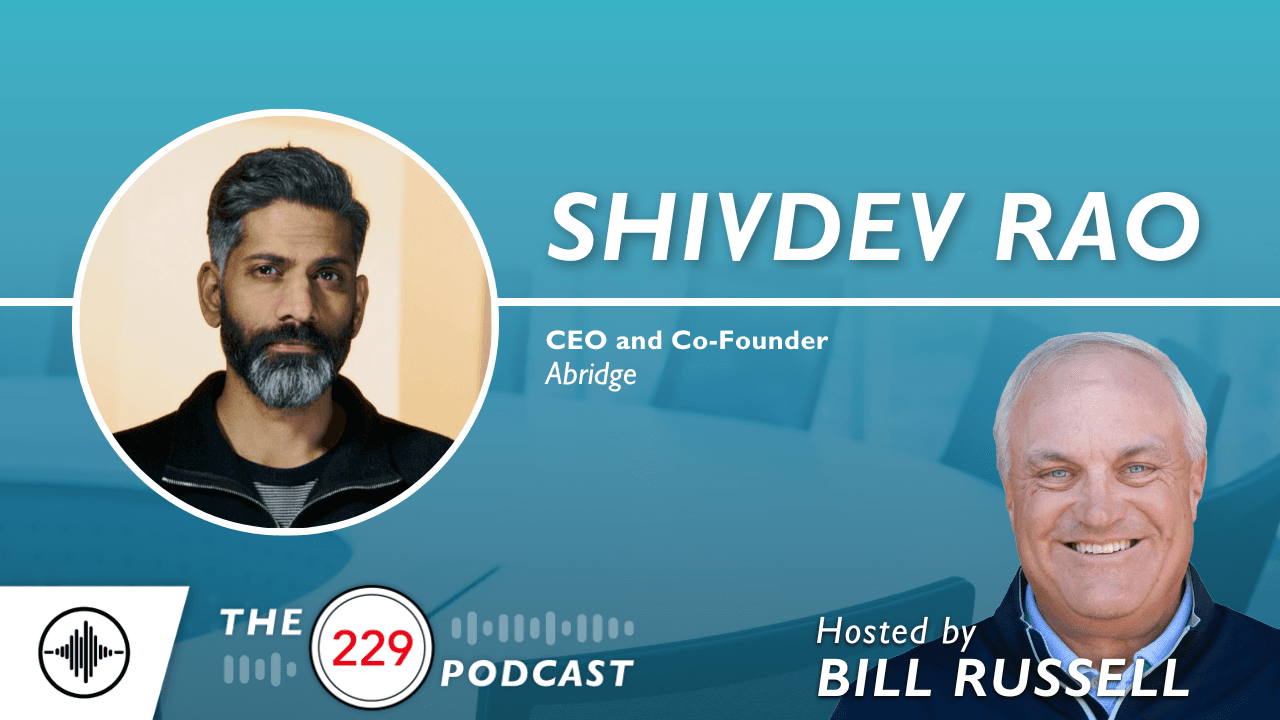
Innovating at the Speed of Trust and Fixing the Rev Cycle | The 229 Podcast with Shiv Rao
 Apple Podcasts
Questions Answered in This Episode
- How can clinical conversations power revenue cycle and value-based care simultaneously?
- What happens when a cardiologist stops doing pajama time administrative work?
- Can unified patient intelligence serve payers, providers, and life sciences at scale?
- Why is enterprise-grade healthcare AI fundamentally different from a party trick demo?
- How does proper documentation actually determine physician compensation in healthcare?
About This Episode
June 18, 2026: Shiv Rao, Co-founder and CEO of Abridge, has spent eight years building the company into something most people didn't see coming. Now live in 300+ health systems, touching 250 million patients and processing over 100 million clinical conversations a year. But Shiv isn't just a technologist. He still rounds at UPMC as a practicing cardiologist, and that dual lens shapes everything about how he thinks. In this conversation with Bill Russell, Shiv reframes what Abridge actually is: not an AI scribe, but computable infrastructure. The clinical conversation sits upstream of every workflow in healthcare, and what Abridge is building is the platform that proves it.
Keep up to date on the latest in health IT:
https://thisweekhealth.com/news/
Key Points:
01:41 Big Announcement Beyond Notes
06:29 Unified Patient Intelligence
10:52 Enterprise AI and Trust
15:59 Coalition With Payers and NVIDIA
35:27 So What and Closing Bets
Donate: Alex’s Lemonade Stand: Foundation for Childhood Cancer
Thank You to Our Episode Partner


Transcript
This transcription is provided by artificial intelligence. We believe in technology but understand that even the smartest robots can sometimes get speech recognition wrong. It's so easy to create a party trick, and it's a, it's a totally different endeavor to create an enterprise-grade, healthcare-grade product, or much less platform. My name is Bill Russell. I'm a former health system, CIO, and creator of this Week Health, where our mission is to transform healthcare one connection at a time. Welcome to the 2 29 Podcast where we continue the conversations happening at our events with the leaders who are shaping healthcare. Let's jump into today's conversation. All right, welcome to the 229 podcast. I'm Bill Russell, and today we are joined by Shiv Rao, founder and CEO of Abridge. Shiv, welcome to the show. Thanks so much, Bill. It's really, it's a privilege I, um, I, I also want to mention that Shiv is a practicing cardiologist by training, uh, which I think really matters here. Um, the thing I'm hearing from CIOs and CMIOs, isn't just about the technology, it's about whether the people building these tools really understand the clinical workflows they're trying to close. Um, but let, let's, let's get right to it, uh, the announcements. Yeah Shiv, you've been building Abridge for eight years. Yeah Uh, what did you announce today and, and why does it matter beyond the ambient documentation story that most CIOs already know? Yeah, absolutely. For us, the thesis that has underpinned everything that we've been building over these last several years, the thesis has been that healthcare is about people. That's what we don't think is ever going to change. We think that when we get sick, when our family members get sick, they're gonna see doctors, they're gonna see nurses, and we're gonna expect those professionals to have access to the latest and greatest tools and technologies and AI to help navigate us through our, our care journeys, our health journeys. But we're still gonna need those people, and if you believe that, as long as you believe healthcare is gonna have people in the future, then you also should believe that those interactions between them, those human interactions, those conversations really drive so many of the workflows in healthcare. They're upstream of not just clerical work like notes, like documentation where we started. They're also upstream of revenue cycle, upstream and can power value-based care. They're upstream of clinical trial recruitment, and really, like, the list goes on. So today, we had the privilege to make clear that that sacrosanct moment between the professional and the patient can power not just provider health system workflows, can also build a bridge between the provider and payers, and also can build a bridge between providers and life sciences companies, for example, for clinical trial recruitment I want to come back to your perspective uh, your lens. You, you, you're still around at UPMC. you're not a, a tech founder who has read about physician burnout in a, in a white paper. what do you see as you walk into that hospital that your competitors maybe don't? I still run in the hospital. I do about one weekend a month and, it's hard running a company of your size and continuing to practice Uh, it's, it's, it's a, it's a privilege that they let me do it, and I get to stay close to the mission of the company. I get to learn osmotically from all the clinicians I get to work with on those weekends, and I, I get to stay close to patients. And when I round in the hospital, you know, you can't swing a stick in healthcare and not feel like you've hit this billion-dollar opportunity, this problem that you could solve, that you feel like you could solve. I remember when I used to be a corporate investor, what was very clear is that as many problems, opportunities there, there may be, it's so hard to earn the right to actually start to solve them. And at this moment in time, Abridge, we've, we've earned the right thanks to all the people I get to work with on a daily basis. We've earned a lot of trust in the marketplace, which means we can start to go after those problems. So when I, I round in the hospital, for example, you know how it used to be, I would, before I walk in a cardiology consult room to see a patient, I would read up on the patient, figure out who they are, what is their s- specific kind of cardiology-related issue. I'd maybe study EKGs and look up CT scans or echocardiogram reports. I'd really try to get a sense of who this person is. Maybe if it's a complicated and more obscure cardiology issue, I'll look something up and try to feel like I have access to the latest evidence on my fingertips before I walk in the room. And then I'd walk in the room, take a history, do a physical exam, and then come up with an assessment and plan with the patient right in front of me and their, their family members. And then I'd leave the room and perhaps check my work and then document that, and not just put in my note, but I'd have to put in those visit diagnoses, those ICDs that end up informing claims, bills, accounting, billing, and all those workflows, you know, that takes a lot of time, and we call that pajama time. And so what Abridge can do now for me is before I walk in the room, I know who this patient is. I feel like a superhero. When I walk in that room, I know what questions to ask, what specific issues I should focus on as a cardiologist. And then when I leave the room, not as my-- not only is my note there, but also my orders can be there. My billing and coding is essentially complete for me, and, you know, I don't have to go to all those different schools that I never wanted to, to go to in the first place. I can just focus on the patient and, and delivering the best experience and hopefully the best clinical outcome. So when you were, when you were studying the, uh, the coding class, um, w- know, that, that wasn't your favorite class, I guess, in, in, uh, in preparing to be a doctor? Well, we never even got those classes, uh, like n- certainly not in medical school. But then, you know, even after residency as an attending, they start to sit you down in these lunch and learns, pizza and PowerPoints, and give you, give you presentations on E&Ms and, MDM criteria and what makes up, you know, an, like a, a, a proper value-based care document from a meet criteria standpoint, and what is a DRG. If you're lucky, you might figure that out over time All right, so we- we've been in pursuit of the longitudinal patient record for eons Yeah. the, reality of the longitudinal patient record is it's loaded with Signal and it's loaded with noise. Yeah And so I, want you to walk me through the, the, the unified patient intelligence. Um, what does it actually mean in practice? What, does a day in the life look like for a clinician using the full platform? Yeah, absolutely. I think the most important aspect of that term, unified patient intelligence, really is the intelligence piece, and that we're finding a way to help clinicians feel like superheroes when they're in the moment in such a way that they can solve problems across, you know, all the different stakeholders that, you know, live beyond that, room, that conversation. So when I'm seeing a patient, there's what I'm focused on as a clinician, just making sure that I can address the, chief complaint that the patient came in with. But then after I see that patient, there are all the different stakeholders who care about what I talked about and care about how I documented what I talked about and how I coded what I talked about. And so payers care, revenue cycle experts care, you know, coders care, auditors care, medical legal experts care, and life sciences also care because maybe this patient in front of me has some rare disease and they could benefit from being in a clinical trial and there's no possible way I could keep up with all the inclusion, exclusion criteria out there on who can benefit from what at my specific health system or, beyond. And so wh- when we say unified, we really mean that this thesis that healthcare is about people, and given that we are at scale now with that thesis, we're live across well over 300 of the largest health systems in the country, we can start to connect the dots. We can start to build these connections between those moments where care is being delivered and the intelligence that can help serve the broader ecosystem. So a PCP doesn't need to, you know, necessarily be paranoid that, they don't understand the latest rules around, you know, value-based care documentation, for example You know, I was, I was doing a little research before this. Uh, 300-plus systems live, um, partners that you, uh, that, that you serve have over 250 million patients, more than 100 million clinical conversations in a year. Talk to, talk to me a little bit about , what that provides you at scale You know, t-trust is everything, and we say, and I know you say this too, like, healthcare moves at the speed of trust. And earning trust is hard because you, you earn it in drops and you can lose it in buckets. And it's, it's some combination of transparency, reliability and credibility. I think when we first started off years ago, 2022, 2023 especially when we were starting to take off, folks sort of perceived the node as like the be-all, end-all. And then I think the industry started to understand that it wasn't never about like the AI scribe. They started to create this new category that they could bucket us into called ambient. And I think more recently, the industry sort of recognizes that it's actually not AI scribe or ambient, it's just intelligence. It's AI. It's, it's finding ways to, to force multiply all the good parts of healthcare and also redesign the parts that don't work as well. And so that's the opportunity that we have right now, thanks to the scale that we've been able to earn. If you don't have scale, it's hard to think about reimagining revenue cycle, for example, or force mult-multiplying or de-risking value-based care or redesigning prior authorization. But when you've got scale, you can, you can earn that trust. You can earn that right. And that we live across all the different systems of record, that we can live across an electronic medical record, we can live across uh, an ERP, a CRM. We can live across payer systems, long- longitudinal claims data. We can live across prior auth guidelines and payer-provider contracts and also clinical trial management systems. That we can live across means that we have access to very special differentiated opportunities that no single entity, I think historically, lower in the stack could, could get after CIOs are, uh, drowning in AI pitches these days, Totally they are, um, you know, there's people sitting across them, today. Like, if they're listening to this today, someone's gonna s- sit across from them and give them some, some story about how, uh, the AI's gonna sit on top of it and make it smarter, or it's gonna integrate something that hasn't been able to be, Yeah integrated, uh, before. What, what's your answer to that skepticism of just another AI layer on top of the, uh, EHR? Well, I think sprinkling AI on top of existing workflows isn't the answer. I think, um, it's so important to find a way to thread the needle through making it easy, being in the workflow, m- helping it feel seamless for the end user, and also thinking about what the ramifications of what your AI is going to do on the, like the broader system. So just to give you an example, when we first started off, it was very clear that you could create a note relatively easily. You know, anymore with AI and the way that the, the ground is rising as fast as it, as it is with where the frontier models are going, I'd say, you know, my 15-year-old daughter could vibe code some- something in healthcare and probably pitch it to some CIO and maybe, maybe get a second call even becuase a- and you know what? It would look pretty good. Like, Yeah. the, the demos look amazing It's so easy to create a party trick, and it's a, it's a totally different endeavor to create an enterprise-grade, healthcare-grade product, or much less platform. And I think that distance is actually the challenge. That distance is, is the game. It's, it's the obstacle that, like, companies need to find a way to traverse. So when we first started off, it was very clear that, like, easy to vibe code things, you can use these off-the-shelf tools and get maybe some approximation of, of, of a product. But then very quickly, for certain opportunities, certain high-stakes opportunities, you know, you have to hold yourself to a higher s- higher standard. Notes are one of those opportunities. Even notes. I'm putting aside orders and prior auth and value-based care and risk adjustment and, and revenue cycle and clinical trial recruitment and everything else. Just notes are so important because we don't get compensated for the care that we deliver in this country, we get compensated for the care that we documented that we deliver. So when you unpack that, what constitutes a note? Well, it's not just what we talked about, it's also the information that's in the chart. It's also prior visit diagnoses that need to show up in the assessment and plan. It's also memorizing or understanding the payer-provider contract to get the, the language right. Um, making sure that you don't use phrases or words like suspicious for or suspected of. Getting all the medical decision-making criteria into that assessment and plan correctly. Making sure there's meat criteria, what you discuss monitoring, evaluating, assessing, or treating if it's a chronic condition that can inform a RAF score. And, and if you're at risk, there's real dollars associated with that and real outcomes as well. And the list goes on and on and on. So anymore, in our four-block radius in San Francisco, there are a couple buzz phrases that we hear every single day: context engineering and harness engineering. And context engineering in healthcare is about being able to use not just in our, in our world, not just the conversation, but also prior notes that were written for this patient. Also, the visit diagnoses that live maybe not just in one system of record. For value-based care and HECS, we should be pulling that from a payer as well, ideally, or for Medicare. Um, it's also being able to pull labs to inform what that note should look like. Um, and, and, and, and perhaps also the latest, you know, American Hospital Association informed coding clinic kind of information that a CDI expert holds in, in their head, you know, in the revenue cycle department. So all of that context needs to be engineered behind the scenes to create output that checks off the box, number one, for the doctor or the, the, the PA or the nurse Also then for all the stakeholders around them. And threading the needle through all of those constituents is, is how you differentiate in our space. Because the last thing we want is to create a note that the doctor loves that actually loses the health system money, and that's really the moment that we're in. And what we're seeing in a, in a lot of head-to-head pilots is that if you do this wrong or if you do this the way my 15-year-old daughter would do it, you might have like a, a short-term, you know, uh, a vitamin, but you're gonna be in for a good amount of pain, you know, on the other side The, the phrase I keep hearing from clinicians in our, uh, 229 rooms is we want to get paid for the work that we are doing. No more, no less. We just-- and that just keeps falling through the cracks if you don't capture that, that conversation correctly or the work that's actually being done correctly, and I, I think that's the maybe people aren't, aren't picking up on Yeah, uh, absolutely. 'Cause the, the notes need to be consistent with the codes, which need to be consistent with the claims, you know, which need to be consistent with payer-provider contracts. So you, you s- when you start to pull the string, you see that there's a huge opportunity to go really, really deep I wanna come back to scale 'cause I think it, it, uh, it- the one thing that you announced were these really interesting partnerships. So you announced partnerships with Aetna, Cigna, um, that's providers, payers, and, um, NVIDIA, A- AI infrastructure, Yeah uh, all, all in one room. Uh, I think scale gives you the ability to have those kinds of conversations. What's the, what's the logic of that coalition? 'Cause they're very different companies. Yeah, absolutely. Well, you know, the, the platform requires multiple things. We need clinician trust and engagement. That's how care is delivered. We need seamless integration with all the different stakeholders to deliver these new value props that we're talking about. Um, and that means integrating not just with systems of record on the provider side, but ideally systems of record also on the payer side or even, like, the life sciences side in order to help with these different use cases. So one by one, NVIDIA, um, that partnership is special to us. They've been an investor. Jensen's been a, a mentor for, for years now. And what we are building, you know, the world hasn't seen before. We're really building a conversation foundation model. A lot of folks out there, I think, um, recognize that these frontier model companies, for example, like Anthropic, OpenAI, that they are planning to go public soon. And there's already a lot of fear in the industry that as they go public, the tokenomics, the, the cost per token for these companies is gonna go through the roof. It's gonna go up. Essentially, this-- the, this technology has, has been subsidized by, by, by venture capitalists for some number of years now, and, you know, if you want access to the latest and greatest models, you're gonna have to pay a lot of money. What's helped us as a company over these last years is that we are T-shaped. You know, we, we go really deep on a specific vertical, healthcare, but we can also go broad from a technology and science standpoint. We can fine-tune and distill and post-train our own in-house proprietary models to get specific jobs done. Those jobs might include extracting orders from the conversation, um, so that we can put them in the EMR. They could include creating notes for a cardiologist. Could include pre-charting, so that before I walk in the room, I know who I'm, I'm about to talk to. But depending on the task, we'll either use our own in-house model or some combination of in-house plus off the shelf in order to get that job done. But given that we own and control our stack and, and given that we do work like this with NVIDIA, where we're training these new foundation models for our specific use cases, it allows us to own and control our destiny, our P&L, and give psychological security to all of our, our health system partners that we're not gonna be ratcheting up, up costs in the future. And that even if the industry moves that way, we can work together with everyone to make sure that this is technology that, that they can really rely upon. So that's the NVIDIA piece. The, the NVIDIA piece probably surprised me the, the most. The economics of it, think makes the most sense, uh, especially now that we have stories of, um, uh, we have the Uber story, we have Microsoft story. Uh, the, the, the, the tokenomics is a, is, is a real deal, and with the amount of transactions and conversations we're gonna be having in healthcare, that can add up, uh, really, really quickly. Uh, just on a s- side note, is, is Jensen as encouraging as he appears, um, from the various videos I've seen? He's really unreal. Just world-changing. And yet, um, he'll find time to give me advice. He'll, he'll find time to call me and, um, and if I, if I email him, his SLAs are unbelievable. He'll respond by the end of the day. Um, and it always, it's, it's eye-opening to me. Like, if he can do that, then, um, what k- what, what, what kind of standard should I be holding myself to? Yeah, then, then there's hope for the rest of us. Um, let, let's go deeper. Some of these partnerships are, are really, uh, interesting and important. Aetna, Cigna, uh, what are they actually committing to, and what does it mean for health systems? Yeah. These are two of the largest national payers in the country, as everybody knows. And they're payers who recognize at this moment the worst thing that can happen to this industry is that we have AI agents fighting AI agents, and that's a race to some dystopic future that none of us wanna live in as, as people, as patients. And certainly, it's not a good thing in, in the long term for, for, um, health systems or, or anyone else involved. And so finding a way to create win-win opportunities, that's what this is all about. So with Aetna, it's really a focus on value-based care. Can we create this n- new way of, of, of approaching value-based care with AI that helps clinicians actually, you know, have access to all of the information about a patient so that they can deliver the most care related to, you know, all of the c- the, the, the complexity, you know, that, that's in front of them? Sometimes you'll talk to... we'll talk to, uh, primary care clinicians who are using Abridge, and they'll tell us that some of their patients have, you know, a dozen chronic conditions, and they, they have to triage. They have to only focus on a couple, and it takes hours and hours the night before to look up, um, you know, the details of their diabetes with end-stage renal disease and, and, and talk to the nephrologist to figure out how they should adjust the ACE inhibitor that that patient is on the next day. And, um, that's really hard work. That's taxing work, and it's important work, not just for the patient, a- and it's important to help enable the clinician to do that, but it's, uh, also really, really important to value-based care. Um, anyone taking risk understands that these notes, as, again, are, are like bills. If you're addressing care gaps, you need to document those, the, the way you address those care gaps. You need to, um, address the problem at a degree of specificity from a coding standpoint, um, that will check off the box for auditors after the fact that, okay, you talked about heart failure, um, that's, you know, systolic and secondary to sarcoidosis. All of those details matter a lot. So now, when clinicians walk in the room and they've got access to our technology to Abridge, they can feel like superheroes knowing what questions to ask. And when they ask those questions, we help them understand, um, that they checked off those boxes. We'll help them understand what's outstanding. And then we generate the documentation with those HCCs in a compliant and complete way that is auditable. And, um, you know, there's provenance. So it's like a win-win for everyone involved here because what, what did we really do? We just helped clinicians deliver better care that they wish they had time to do, they wish they had the, the, the technology to do today. Now, um, that's one piece. And then there's, there's, um, Cigna is a, is, is a whole another kind of opportunity I can unpack too. Yeah, I think, I think I want you to unpack that 'cause you're, you're, you're framing this as an infrastructure problem. The, the, the AR and the prior auth, you're, you're saying we're going to address this with the right infrastructure, the right intelligence layer, the right, uh, of processes around it, and you're bringing the coalition together to really solve those things, uh, uh, and I think in a, in a different way Yeah, it's, exactly. Um, well, may- maybe it's a great opportunity to talk about what we are working on with Cigna. So what happens today in, in a, in a clinic? I see a patient, I write a note, I put in my visit diagnoses. Those are mapped to ICDs. Those ICDs then inform a claim, an 837. Someone in the basement of my health system, literally, is gonna look at that claim, maybe look at my note, make sure that everything is consistent such that there's gonna be a lower chance of a denial after the fact. They're gonna edit and adjust. Then they're gonna use some technology as well. Then it's gonna go, that 837, to a clearing house. The clearing house is gonna apply another set of edits and adjustments, make sure that it's clean and can go one to many payers. Then the payers, with some combination of technology and process and, and, and, and human labor, some of it offshore, they're gonna decide how to adjudicate. And if they deny, it's an 835, it comes all the way back to that windowless basement in my health system and, you know, my team of revenue cycle experts are gonna look at the denial, look at m- the note that I wrote weeks ago, and then they're gonna get the nerve to send me an inbox query or an email asking me to either addend that note, adjust it, or bring that patient back because there's no other way we're gonna get paid. That's revenue cycle in America at a really, really high level, and that's hundreds of billions of dollars of, of, of expense, of cost, and there's just a better way of doing this. And so one of our mantras in the company is shift left but prove right. You know, prove that the outcomes are improving for everyone involved, but, but shift left as much as we possibly can. Redesign the system. So back to what we were talking about earlier, like, you know, there's a, a compliant enterprise-grade, healthcare-grade note that doesn't lose you money, that actually helps the P&L, that can create win-win opportunities with payers, and then there's the note that maybe my, my daughter could build. Um, but the healthcare-grade note, that enterprise-grade note has a lot of stakes associated because we get the note right, we make sure the codes are consistent, we make sure that clean- claim is even cleaner. And Cigna is saying if we do all of that work, then they would love to find a way to pay in real time. And, and you know this. We've been talking about real-time payments in healthcare for, I don't know, decades. But this is an opportunity with this technology, and thanks to the scale that we've got, to actually go after this and, and demonstrate that you can create y- win-wins for everyone involved, and most importantly the patient And these are the largest payers, uh, in the country. Um, I, I'm going to, I'm gonna figure out a way to, uh, button that up. That was the, the, the best storytelling of what actually happens that I, it, it... I, I always miss pieces. That was, that was really well done. I, all right, so the, the Eli Lilly investment is probably o- one of the more interesting pieces for me. Uh, what does a pharma company care about the clinical conversation? What are they actually looking for? It's a great question. At, you know, my health system, there's a clipboard behind my desk that has all the clinical trials that are live inside of UPMC. I can never find the time to study all of these pieces of paper. I can never find the time to understand that my colleague is looking into amyloidosis and would love it if, if all of, of, you know, our colleagues in the department can keep an eye out for amyloidosis, and that when we see amyloidosis in the clinic, that we, we let him know. Um, but what he would love even more is if we could go even deeper, but he just can't expect us to find the time to validate that this patient with amyloidosis has all the other inclusion and exclusion criteria to be the candidate for that trial that could potentially save that patient's life. So it's a win, number one, for the patient, um, if I can have access to all this information at the point of the conversation itself, so it's, it's a win for me. I feel like I'm delivering better care. And then beyond that, it's a win for the system because between health systems and life sciences companies, they're always trying to figure out ways to collaborate around clinical trials, um, ways to, to make it more efficient, you know, and, and ways to scale, um, more quickly. It, it's, it's a very difficult undertaking. There are a lot of, you know, clinical research assistants, um, involved in getting any single trial to, to really, like, work well. And we have, you know, so many systems, uh, as partners, academic medical centers across the country that are doing deep work on clinical trials, and they all tell us that if we could scale this technology, if we could help doctors understand that the patient in front of them is a candidate for something, and then if we could pass that baton to the right person, you know, on the, on the sort of pharma life sciences side, maybe a, a CRO-type entity or other, um, then it would be a, a huge game changer for them. And so, um, that's what this partnership with Eli Lilly is partially about. But there's really so many other opportunities to just make it easier for, for, you know, patients and clinicians to, um, you know, get access to the best medications and, and for clinicians to deliver the best possible care. You know, earlier you, you talked about the speed of trust and, and the foundation of trust, and I still find myself having conversations with clinicians, uh, CNIOs, CMIOs, others who are skeptical. They still use the word hallucinations. Yeah y- you know, I, I personally have been, doing a lot with context engineering, harness engineering, and I, I've seen this whole idea of hallucinations, uh, start to diminish. But it doesn't... I- it's, it's, in their mind, it's still front and center. There's liability associated with it. There's AI making decisions Yeah that, that it shouldn't. How do you address the, the, the, the trust of the clinician in this, uh, i- in this platform? Yeah. It's such a good question because there is a, a litmus test that clinicians, you know, put any AI technology through that's very much based on vibes. You know? Like, clinicians just... A cardiologist sees an output, an oncologist sees an output, whether it's a note or an order or a code, and o- oftentimes they can just tell this is better. And when you kind of push them on, on why, maybe they'll be able to answer, "Well, this sounds like me," or, "I'd be proud of this," and, "I like how it's auditable or that it's put evidence into my note," or, um, you know, maybe they can unpack some of those details, but it's really hard to quantify, you know, sometimes for them. And, you know, I think that one of the things that, um, is easier to quantify are, are just issues around, like, core technology performance. How fast was the note generated? How many errors are in it? False positives, false negatives. So omissions are a really big issue, as much as hallucinations are. And on that hallucination and confabulation side, it's like Whac-A-Mole, you know, this technology. A new model comes out, and you actually have to relearn how to work with this new model. But if you can find a way to quickly relearn and f- and, and, you know, this is like the sort of the harness that we were talking about, figure out what the harness should look like around this new model, you'll probably end up delivering a better product to the end user. So, you know, the, the companies that end up winning across all the different verticals, and it's not just healthcare, but also if you look at the legal space and the accounting space, there are so many different verticals that have popped up, are the, the companies that end, end up winning are the companies that can be incredibly agile and essentially reinvent their stack at a moment's notice in a, in a very modular way. Like, they can reinvent a part of the stack that allows them to play with the latest Opus model or the latest GPT model, or in a way that to, that they can play with their own in-house models, like the, the one we're building with, with, with NVIDIA. So, um, if you can do that, then you'll probably be able to d- to demonstrate that your performance is getting better across all the metrics that matter. Being able to even measure, you know, hallucinations is, is, is its own sort of challenge. And so we take a lot of pride in publishing our results, publishing our benchmarks, making clear where we were, um, the honest truth, for example, with speech recognition, medical term recall, or word error rates. And then we, we take a lot of pride in demonstrating, like, okay, this is where we were last week, and this is where we are this week, and this is where we think we'll be next week. That trend line, I think, is really, really critical for an AI company to demonstrate. Because if they don't have agency and control over their own performance, then you're, you're essentially getting, you know, what is a very thin wrapper around something that's off the shelf that in an industry, in a regulated industry like a, like, like healthcare, it's just not enough You know, I, I, I want to come back to the model. that's the, the announcement that probably surprised me the most. Um, I mean, not that we're not seeing. We're seeing it in the legal side, we're seeing it in finance. Uh, the, the... There's organizations that are starting to build their own models now. It's, it's, uh, it's expensive, we talked earlier about the, the need to control the economics of it, but there's, there's a lot more to it than that. And you started talking about fine-tuning the models and, uh, getting predictable results and those kind of things. Uh, talk a little bit about, um, why build your own foundation model? Yeah, absolutely. When you think about the stack and what it looks like for an AI-native company, there is the, obviously the compute layer, the, the GPUs, um, the CPUs. There is the model layer, there is the infrastructure layer, and there's the application and, and you could say like the intelligence or translational layer at the very top. And I think across all those different vertical industries, what companies, um, like ours need to do is focus on the value. What is the actual value that you're, you're providing your, your customer, your health system CIO, uh, or CFO or CMIO? Um, and then kind of figure out how far down in the stack you need to reach in order to deliver that value. And what became clear, I think, to us some, some years ago really, was that the farther down we could reach, the more we could control the value that we could deliver, the less it's us being opportunistic. "Hey, there's a new model that came out that's multimodal and can do vision. Cool, let's go build another product." Like, we're not opening up a trench coat and just sort of delivering what other people are sort of building, you know, bits and pieces of. We can be very opinionated and strategic and sit down with our customers, with our CIOs and ask them, like, "What are your problems?" And then given that we've got the right people, the PhDs, the professors, the postdocs, and the datasets, the de-identified datasets that we've aggregated in a, in a, um, um, a, a secure way, in a private way over the ye- several, several years, and all the associated annotations, we can reach down lower into the stack and actually train models to solve those problems. So there was a legal firm, I think last week or maybe it was this week, Kirkland & Ellis announced that they were gonna put $500 million over a couple years or a few years to build their own proprietary AI model and, and, and that's what it takes. So how many health systems out there wanna put $500 million into building their own proprietary health system model? I don't think too many. And I think in an industry like healthcare as opposed to legal, where the ground is shifting underneath us all the time, pairs with new rules, um, you know, revenue cycle is always shifting a little bit. Value-based care is a moving target to some extent. Um, you know, doctors can't keep up with prior auth guidelines. When, when the, the rules are shifting and are as dynamic as they are, you, you also don't wanna make those hardcore investments yourself. You probably want someone else, um, to, to make it their full-time job, and that's, that's where our opportunity comes in. Two more questions. One is, is more I just want to get the mind of who's trying to navigate a ship like yours. But before I get there, I had a mentor once who said, "After any, uh, talk or conversation, ask yourself, so what?" And I want to give you the opportunity to tell us the so what. So all of these announcements, all of this, uh, you know, what's, what's going on. When, when you walk through the hospital and you are experiencing what clinicians experience, what does Abridge give you that, um, maybe you didn't have five years ago? Or what is it going to give you a year from now that you don't have today? Yeah. Well, I, I, I start with the problem, with the pain point always. And, and you think about it at the end user level, the doctor level, the nurse level, the patient level, and then you, you think about it at the CIO level and the CFO level, the CEO level. At the end user level, the st- the stats are still the stats. You know, so many clinicians are burning out. The last survey I saw was still two out of five doctors saying they don't want to be doctors in the next two to three years. Or there was a JAMA article some years ago that said that 27% of nurses didn't want to be nurses very soon I see patients in the hospital who are getting transferred from rural settings. Patients are driving from rural settings five, six hours to see the inner city rheumatologist who can potentially save their life. So this is a public health emergency. I think the why for, for the need for AI and, um, you know, y- this type of the, of, of technology in healthcare is just so undeniable. And, and then you, you think also about the system level, about the executives, and we know what P&Ls look like. We know what pressure looks like in healthcare. We, we know that it's always a challenge to figure out how to further consolidate your stack, um, how to find more efficiencies. And it's, uh, we've, we've heard a refrain across the marketplace just around how difficult and painful it is to, to, you know, think about the budget and think about this moment too where you want to invest at the same time. And so you've, you've gotta find trustworthy platforms, and you've gotta find a way to redesign the system. And this is one of those moments. This is a rare moment where a technology can improve the human experience in the most, you know, core way in healthcare and can improve the system architecture at the same time. And, and the first order of benefit, we've seen it. Doctors can be more present with patients, but the second order benefit is even larger. The health system can start to organiz- organize itself around what actually happened instead of reconstructing it afterward through all the fragmented data and workflows that are out there, and that means we can redesign the business model. And if we don't redesign the business model in healthcare or find a way to leverage technologies today that will allow us to be first movers on new business models that will emerge, well, you know, we've done a disservice to our kids, to future generations because, um, we are on a path right now where, um, you know, it's just unsustainable. So our mantra inside of Abridge is save time, save money, and save lives. And, you know, we believe right now we're building products in parallel that in, in, in their own humble way are, are doing all of those things. Now we have to do a better and better job at quantifying how we, for example, help health systems get full credit for the care that they're delivering. They're actually making money. But at a meta level, as we create these partnerships with Cigna, with Aetna and others, we'll demonstrate at the system level you can actually save money. You can actually attack Baltimore's cost disease. And saving lives, helping clinicians make better decisions at the point of care, uh, uh, it's as undeniable as it gets. And if we can find business models like clinical trials that allow us to actually drive economics to health systems, help CFOs at health systems actually make money for using our technology, then again, it's another win-win opportunity you know, if I was a business school professor right now, I'd be calling you up seeing if I could have you in for a case study conversation with my class. That was, uh, that was a, it was an interesting, uh, couple of months and it's probably been an interesting year. Uh, Shiv, great announcements. Love, love what you guys are doing, and really appreciate you taking the time to come on the show Yeah, absolutely Bill. Thank you so much. It's such a privilege Thanks for listening to the 2 29 podcast. The best conversations don't end when the event does. They continue here with our community of healthcare leaders. Join us by subscribing at this week health.com/subscribe. If you have a conversation, that's too good not to share. Reach out. Also, check out our events on the 2 29 project.com website. Share this episode with a peer. It's how we grow our network, increase our collective knowledge and transform healthcare together. Thanks for listening. That's all for now.