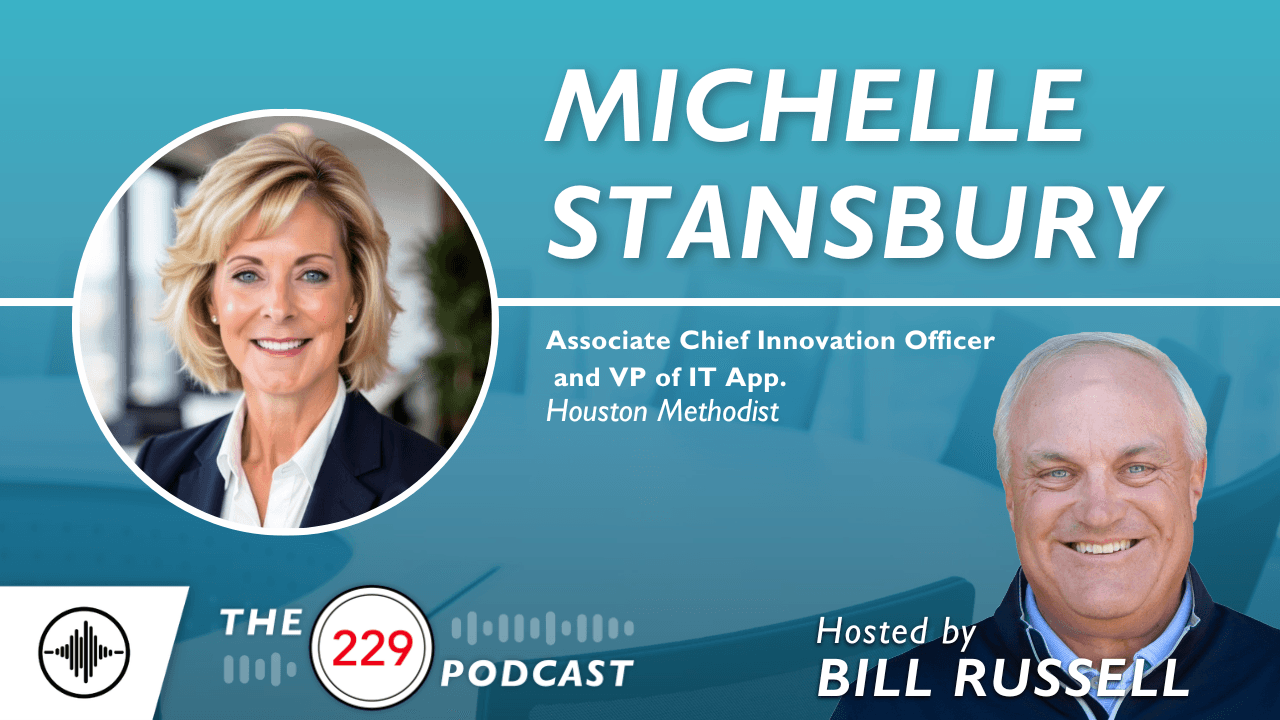
Houston Methodists' Approach to Innovation and Physician Champions | The 229 Podcast with Michelle Stansbury
 Apple Podcasts
Questions Answered in This Episode
- How do physician champions drive adoption of controversial technologies like OR cameras?
- What's the real difference between innovation and change management in healthcare?
- Can AI-powered care traffic control actually reduce patient mortality rates?
- How did Houston Methodist scale pilots across eight hospitals before opening one new facility?
- What evolved from 12 strategic bets in 2021 to 10 intelligent healthcare system bets today?
About This Episode
June 11, 2026: Michelle Stansbury, Associate Chief Innovation Officer and Vice President of IT Applications at Houston Methodist, joins Bill Russell to unpack the health system's bold "Intelligent Healthcare System of the Future" initiative. 10 strategic bets built around the opening of their most advanced facility yet, Cypress Hospital. From RTLS-enabled smart spaces and AI-powered care traffic control to virtual nursing programs that transformed skeptical nurses into advocates, Houston Methodist is rewriting the playbook on what a modern health system can be. Michelle shares hard-won lessons on change management, AI agent governance, token cost reality checks, and why co-developing with Epic means telling them what they need to hear, not what they want to hear.
Keep up to date on the latest in health IT:
https://thisweekhealth.com/news/
Key Points:
- 00:51 12 Bets Roadmap
- 02:48 Cypress Smart Hospital
- 10:36 Care Traffic Control
- 20:09 Epic Partnerships and Nursing
- 33:55 Next Gen Marketing and AI Agents
Donate: Alex’s Lemonade Stand: Foundation for Childhood Cancer
Thank You to Our Episode Partner

Contributors
People featured in this episode — open a profile for more.


Transcript
This transcription is provided by artificial intelligence. We believe in technology but understand that even the smartest robots can sometimes get speech recognition wrong. Today on the 2 29 podcast. Innovation and transformation, technology's the easy part. The change- I- ... management of it is the hardest part of all 📍 📍 My name is Bill Russell. I'm a former health system, CIO, and creator of this Week Health, where our mission is to transform healthcare one connection at a time. Welcome to the 2 29 Podcast where we continue the conversations happening at our events with the leaders who are shaping healthcare. Let's jump into today's conversation. All right. It's a 229 Project podcast, and today I'm joined by Michelle Stansbury with Houston Methodist, Associate Chief Innovation Officer and, Vice President of IT Applications. Michelle, welcome back to the show. Great. Thank you so much for having me, Bill. I'm looking forward to it. We, we got to hang out a little bit at the Houston City Tour Dinner and got to hear some of the fun things that you guys are doing. Uh, we wanted to do a little walk, uh, through history, because you guys, you guys set up, uh, 12 bets in 2021, and we're gonna update that a little bit. So I, I'd love to hear about, you know, how does, how does Houston Methodist, um, really approach this, this, uh, health system of the future, and, and how do you, how do you, how'd you decide on what the bets were in 2021? I think it'll be interesting to look at how they've, they've changed in a few short years. We had a great opportunity back in 2021, 'cause we were building a brand-new hospital out in one of the regions within Houston area. And as you know, Houston is very, very wide, diverse, multi kind of counties, um, and we have a big, huge population that we serve overall within the Houston surrounding communities. But because we had this opportunity with building a brand-new hospital, we sat back and asked ourselves, because we'd been doing innovation, transformation, and so forth, what did we want overall the experience to be for our patients, our clinicians? What kind of operational efficiencies that we think we can get? So we developed what we kind of created our roadmap, and there were really 12 bets, 12 bets for what do we think that the smart hospital of the future should look like when it opens up. So that's three years from now. And I mean, as fast as technology is changing, that's somewhat kind of hard to do these days, right? Yeah. But in, uh, the bets themselves really weren't technology focused, but areas in, within operations of what we wanted to make sure that we were providing, such as overall the smart check-in or no call centers or, you know, many of those other things. And so we... That was really kind of our roadmap. But it wasn't just for that Cypress Hospital, 'cause we have eight other hospitals that, of course, are running. And what we were doing was really finding the technology, piloting the technology. Was it really bringing the returns, whether it was patient satisfaction or clinician or operational efficiencies? So we brought those things in, we put them in pilot mode, and if they worked well, we scaled it across the rest of the eight hospitals before it ever came up at Cypress. So when Cypress opened up, it just was really a culmination because there were some things within Cypress that we couldn't do at our other hospitals, such as in the smart room technology, um, overall with having a digital whiteboard, 'cause most of our other hospital rooms couldn't accommodate that at the moment, yet we didn't put any whiteboards in the room. We all had it digitalized. We had a, um, digital door sign. We had the opportunity for the patients to be able to change the environmentals within the room. Those kind of things are very hard to do when you have an older hospital and trying to build those in. So When it opened up in March of 2025, um, it was just kind of a culmination of all of it. Great technology. There was things that overall that were changing, within that space. But what it did for us is helped us recognize that when you really have a roadmap, it tends to keep you focused on what you believe will happen. And so we asked ourselves, what are we gonna do now, right? We could kind of continue on with keep, you know, expanding and doing other things, but we said, this is really this and not smart. Everything's always been smart, right? It was up until. But now I think kind of with where technology is leading and in this intelligence space, we were like, where do we wanna go? So we created our new intelligent healthcare system of the future bets. It's 10 new bets to help, again, keep us focused on what we are trying to accomplish overall within our healthcare system. So I wanna go through these 10, um, at, at a high level, and then I also wanna talk about what dropped off or maybe consolidated, because 2021, uh, I'm trying to think. So, you know, the big, the big generative AI explosion was a little later than that. Yeah. And it's, it's probably... And, and agentic was being talked about back then. Right. But it's becoming a lot more real. I, I'm curious. Yeah. Well, anyway, let's, let's talk through these, let's talk through these 10, and then we can talk about what, what sort of dropped off or consolidated based on, on the time that's gone by. Yeah. So the first one's really, as to it's in smart spaces, right? So everything has become smart overall within healthcare systems, right? I mean, we ended up creating, putting RTLS across over 11 million square feet of all of our facilities. We put cameras in all of our patient rooms, emergency rooms, the ORs, and into procedural areas. And really we're looking at how can we take that overall into the clinics and into some of our wait- our waiting rooms. So really those- Things that we did for the infrastructure really provided that foundation for video AI. So think about overall from virtual nursing to everything else, where we now can be able to see with having overall the cameras in all the rooms in the ORs, it's... You can begin to build AI capabilities on there. So fall detection, some of the other things. So the, the things that we've been able to gather from those smart spaces, and I will just tell you, the cameras that we put in the ORs, that was really on o- operational efficiencies. It wasn't there for the patients or the surgeons, but it was... We knew that we had a turnover problem, but we didn't know significantly how it was. Because right now, how all that information is gathered is people putting in information within the EMR, right? Right. Well, I get busy. "Oh, I forgot to put when the case started. I forgot to put when the tourniquet started," and so forth, and when it's done and cleaned up. Now we have AI running into those ORs, and so it has been able to produce for us to gain back really valuable OR time, which I'm gonna tell you in the beginning, wasn't real popular with our surgeons. It's almost like I liken it back, I tell people, "How would you like it if I put a camera in your office?" Yeah, that's what I was gonna ask you. I mean, uh, th- so culturally, there was probably some obstacles you had to get over- and conversations you had to... the difficult conversation to have. what was the primary pushback for cameras everywhere? Well, I would say it wasn't so much in the patient rooms. It was in the ORs, I will say. And I, I will... Roberta Schwartz, who I know that you know very well, um, she used to have to tell the surgeons, "Do you think I'm just sitting in my office watching you every single day?" It is like, no, that's not what we're trying to use them for. We know you are always wanting more OR time. There's block time on the schedule that is not fully being utilized, so what we're trying to do is really use the AI embedded overall within those cameras to help us understand how we can turn them over faster. And it, uh, it was a pushback. It was I'm gonna tell you, it, it was a long battle for us, but finally they began to realize when they were getting back more OR time, the efficiencies gained at what we were seeing. So it's now been able for them to see the value of it. And I think part of this overall, we found clearly that overall- Innovation and transformation, technology's the easy part. The change- I- ... management of it is the hardest part of all Well, there's a, there's a trust foundation that has to exist because all of this requires change, change operationally, change in workflow, and those kind of things. And so they have to trust, uh, that everybody's working towards the best interest of fill in the blank, the, of the patient, of the clinician, of, you know, of the health system. And- Uh, you know, some of, some of the projects we've done over the years haven't exactly built on, built trust 'cause we've made some mistakes. But others, you know, it's just a matter of, of telling that story and, and, uh, and then keeping that trust, that trust wall up that says- Part of it- We're, we're not gonna- So- We're not gonna sit here and watch everything ... you're, you're, uh, you're absolutely right. But, uh, I mean, I think the way that we approach innovation at Houston Methodist, it's not just a core group that's working on innovation, but these are individuals who come from operations, who come from IT. We have physicians, we have surgeons that are overall our champions to help us move things forward, right? To be able to tell that story of why we're doing it. We're not just doing it for innovation's sake. There is a whole reason behind it. Yeah. Um, and part of this is overall to help you as a surgeon to be able to get back more OR time. So, you know, I, give credit overall to our physician leaders who help us along the way in some of these things that we're doing. Um, If we did not have them, we probably wouldn't be where we're at today. And if we didn't have the operational leaders who are helping us drive the change. I would tell you virtual nursing, if we didn't have our chief nursing officer helping us drive this across the organization, I mean... because virtual nursing when we very first started, the nurses were like, "What are you trying to do, take my job away from me?" No, we're trying to give you more time back to the bedside to the patient, right? So I, think that is kind of key that's been overall helpful for us. And because when we find value-added transformational solutions, we wanna scale them very quickly. I'm, I'm gonna skim over a couple of these. So connected virtual care, uh, remote monitoring, these are, these are core items for most health systems. Yeah. Talk about care traffic control. Yeah. Well, kind of what we were looking is that we needed a new way to really create capacity for our clinicians in the hospital. So, uh, what you can't see is we created overall, um, our virtual operations command center, right? So it is a way, and also too, we're using technology such as a bio button that's capturing overall vital signs instead of doing the vital, traditional vital signs the way that it was happening. So when you take this and you do the culmination of all the data that is being captured even by our, in our ICUs, in our EDs with some of the camera technology, what the programs have done is they have AI that's embedded in them to, nudge overall the clinicians of when a patient is starting to deteriorate. Right? So it is looking at overall how in that care traffic control process within our virtual operations command center that really helps to drive when the patients need higher level of care, what else, you know, it... Does a clinician need to, you know, get onto a virtual camera to be able to see what's going on with that patient right at that moment? Maybe they're in a patient room and they need to get de-escalated into an ICU. So what we t- talk about in care traffic control is using the data, using the AI, using the video capabilities that we have to really get patients the service that they need at that moment. So I will tell you, using the data and this approach that we've had, we've been able to reduce our mortality and more intelligently and really moving our deteriorating patients to higher levels of care within the organization. And right now, we have got, because of all of this, we have got the lowest mortality comparison to overall in the Visi- benchmarking cohorts. So we believe that having this, we can extend it even beyond further than what we're doing right now. So stop and thinking about home, home care. Where are those patients that we could potentially keep based on all the technology that we can use in the AI, that we can keep them at lower levels of care in the home or maybe an urgent care center, instead of always continually coming to the ED or having to be an inpatient. So think it holistically and which is what we're trying to drive overall with building overall this technology in place. Yeah, it's interesting. I'm, I'm looking at these. So sm- smart spaces, connected virtual care, remote monitoring, care traffic control. So those are, those are related and linked. They are. And, and it, it goes outside the four walls of your health system. Um, but I would imagine it's, it's, it's more, uh, f- it's more focused, it's more, uh, I don't know, layered within the acute care setting, and then it gets a little, li- little less 'cause the, the technology, um... I don't know. Is the techno- would you say the technology is there for home remote monitoring and, and those kind of things? No, it i- no. It is not as mature as what it is overall within the inpatient setting or, you know, in those areas. But what we've seen, and I will tell you, a lot of people when they were doing hospital at home or remote monitoring, a lot of those were really focused in on value-based care, right? And how do we keep you out of the hospitals? What we wanted to do, because Texas is a still big fee-for-service state, right? We wanted to learn from all the technology. So we built all of these things internally in the, you know, hospital itself, from the virtual care to the remote monitoring and so forth. So now, once we... And we have a big, huge virtual operations command center, which it is everything is being monitored through, um, different algorithms that have been built in overall to monitor patients on their acuity. How are they doing? Are they deteriorating? Plus virtual. Virtual, I can go in to overall a patient room. If I'm seeing something overall from the bio button that shows me, oh, there may be something going on with this patient, they can beam into the room, talk to the patient, be able to see if there's a problem, and then notify overall the bedside nurse or a clinician, a physician that needs to get to that patient right now because we, we believe we're seeing something that overall is not quite right. So but if you take all of that and thinking with that virtual operations command center, now think about how you can take it outside of the, the walls of the hospital. Maybe we have somebody that comes into the ED. We've placed a bio button onto them. We don't feel that they're- In need to be hospitalized, but they could probably go home with overall with us being able to monitor the data that's coming off of that bio button You- your- do your specialists utilize the ability to beam into the room- Yes pretty extensively? Yes, they do. We have a lot of consults. We have a lot of specialists. I mean, we started off with our virtual operations command center really in our ICUs, and it really was purpose-driven. Um, hospitalists and intensivists, right? It was very hard for us to staff all of our, our hospitals at night. So that's how we were able to accomplish it, by overall having these, um, different algorithms built in overall that we have staff that are monitoring them overall during the night. And if we believe that there was a potential deterioration issue, the, the intensivists could log in, look at that camera, and I mean, get down to very specific of just seeing, okay, what's the medications, what's going on, to be able to determine if there was a higher level of care that was needed or something that they could just make a minor modification on. So learned from that. Gone on to our virtual care within all of our hospital rooms, which is where we put virtual cameras in every one of our patient rooms across our hospitals. So started off with admit and discharges. Now it's a rounding. Now it's something where consults can be done. So we call it our virtual care highway. Now that you have the highway, just stop and think about what else that you can keep adding on. We added telestroke, telepsychiatry, hospitalists being able. So that's how it is. Had a program. Now it's overall how do we continue to expand that program across? And now we're even being asked by some other organizations, could we potentially help monitor some of their patients, maybe at a smaller institution? So we are experimenting and thinking about that as well. But again, what we value and see with, we learn from is not just what we're doing at the moment, but what are the other possibilities now that we have it? Right. Yeah, once you put that infrastructure in place. Um, I'm gonna ask you about Smart Chart only because, um, uh- J- put a smart in front of a word and it's, I mean, are, is it agents? Is it just a set of analytics? Is it, um, you know, models? I mean, what, what, what makes a chart smart? I think it's because, which if you're looking at, and this is overall, you know, the EHRs have come a long way. There is overall with the ambient intelligence that you get overall, this is where it is of using the chart, the right algorithms, the right data to be able to nudge to give physicians the information they need much s- sooner, instead of them having to go and search and find it. I mean, the other place overall within that chart, how is it helping to be able to determine based on what you're seeing overall from the patient, here's the recommendations overall of what else may be needed for this patient? So it was a way for us to be able to look and know firsthand what's going on with the patient, and how can we correlate it with all the data that's overall within that chart to help drive better intelligence and decision-making in the care that's needed for that patient at the time. Yeah. So its cousin on this chart is clinical intelligence. How, how does this all work together? Well, that was the other thing. So stop and think about, um, visual imaging and, uh, overall. So when you start to take everything that is available now, because we're bringing in overall another solution that is allowing a radiologist, a pathologist, a cardiologist overall an image, right? And this one's somewhat been around for a while, but I think it is becoming much more mature now that you might have come in just for a basic CT on something, right? But overall, now, how can I use other data within overall in the chart and that imaging that can potentially see other potential issues that are, that a clinician, a radiologist or whomever, it, it's bringing in that clinical intelligence with all the data to determine there's a possibility that you need to be looking at something else other than the one thing that you came in for. So that's where we believe that the intelligence overall that you can see within the vision-based imaging, specialty support, overall from the other care that's... 'Cause you could've come in five years ago for something else. Does all of this now pertain to where potentially you can see other issues that are going on? And that's where we believe that overall, where it used to take a clinician based on research and looking at everything, taking them much longer to determine what's the possible next steps, it's now being done overall within seconds, you know, combined overall with kind of, you know, that competitive nature. So I think it's overall getting clinicians to understand the power of the data that they have with them to be able to make those- clinical decisions much faster. You, you have a history, or Houston Methodist has a history of really innovating, getting out in front, building things. The build versus buy, you guys probably lean in the build side more than most. Well- I, I wouldn't say it's a, it's a primary for any health system, but it's- Correct ... more than most. But these two, clinical intelligence and Smart Chart, how much are you d- is it you're, you're utilizing the tools that Epic is, is rolling out and informing them on what you need? Well, I'll, I'll give you an example of going back, and we do push the envelope Back when we kind of started five years ago, six years ago, there wasn't as much embedded overall within Epic as what we wanted to see. So we did go out and get sort of bolt-on solutions to be able to help us. Where we've seen is Epic is coming quite a long way. So if Epic can provide overall the intelligence or the experience that we want for our patients, we'll use it. But if it doesn't, we will continue to go out and look and push the envelope with kind of other vendors. And what's helped us with this is that Epic is now looking at us as true innovators, and so they're coming to us to overall to give them overall feedback on new products that they're developing out. And I'll give you an example. Um, ambient intelligence. We've been doing it overall for a while with our physicians. But we have been probably for three now, three years now, of really trying to push the envelope for nursing because they just have as much of a burden on documentation as our physicians do. And we'd searched, probably like I said, for years and really tried to push to other vendors, and they just weren't ready to get into the space. And so we finally got Epic. They were already coming out with their product, and so one of the things that we're doing is piloting out at Cypress overall at our hospital because they are very much, you know, in line of trying to take the latest technology that's there, um, to use it, provide the feedback because the way that nurses document is completely different than a physician overall. And so they're learning, we're learning overall of how well, you know, that the product is today and how can we give them feedback so that it works not only for us, but will work as it's kind of going forward. We did that for overall our digital whiteboard. So if you think about overall in the patient room, nurses come in, they, you know, during their shift change, who are they, what, you know, who's your clinic team, how are you feeling, so forth. What we did was we got rid of that, and we had a digital solution with another vendor. And I'm gonna tell you, it was slick. Loved it. But it was very expensive. So, um, Epic had a solution, but it was not really ready yet. But I will tell you, and, and this is where Epic's been really good with working with us, um, they... We, we asked them, "Well, would you be willing to give us, give you feedback, right, overall to help make that solution better so that we could open up Cypress with your solution?" So it's their MyChart bedside TV solution. And, um, we did. We had two months. And I give Epic credit. They sent developers down here with us into our innovation tech hub. We worked with them overall for a month. Um, and were able to bring up overall that solution at our Cypress Hospital. But that's what they've seen, is that we're willing to give them feedback and sometimes it's not so much what they wanna hear but what they need to hear, um, in order to make solutions better for overall for hospitals and clinics, and you name it. So that's what's been beneficial for us. Now You talk about buy versus build. Um, and we'll probably get into it when we get into the agentic AI space. But, you know, what we have found is our sweet spot is we look for companies that have a solution. It's not an alpha product, it's probably a beta product, or they have it someplace on another small health system or a hospital, but they're looking for a really big health system like Houston Methodist to help them further refine what their product can do. Um, and that's where it is. We work overall with them so that we can make it work for us, and if they know that it works for us, they can make it work for other health systems as well. So you, you sh- you shape their roadmap along, they, uh, along- We, we try to make sure that it works for us. And what we also do very well is not only look at the product itself for what it's doing today, but what are the other possibilities? And many times it was, "Hey, have you ever thought about building this into your product? Have you ever thought about doing this?" Um, and that's what's overall kind of helped us to keep driving overall that digital transformation and, and really innovative solutions within our overall health system. Do the cameras help with the nursing documentation? Is, is nursing more physical than, say, the physician who comes in and, and speaks? I mean, what, what makes nursing so hard to- What we were trying to do was... And we've actually even changed our model for nursing because n- nursing was really on the bedside care coordination and what and so forth, and virtual nursing was kind of sitting off up here, right? They were just doing admits and discharges. And what we've been able to do is give nurses time back overall to do the more difficult things that they need to do instead of, oh, a patient, you know, they're calling in because they, they wanted to know when their next medication was or how are they doing. So now virtual nursing has just become a part of overall nursing care at Houston Methodist. So as I said, it's not only just the admits and discharges, but it's also overall of just virtual rounding. Let's round on all the patients. Let's see how they're doing. Is there anything more that they need? Um, or it is just the, they have questions overall that need to be answered. The virtual nursing is there. But what we've seen overall, what we're trying to do on the documentation side was The virtual nurses can document in the chart as well. It's not just overall the bedside nurses. So that helps. So if the bedside nurse needs to see if there was something that happened with the virtual kind of visit with virtual nursing, they can see it overall that's in the chart. But overall, what we've seel- still seen is that nurses are still spending. They will... Because they're not able to document real time, right? Just overall from a virtual perspect- or from a, a voice perspective, is that they'll talk to the patients, they're still writing things down, or they're documenting in the chart while they're there, but they have much more that they need to. And so they're spending their end of shift, whatever, trying to go back and finish documentation. Where we've seen is that overall They'll have the opportunity, just like the physicians do today within the clinics. Their, as you know, pajama time has drastically declined because overall now the charts, it's being captured overall just from having the visit overall. That's what we wanna try to capture, and that the vir- that the nurses themselves too can overall use the voice commands, documenting in the flow sheets of what they need it to. But the other piece overall, if you look, it's not just virtual nursing, but if our virtual pharmacist, right? If they need to get into to talk to the patients about their medications they're being taken at home or what it may, whatever it may be, that's where the virtual side of the house is just really growing exponentially. Respiratory therapist or physical therapist or whatever. If you can think about overall if there's things that you don't have to do at the bedside that is still giving the patients what they need, that's where the virtual services is coming overall in place. Business modernization, I assume, is, uh, things like coding, prior authorizations, all that. I mean, it's all that, that workflow behind the... I, I know I just took a massive thing and just made it into a little- No ... nice little- No, no, no, no. You're absolutely right. Business... And some of those things, right, we're already doing. But where we were kind of talking about it was we just recently went live with the new ERP system. I mean, we had one that was older, it was kind of on-prem. We had done a bunch of bolt-ons because it wasn't really, you know, being enhanced because it was an on-prem product, right? Everything's going cloud today. But because of that now it is, we're seeing lots of overall possibilities that go in, could go in business modernization. But yeah. But the other thing is, you know, where we look at too, stop and think about... 'cause we're really looking at how can you begin to use overall delivering critical medications, right? Is it overall drone technology and things that you can begin to use? So we're not just thinking about internally, but where externally overall it can help us as well. Um, but yeah, that's part of overall business modernization. Well, y- you have next gen marketing here and AI agents, and I wanna... We're, we're, we're gonna probably end on agents, uh- Okay ... 'cause I wanna ta- I wanna talk about that as infrastructure. I, I, and everybody wants t- to hear about that. Um, I, I'm curious though, with, with all of these things, the... You know, one of the challenges, challenges with being early, and we get into this conversation when people are building a new building. I, I talked to Ohio State, talked to others- Yeah ... that building new buildings. It's so hard 'cause you're planning, and the building's not gonna be built for three years Like, when you think about the pace at which technology's moving, and my question to you is a little different. It's, it's how quickly are you generating tech debt because you decide to be early adopters? And does it require a culture that just says, "Look, when the right thing comes along, we're, we're willing... T- the opportunity costs, all those costs, we're willing to swap it out for the thing that's gonna provide the best, uh, outcome?" Value. Value and outcomes. Here's what I tell you. We don't do innovation and technology for technology's sake. I mean, anything that we do build has to have an ROI to it. I mean- But, but, but a, a great example is you put cameras in all the rooms. Mm-hmm. Over the last three years, that has advanced dramatically. Do you find yourself looking at it going, "Oh, man, we don't have the right cameras for today. We're gonna swap those out"? That's, that's, that's the thing. I think people are concerned about making... Those are big bets. They're expensive. They are big bets. And I, I mean, and I will tell you, the thing that I had, we have explained overall is you ha- you have to go back and you stop and think about your... 'Cause we created our own IoT network, um, the other thing with all of this, because we didn't want everything on our production network. You have to make sure overall, right, that you're not bringing down other systems with some of this other, um, with running other things. But because of that, and I know you've been a CIO before, stop and think about some of your older hospitals. They didn't have, they didn't have the infrastructure to support all of this. So we have done... I, I, I told you we started off in our ICUs. That's really where we started off with our virtual services. What really sort of culminated and really began to have us thinking more broadly was COVID happened, right? So the same technology that we were using overall within our ACUs, we could use it on an iPad. Well, all that we were using it for within the patient rooms was started the process of virtual, virtualized services, right? You had clinicians that could overall talk to the patients, not having to gown up and everything else. You had patients that could talk to their family members. So it was all done on iPads, right? So now we said, COVID kind of went away. We're back overall to getting some sort of normalcy. Well, then you couldn't hire nurses. Nurses were all leaving because of COVID, right? Right. And so how could we take some of the, the burden some off of our bedside nurses? And this is where Roberta... I mean, I love her to death, love working with her, but Roberta was like, "What can I do?" And I think there was one other institution that had been thinking about virtual nursing, and maybe they started off with a pilot. And she was like, "I have the technology. I have the iPads in the room. You know what? I'm gonna take two units, and, you know, for a short period of time, I'm gonna try to do a virtual nursing program." And that's where I told you, the nurses were like, "What? No." Right? It is, "That's my job." And it was like, "No, no, no. We're just gonna start off with admittance and discharge." You're, you're gonna find Roberta tied up in a closet someday and be like, "What? What happened?" Yeah. But, but, so you know what? Within one week they absolutely loved it. We could see overall what the value was, but that was with iPads. And then it is, how could you stop to think about that further? And this is where you're actually looking at newest technology coming out, um, with having virtual cameras and having it go through the TVs and having the audio that was there. So yes, we quickly kind of looked at the different vendor space around. We chose a vendor after we piloted it in a couple of units. Overall, having, uh, the TV be with the camera, kind of like you and I are doing right now, right? It was like, "Okay, it's working. Well, let's expand it across our institution." So we do learn. I'm not gonna tell you it was smooth. I mean, one of the- Yeah ... one things of learning out, who would have... I mean, let me ask you, back, way back when, did you have standardized TVs in all of your patient rooms? Oh, no. Oh, heck no. So, no, we had to go through that. Lessons learned. Did we have the right infrastructure? No. Had to go through that. It is, oh, the audio wasn't quite working right. I mean, I can't tell you how many different devices we hung over the bed or up against the wall or whatever. Um, in your isolation rooms, you had so much of the noise. Yeah. So it was a learning curve. It wasn't like we put it up, it all worked seamlessly in the beginning. No, it did not. I wanna stop for a moment on next gen marketing. Um, I am on the record as saying nobody markets worse than health systems. It's like, um- I agree ... you know, buy the big billboards, sponsor your local baseball and football teams. And- Mm-hmm ... uh, but for the most part, um, the stuff I get in the mail, the stuff I, I... It's hard to find them on the internet when I really need them, and now we're finding them through AI agents. How are you- Mm-hmm. What... How are you thinking about marketing? What does next gen marketing look like? Well, and I will tell you, this is probably one of the more newer things that we are working on now overall with our marketing department. And you're absolutely right. The way that people are finding information about health systems, physicians, scheduling appointments and d- is completely different. I don't know that anybody's paying attention to the stuff that comes into mail these days. I mean, and so how is it that we are using the right, um, technology to really target those patients, right? So that they know, they know about Houston Methodist, they know about our quality, they know about the services that we provide, all of our specialists, and we're making it easy enough for them to be able to get scheduling pa- scheduling their appointments with us. So it's not just about marketing, but then also how are you using the data and the technology to target, right? Overall, it's time for your annual mammograms, it's time for your annual, you know, appointments or whatever. Um, so it is a whole segment that we're looking at because traditional things, they're gone. And, and- People are not paying attention to them anymore ... is this patient-focused or is this consumer-focus- Like, could you- Both. Both. It's both. Got it. It is both. And, and this is where overall, and we'll get into, to the agentic side of the house, but, you know, I will tell you, I just, I saw a presentation, it was a keynote that was done by Laura Webb. I mean, she's phenomenal, but, um, she's talking about, you know, we've got the next generation of the patients, right? Patients are using AI to determine, "Oh, this is what... I'm putting in all this information and it's telling me this is what's wrong with me and this is who I need to go see," right? So our clinicians are being bombarded with, "Yes, I came because this is what, you know, ChatGPT or whatever told me that was wrong with me." And, you know, or, or they don't even say, they're just kind of showing. So our clinicians are having to rethink, mostly our physicians, you know, on how they're dealing with these new patients coming in these days who's already self-diagnosed themselves over all of what's going on with them. And but this is where it's overall, yes, it's targeting consumers, right? It's tar- And if... I know you've been to Houston and you've seen this big, huge Texas Medical Center that is a combination of not just Houston Methodist, but many other organizations, right? And so how do you get those patients to understand and get the information they know about Houston Methodist and what services we provide, and how are we making it easy enough for them to be able to get services from us, and not three to four months from now? So it's all, it's marketing overall to consumer, because a lot of people are moving in to Texas from other states. Um, we have a big influx of new individuals moving in here that may not even know about Houston Methodist Yeah. It's, uh, yeah, it's definitely one of the fastest growing, uh, populations in the country. Um, all right, AI agents. People have stuck around this long just to hear us talk about AI agents. I assume you guys are approaching this methodically. You were thinking about governance, you're thinking about observability and transparency. You're thinking about, uh, measurement and ROI. Uh, give us an idea of, of how you're, how you're thinking about AI agents and how you're approaching it. Yeah. Well, I will tell you probably the past couple of months, um, there is a small group of us that have been really working on what is our strategy, right? Um, how are we going to use AI agents? I mean, we believe that there is a lot of opportunity across our organization, but we wanna do it the right way. And I will tell you, um, AI agents, and hopefully none of this, uh, doesn't offend anybody, but I think it's the new sexy thing everybody's talking about, right? Oh my gosh, we've gotta get into, you know, using agents. But I don't know that agents is right for everything, and that's why it is that we are trying to really think through what do we want to do. I mean, we've been doing RPA for years, and I still think there's a space for RPA, right? Just of automating a process. Does it need to be done by an agent? I don't know. So we've kind of created our framework of what we're going to look at. We're creating the right governance. We already have AI governance, but we're gonna kind of create a segment off of just agentic AI governance. We've created where we need people to think about, what do you think you need an agent for? What's the process that you're trying to have the agent, um, automate? What is the data that's behind it? What is the outcome that you're looking for from the agent? And what do you expect the ROI to be? Because I think a lot of times people are just wanting to- L- let me just put an agent out here to be able to handle this process, but is it really not bringing any kind of return? So, I mean, what we have said is we're not going to just put agents out there just because it's the new thing and everybody thinks we do. We need to methodically think, what is it benefiting? Is it helping us to reduce overall staffing? So is it overall helping us to become more efficient? So I'll give you kind of an example of what we're doing now with an agent, and, um, it's over in our call center. So these are our existing patients that are calling in to schedule an appointment. We've got agents now that are overall making sure they have the right patient, what appointment are they trying to schedule, what are the dates and times that they would like, the agent providing that overall information back to the patient, helping them kind of navigate the right date, time, everything, and then scheduling the appointment and sending over all the reminder out and with overall in a text-based solution. That's all being done with no human interaction. Now, what did that help us do? It's reducing overall our call center staff. So, or, and this is where we've got to be very careful because we recognize so many people are worried about their jobs. "Oh, my gosh, is my job going to be replaced?" Maybe now you're using that call center a- that call center person for the more difficult, Yeah, follow-up, follow-up, uh- Follow-ups where I've got to make- Dis- the discharge, discharge visits and, yeah multiple appointments or whatever it may be because I'm a cancer patient and I need, you know, to make multiple different... I need to get a lab, I need to get in to get a scan, you know, and then, oh, follow up with the physician. So that's where it is of just making sure that we're doing the, the right things overall for our agents. The other thing is what we're trying to decide, Bill, and I will tell you, is do we buy, do we build? And we think it's a combination of both. So we're already having... We, we've taken overall our RPA team that we had that was building out automations on a solution, and they're gonna move over to be our agentic AI team building solutions for us because what we've seen, and I'm telling you, we've looked across, you know, there is- Kind of the niche vendors overall, let's just say Epic and Workday and ServiceNow and some of the others that have their AI solutions. But they think they're gold. I'm like you know, what they're trying to sell to us. A- and I'm like, "I, I can't see a return on what you're wanting to charge for us overall with this." Yeah. But then you see other sort of overarching vendors, um, who kind of will dig in overall to, you know, in each one of those niche solutions to be able to help you build the agents, or allow our own individuals to build. But the other thing that I'm trying to educate people on here at Houston Methodist, um, and we're getting ready here in the next 15 minutes of meeting with our DIOT team, um, because they have vendors reaching out to them all the time. "Oh, just, yeah, I'll, I'll build agents for... I'll do it free. You know, I just want you to be able to see what it can do." Nothing is free. I'm like, there's the consumption model of what overall the tokens that they're gonna charge when things go into production, and what is that going to cost? And, "No, no, no, Michelle, it's free." I said, "No, there's never anything that is free." So, you know, it's overall kind of educating others of what's our strategy, what do we wanna make sure that we're doing, how are we evaluating each of these solutions? Is it something that we'll build ourselves? Do we wanna take over all the models of things that have been built from, you know, kind of these other niche vendors, and what's the cost? You know, Michelle, I, I wrote tomorrow's article, uh, right before I got on the, on the call with you. Tomorrow's article I talk about the fact that I spent $1,000 on tokens this week. It felt to me a little bit... You remember, like, you went, went and played skee ball or whatever at those things? Yep. And you'd get tickets, and then you'd walk- Kinda did ... and then you'd walk over and you'd, you'd go, "Oh my gosh, there's nothing here worth anything. Like, I just spent $40 to get these tickets- Yeah and I got a $5 trinket." Um- Mm-hmm ... and I, I think the, the, the whole token thing feels a little bit like that. It's like we should start- Yeah ... at the desk and say, "What do we want? This." Mm-hmm. " How much am I willing to spend for this, and what's the return?" And I, I'm not sure, I'm not sure we're, we're doing that. It, I, I appreciate you saying, you know, you're looking at all the, the platform vendors and saying, "Look, you know, this is the outcome I'm gonna get, this is what it's worth to me, and this is what you're charging me." Right. Like, bring, bring these in line and I'll sign the contract tomorrow. Bring... Don't bring these in line and it's, it's, uh, you know, that's how you make, uh, informed decisions on, on where you're going to invest your time. It's- I, I agree. I'm just gonna tell you, I think everyone's still struggling how do they price this out, right? Because it- Yeah ... it is... I mean, I don't... Did you see the article here recently with Uber where they were like- Yeah, we- ... you know, they'd spent their whole 2026 budget already of what, you know, on their- Four, four months, and then Microsoft shot, shot their wad in five months. It's like, wow. Right. A- a- and that's the reality of what we're living in, right? Which is kind of, you know, Roberto and I just had a discussion about it this morning. It is we had thought we would buy sort of 80% and 20% we'll build. I don't know. We may be changing that around because maybe we can build it better ourselves, but we still have to look at this overall token methodology and what it's going to cost us. And, you know, um, it's a fas- it's a fascinating world. I am just, yes, I am- It is ... really appreciative and glad I'm able to kind of work and do this, but I can't wait to see what the outcome's gonna be on all of this It, it is a, it is a fun time to be, to be looking at all this stuff, and I think we're gonna be, um, we're gonna be talking about agents for, for quite some time. We're using them extensively over here, but, um, obviously you guys have a regulatory environment that's a little- Yes ... um, that re- requires the, the level of governance. It's one of the things I liked about when, at least when I read about, um, uh, Epic's Agent Factory, it seems like they, they put the, the whole governance first and then- Yeah built. Um, so I mean, we'll, we'll, we'll see where that comes out, and I'm gonna do, uh, an interview with them here shortly just on Agent Factory, so that, that's how I get my... Yeah, they come to you and talk to you about it. I have to, I have to actually call them and get the interview. You really try to pull it, pull it out of them. Yeah. Well, I have to tell you, uh, you know, on... I'm gonna give you a plug here, Bill. I so appreciate your articles that you put out. I mean, I am always fascinated, you know, to kind of keep up and, you know, uh, I've seen so many parallels with the things that you're talking about and the things that we're dealing with over here with Houston Methodist. So really appreciate the time and effort that you all put in to putting out that content. Well, I, I appreciate it. I was fishing for that, so I appreciate you, uh- ... doing that. Um, well, Michelle, thank you for, uh, taking the time. We will have to, uh, put this on the schedule and keep revisiting it, 'cause you guys are, uh, you guys are moving fast and it's, it's fun to hear the things that you're doing at Houston Methodist. Well, thank you for giving me the opportunity to kind of tell you what we're up to. Thanks for listening to the 2 29 podcast. The best conversations don't end when the event does. They continue here with our community of healthcare leaders. Join us by subscribing at this week health.com/subscribe. If you have a conversation, that's too good not to share. Reach out. Also, check out our events on the 2 29 project.com website. Share this episode with a peer. It's how we grow our network, increase our collective knowledge and transform healthcare together. Thanks for listening. That's all for now.