The First Acute System on Epic Orchard | The 229 Podcast with John McDaniel
 Apple Podcasts
Questions Answered in This Episode
- Why did recruiting and educating an Epic team fail for a rural system?
- What does Orchard change about third-party contracts and upgrades?
- Why replace an RFP with discovery?
- Where did about $36 million a year in undercoded care show up?
- Who has the authority to say no to an AI tool?
About This Episode
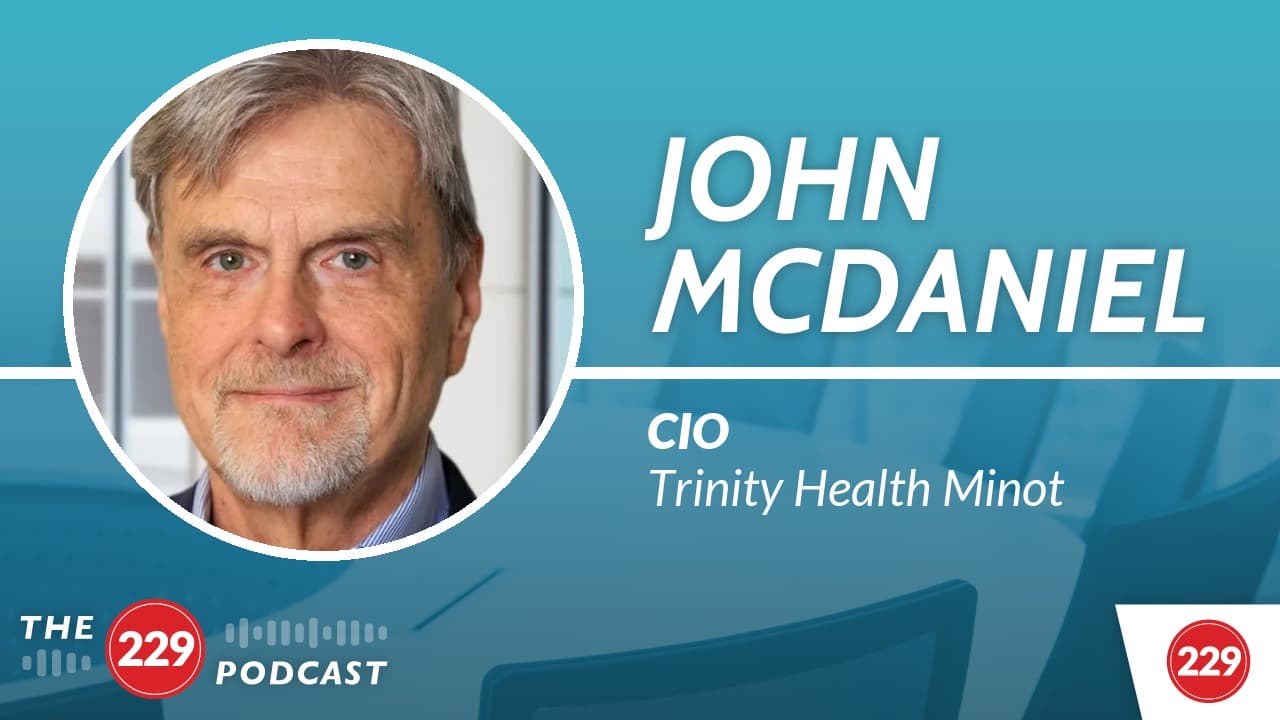
October 1, 2026: John McDaniel, CIO at Trinity Health in Minot, North Dakota, sits down with Sarah Richardson. Trinity is the first acute system on Epic Orchard. The region is rural, about a 120-mile radius, and recruiting and educating an implementation team was the hard part. Epic handles the third-party contracts and the upgrades. Discovery replaced an RFP. More than 300 people, about 10 percent of the organization, took part. John says 97.9 percent chose Epic. He also says undercoded care was about $36 million a year. He chairs the AI council and can say no.
Key Points:
0:00 The first acute system on Orchard
4:16 Luma Health
5:32 Epic handles the contracts and the upgrades
7:38 Clearsense
8:26 Discovery instead of an RFP
10:02 A 10-year case approaches a billion dollars
10:29 About $36 million a year undercoded
13:06 Data owners sign off
13:58 The AI council can say no
16:03 $5 to $10 per encounter
19:43 Use the enterprise as an extension of DTG
Donate: Alex's Lemonade Stand: Foundation for Childhood Cancer
Thank You to Our Episode Partners



Transcript
This transcription is provided by artificial intelligence. We believe in technology but understand that even the smartest robots can sometimes get speech recognition wrong.
The First Acute System on Epic Orchard
[00:00:06] Sarah: Welcome to the 229 podcast. Today we are joined by John McDaniel, Chief Information Officer at Trinity Health and Minot, North Dakota, where Trinity is an independent nonprofit health system serving communities across northwest and central North Dakota and eastern Montana. John is leading an unusually ambitious period of transformation, a move to Epic being the
[00:00:28] Sarah: first acute health system to do so on Orchard, which we will talk about, a parallel workday implementation, and retiring more than 100 legacy applications, all the while the development of a practical AI governance model. John, you've got over five decades of technology experience in a career that began at NCR in 1977.
[00:00:51] Sarah: I love this because it's a refreshingly operational view of what transformation really takes. Welcome to the show. Thank you. It's a pleasure.
[00:01:01] John: Be here. Always great to chat with you. We always love
[00:01:04] Sarah: chatting with you. You and I got to be together at an event in June, and I said, hey, you have to be on the show. And you said, well, I got a lot going on. So let's figure out what makes sense. Well, here we are in September. Finally having this amazing conversation. And I do want to start at the beginning. You have worked in Enterprise Technology since 1977. You have served. served as both a CIO and an advisor. I want
[00:01:25] Sarah: to know. What has that long arc taught you about what truly changes in a transformation and what remains, what I'm going to say, is stubbornly human? I think
[00:01:39] John: that's a great question. And I think when you look at the biggest concept I've grasped through all my years of experiences, I can't chase technology because I'll never. catch it.
[00:01:53] Sarah: It's moving at such a rapid rate, which I think is a really important
[00:01:56] John: point in understanding how health systems will deploy technologies in the future. Because if we think we have the answer today, it's likely to change in two or three years. So we, it has really taught me the importance of being able to connect with other applications, with other systems, be able to share information in
[00:02:16] John: a non-fragmented way to ensure that what I'm looking at is the most actual to date information available. I think if you look at how I start, I start with one right systems. If you're familiar with those, it's carbon copy.
[00:02:30] Sarah: And went through a number of
[00:02:33] John: iterations of technologies leading to where we are today with some of the more sophisticated robotic AI tools in the industry. It's moving faster,
[00:02:45] Sarah: though, than it ever has. At a conversation with somebody this morning and I said, it used to be fun to go to work every day. It used to be not easy to go to to work every day, but people sought
[00:02:53] John: you out to solve the problems that they had
[00:02:56] Sarah: and you go and you meet with them and you chat it out and you literally go implement the technology that solved it. It's different today. There's the span of a CIO, the integrations, the cyber elements. So many of those factors are at play. What today can bring joy to the role of the CIO? I think
[00:03:14] John: that's also a really good question because there's not a lot of joy in the CIO world today. I think we,
[00:03:21] Sarah: we, We have to celebrate our small wins.
[00:03:25] John: I mean, one of the things that we did, and I know we'll talk about it sometime in the future is the really non-traditional approach we've taken here around the whole concept of digital transformation. We kind of threw everything out, not literally, but figuratively, and said, okay, if we had an opportunity to reinvent,
[00:03:43] John: to reimage everything, where do we start, how do we get there? So that's kind of the process we remember. So what makes me the The happiest about is actually working for an organization that's allowed me to start with a blank sheet of paper and create the roadmap for the next five to 10 years within this organization, understanding I've got no view into what five years is really going to be
[00:04:06] John: like, and I've often said in a number of my presentations and papers is the next five years is going to be more dramatic change than the first 50-some years in my career.
[00:04:55] John: I believe you
[00:04:56] Sarah: on that one. You'll argue if it's a fourth or fifth industrial revolution facing us today. But it's going at it, like we had time to absorb everything else. Now things are happening all around us. You're still pioneering new ways to go about managing a health system appropriately. You have already done your workday implementation.
[00:05:17] Sarah: You are getting ready to go with Epic next. And you still are. And yet, you've taken
[00:05:23] John: a different approach. You've said, hey, I need to rethink about
[00:05:28] Sarah: the geography and the alignment of what is really important to my health system. And you've chosen to be the first acute care facility, your health system, to go with Epic Orchard. Tell us about that. Yeah.
[00:05:41] John: As we were in, and we were heavily engaged in the middle of the initial implementation with Epic true foundation models, close to foundations we could possibly be. We basically set a standard of 98%. We got into, we started the building process. And, And it kind of just hit me because we're having difficult time recruiting,
[00:06:01] John: different kind of difficult time maintaining different type, different challenge of educating people. So what we decided to do is go back to up and say, look, great product, absolutely great product. But your implementation methodology is very owners for organizations our size. Primarily rural, you know, with probably 120 mile radius of the only hospital,
[00:06:26] John: largest employer in this community. So finding resources was a real challenge. I said, how can you help me out? How can you help me get to the end as a true partner? And they actually came back and they said, hey, we've got this concept we've been thinking about for a while that's really consistent with what you're thinking is. Would you sit down and talk to us about creating a new implementation methodology, which is what it is, still all based on
[00:06:50] John: foundation? That would be SaaS-driven. So they're basically not taking it as is. And I made a decision, look, look, look at how many hospitals installed? They probably got it pretty right. we'll go through that process, evaluate and said, we'll definitely move forward with Orchard. The intriguing part of that is, for those organizations that have used Orchard or
[00:07:14] John: not Orchard, but Foundation in the past, the third-party contracts are a nightmare.
[00:07:20] John: And it was extremely true. challenging to us. One of the benefits of Orchard is they will handle the negotiations and management of the majority of the third party contracts. And they'll also handle all the upgrades.
[00:07:36] John: at the end of the day is very, very much a no-brainer.
[00:08:17] John: Well, and I'm curious,
[00:08:18] Sarah: I definitely want to have a conversation with you post that whole experience as well, because you're going to be setting the ground for several others to follow. But you've also rejected a conventional vendor-led selection process in favor of discovery first. I mean, vendors spent time inside departments. Your team has thin-slice workflows
[00:08:36] Sarah: down to root causes. How has that also changed both the decision and the organization's ownership of it? Well,
[00:08:43] John: but basically that put the ownership in the hands of the organization. So we had 90, we had over 300 people involved in the selection process, which is, you know, a good 10 % of our organization and what did is, as you alluded to, is as opposed to writing RFPs, in my career, I've probably written 1,000 RFPs. And you get the same responses
[00:09:06] John: back. Everybody checks the box. Yes. What does that really mean when you've checked the box? So we actually asked those three organizations to come in and say, hey, spend some time with me, spend
[00:09:16] Sarah: some time with our departments, spend some time with our executives,
[00:09:19] John: understand what our challenges really are. And then come back in a month or so. and show us your solution specified to meet our requirements that you saw when you were here. All three of them did, and one of them stood out completely, obviously it was Epic. And 97.9 % of everyone that was
[00:09:43] John: involved in the selection process wanted Epic. Ownership transferred from DTG, which used to be IT, to the enterprise.
[00:09:54] Sarah: Well, I like that. the fact that this starts
[00:09:57] John: to have this owned accountability space,
[00:10:00] Sarah: because you have also discussed a potential 10-year impact that approaches over a billion dollars from savings,
[00:10:08] John: recovering revenue, new revenue streams that
[00:10:10] Sarah: are found. And this goes far beyond traditional IT business case. What
[00:10:15] John: assumptions matter most in
[00:10:17] Sarah: that type of work? And then how do you prove the value after go live? Some of the proof would
[00:10:26] John: be relatively easy. For example, some of it was around coding. We actually had studies where we undercoded approximately $36 million a year in the inventory site for space. So we knew that was going to be recoverable. There were just processes that were closed in
[00:10:44] John: that should not have been closed in, where charges were getting lost. In some cases, we were even charging for things because the information didn't happen. from one system to another system in a timely manner. So when you added that altogether, and you then sliced every single major process in the organization, we came up to that big of a number of savings over 10 years.
[00:11:09] John: Pretty significant. It's incredibly
[00:11:12] Sarah: significant. It's hard to throw that out there and then back your way into it. And a lot of that stems from what you have said is the front end data hygiene, the non-end data hygiene, negotiables. You've elevated HIM as a foundational implementation partner. What has Trinity learned when it examined its sources of
[00:11:31] John: truth the legal medical record? How do
[00:11:33] Sarah: you prevent a new platform from simply automating some of these older inconsistencies? Well,
[00:11:41] John: actually, just to give you an idea, just through the workday process, we went through 13 stages of data cleanup. One of the challenges we have, the most organizations have is we were so we had so many fragmented systems that had duplicate data. So we tried to build some of the reports and move everything
[00:12:00] John: into workday. We had to do it 13 times where we got it right. So the data claims that is extremely important. We think that's going to be on steroids with the EMR. the processes we're looking at now, we're starting, is we'll use a data lake to basically capture the information that needs to go into. into Epic, and sure, it's the right information. It's being updated timely
[00:12:23] John: for the whole conversion process. We've contracted with the third party to start that process. So we will have clean data as we go into Epic. We've already started cleaning up our medical records, and we have our, I think we are below 2 % in duplicate medical record numbers too. What is
[00:12:43] Sarah: the governance, the quality, the lineage, the ownership, the ownership, the ownership, to keep it clean and to have that level of rigor around it ongoing because so many organizations will do a data cleanup. Well, data is flowing in by the millions of records in some cases every single day. What is the structure that allows it to continue to stay that way? Identification,
[00:13:06] John: data ownership. So we've identified who owns the data, and that person is responsible for signing off any changes made to that data. So that will allow us, once it's aggregated, and curated, they own a data. Anything touching their data has to be approved by them. Wow, which is,
[00:13:28] Sarah: again, back to that shared accountability and shared governance structures,
[00:13:31] John: and models that are so, so key. Your AI
[00:13:35] Sarah: governance model, it has drawn a deliberate line between administrative AI, where Trinity is moving aggressively and clinical AI, where you have noted that the FDA vetting is also non-negotiable. How are you deciding? What can move quickly? What is going to require more evidence? And who has the authority to say no? I
[00:13:57] John: actually have the authority to say no. We put together, I chair the AI counsel.
[00:14:02] Sarah: So the AI counsel is made up
[00:14:03] John: of myself, the CEO, the COO, my CSO, and my CMIO, and a couple of physicians. So any request that comes in for AI, first of all, it's vetted for, is it safe? And if it passes that test, then we look at it. Is there value to it? Is it sustainable value? Is it an
[00:14:26] John: isolated standalone type application as opposed to a platform? And if it does, does it have to integrate into any other AI product? If it does, that's a concern for us. By the way, so that's all vetted by the council. The council says, yes, let's try it. We'll pilot. We're pilot in an environment where it's totally safe
[00:14:48] John: because we are deeply concerned about security with AI as bad actors get more and more educated on the capabilities of AI. We want to test that before we even put it into a pilot mode. So pilot, if it meets our rigorous requirements to go forward, we will. And that's primarily on the rev cycle
[00:15:13] John: side. the say patient engagement side. On the clinical side, we have implemented and it's fairly been successful, an AI tool for physician documentation. And so we capture at the time of care in the ambulatory space, any
[00:15:34] John: of the clinical events are happening with a particular patient. That's really actually started to add significant benefit to our reimbursement pieces, because it's also got, it's not a coding product. I don't want to state it that way, but it does such a good job of capturing what's in what you're seeing the patient for
[00:15:53] John: now versus what's in the medical record. It will say, hey, did you think about this? Did you ask that question? If you did, make sure you document it. So we found where that's going to have a significant improvement, maybe as much as $5 to $10 per encounter on just the clinical documentation. is like, if it's anything else that touches the patient,
[00:16:15] John: are gravely concerned that the FDA is going to get involved fairly soon because if you're using it to actually perform or make decisions on how I'm going to treat a patient, the FDA is going to have to have a say in that. So we're saying no until we see any evidence of proof coming from the FDA or any other certification.
[00:16:40] John: organization that says yes, this is safe for patient care. How are you handling
[00:16:46] Sarah: the releases of AI into some of these platform systems that are just happening with regular routine upgrades and you show up the next day, it's live in your environment? How are you governing against the things that are included in some of your platform solutions? Again,
[00:17:03] John: that's something we test out. As soon as we've identified it, part of the testing is the integration capability. other thing we're considering is creating, I don't like the term data lake, but a data lake, because AI is only going to be as good as the information that's being provided. And if you go back to the question you asked earlier, it's extremely important to make sure you have clean data for AI, an
[00:17:27] Sarah: accurate data for AI, even if it's
[00:17:30] John: not a clinical decision. If you're using that to make administrative decisions, bad information could you drive, drive you in it? in an adverse situation. So we're testing all the integrations at the point of pilot.
[00:17:47] John: And you serve,
[00:17:49] Sarah: as you noted earlier, a large rural region. And the organization continues to explore strategic integration and even some partnership options from what your leadership team has said, position of strength. So without getting ahead of that process, how should a CIO design a technology roadmap and what you're doing that preserves local access,
[00:18:11] John: and the optionality, while the organization's
[00:18:14] Sarah: future structure might still be under evaluation? The
[00:18:19] John: future structure is under evaluation. I think it's around establishing guidelines for interoperability, data transformation. I think anything that we do will be recognized as a standard so
[00:18:36] John: that if we were to partner with another organization, it would be a minimal migration of data. And that's part of the assessment that's underway. And
[00:18:48] Sarah: that's one of the reasons I feel like you renamed the IT, the Digital Transformation Group, DTG. You wanted that team viewed as an organizational asset, not undertakers, not the service desk. What changed beyond the name? I mean, a year from now, when you and I are chatting about all the amazing things you continue
[00:19:04] Sarah: to implement into your organization. What outcome would make you say the transformation was delivered on its promise for patients, caregivers, and within your region? I think
[00:19:14] John: improved Prescaney relative to patient access, relative to patient care. I mean, by that time, if we're talking from a year from now, we will have Epic implemented and be in full production. Obviously, we've been more mature with workday. We're also in the process of beginning implementation of a new PAC system. So all that
[00:19:37] John: being aggregated and delivering in a much higher, higher recognized quality of care by our patients. Last
[00:19:45] Sarah: question for you is what advice would you leave CIOs that
[00:19:51] John: are leading simultaneous change
[00:19:54] Sarah: without unlimited people or capital? What do they need to know?
[00:20:00] John: A really great question. And it may change. The way I think that may be. had made the most sense is I used the organization, the enterprise, as an extension of DTG. So that kind of mitigated some of the requirements that gotten higher a bunch of people. Obviously, to do the implementation of the EMR
[00:20:20] John: and worked at me as skill sets, but for some of the others, I didn't. So I really extended the capabilities of DTG through throughout the organization, not in this form of a shadow IT group, but others. I think the other thing is that's made it easy, easier is really having the organization engaged.
[00:20:40] John: I communicate frequently with the organization. One of the big advantages I do report directly to the CEO. I present to the board periodically. So I think having that engagement, that communication, that buy-in is really important long-term down the road, irrespective what decisions you're making. I would agree in
[00:21:01] Sarah: that my last CIO reporter directly to the CEO was one of the requirements I had going in and what a difference that makes in your ability to truly appropriately get the things done that you need to from an alignment with the board and the C-suite perspective. John, what I love about the work that
[00:21:18] Sarah: you're doing is that it's not transformation for technology's sake. It is the discipline of understanding the operation, cleaning and governing data, aligning people around decisions, and then holding the investment accountable for better care in a stronger regional health system. Thank you for joining us today. And thank you for sharing what Trinity is learning
[00:21:36] Sarah: in real time. Can't wait to chat again after another year's worth of all of these amazing activities are under your belt. Thanks
[00:21:44] John: for having to love sharing with you. I'll see you at a summit
[00:21:47] Sarah: next year. Thank
[00:21:50] John: you. For all of you listening, that's all for now.