56% Fewer IV Harm Events. 2,000 Hours Back to the Bedside | The 229 Podcast with Jennifer Jones, Kay Burke, and Rachael Hill
 Apple Podcasts
Questions Answered in This Episode
- If we were designing this today, would we still require this?
- What changes when informatics is in the room before the contract is signed?
- Why were there no nurses in the decision?
- Is go-live the ROI, or is that the beginning?
- How did a device swap become a 56% drop in IV harm?
About This Episode
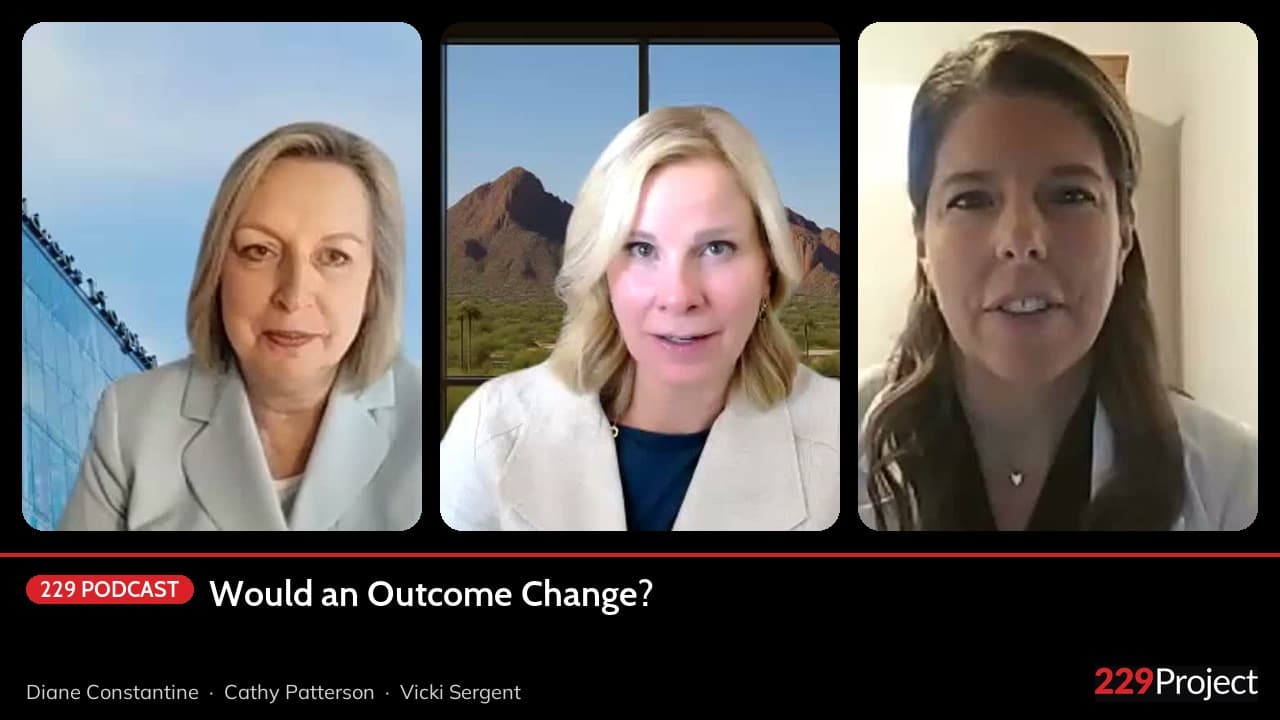
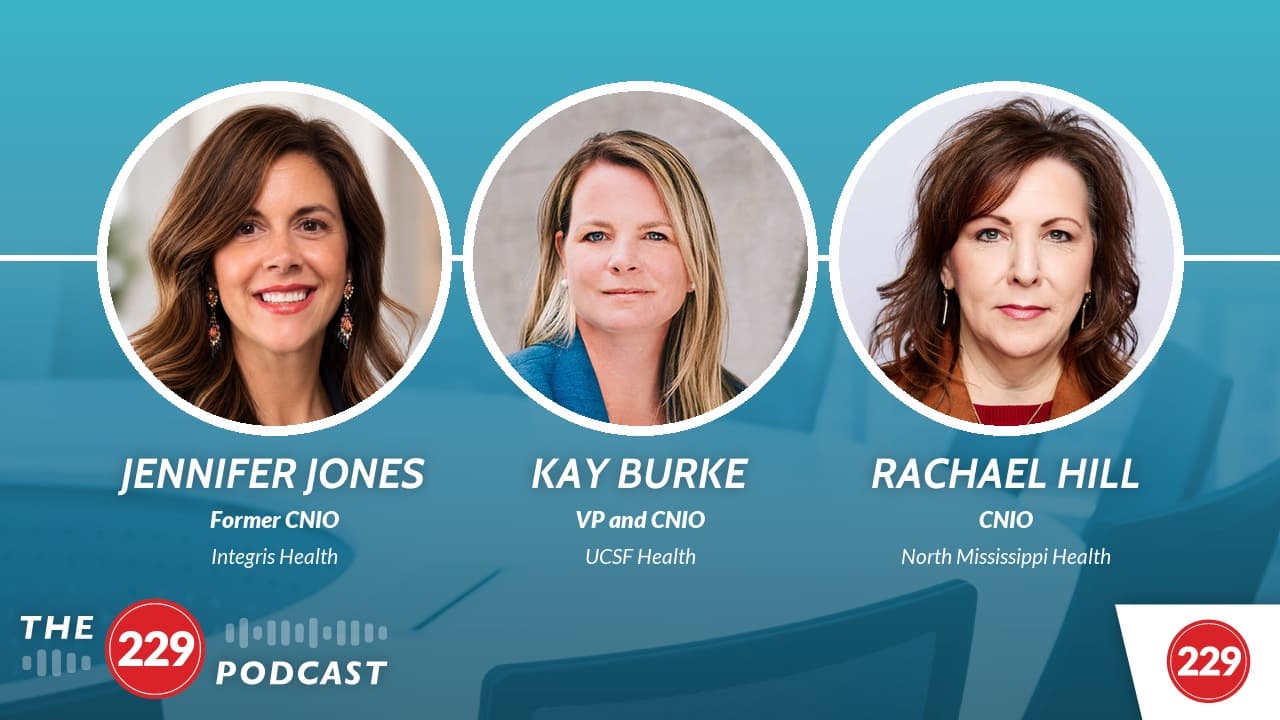
September 17, 2026: Jennifer Jones (former system CNIO and VP, Integris Health), Kay Burke (VP and CNIO, UCSF Health), and Rachael Hill (CNIO and Director of Clinical Systems, North Mississippi Health Services) sit down with Sarah Richardson. What changes when clinical informatics helps shape enterprise strategy from the beginning, not after the technology is already chosen. Jennifer's IV pump work cut adverse infusion events 56%, returned 2,000 nursing hours, and avoided about $500,000 in harm cost.
Key Points:
0:00 Why the CNIO belongs at the strategy table
4:20 Harmony HIT
4:50 Informatics in from the start
8:12 Don't design the hospital as an island
16:08 If we were designing this today
20:13 There were no nurses in the room
28:26 56% fewer IV harm events
31:20 AI acceptance is not generational
36:02 Go-live is not the ROI
Donate: Alex's Lemonade Stand: Foundation for Childhood Cancer
Thank You to Our Episode Partner
Contributors
People featured in this episode — open a profile for more.


Transcript
This transcription is provided by artificial intelligence. We believe in technology but understand that even the smartest robots can sometimes get speech recognition wrong.
56% Fewer IV Harm Events. 2,000 Hours Back to the Bedside
[00:00:06] Sarah: Welcome to the 229 podcast. I am Sarah Richardson. And today we are talking about clinical informatics as a strategic function. And more specifically, why the C-N-I-O belongs at the strategy table. Too often informatics is brought in after a technology has been selected or a transformation plan has already been formed. Yet these leaders sit at one of the most important
[00:00:27] Sarah: intersections in healthcare, clinical practice, operations, technology, data, and the human experience of change. Joining me are three exceptional leaders who bring distinct perspectives to that work, Jennifer Jones, Kay Burke, and Rachel Hill. Before we dive in, I would love to have each of you briefly introduce yourself, share a little bit about what you're currently doing
[00:00:47] Sarah: today and tell us where clinical informatics sits either within your organization or organizations you are working with. And Jennifer, let's begin with you, followed by Kay and then Rachel.
[00:00:59] Jennifer: Hi, I'm Jennifer Jones, a nurse executive and strategic advisor with more than 20 years of leadership experience across clinical care, quality, safety, operations, informatics, and health care technology. Most recently, I served as a system CNIO and vice president leading an enterprise portfolio that included clinical applications, informatics, MR training, imaging, clinical device
[00:01:21] Jennifer: integration, and revenue cycle technology. Today, I advise organizations at the intersection of nursing, operations, technology, and AI, translating digital strategy into safer clinical practice, stronger workforce performance, and enterprise value. Thank you. Hi, everyone. I'm Kay
[00:01:40] Kay: Burke. I am the vice president and chief nursing informatics officer for UCSF Health. My role is an enterprise-wide executive, so I oversee not just our academic medical center, but we're reaching out into the community and have much more of a footprint across the Bay Area. I oversee not just nursing informatics at the organization, which is kind of a misnomer
[00:02:04] Kay: because we support all clinical informatics functions, but also the health IT training team, which is quite large and oversees EHR training, but also all digital technology training.
[00:02:14] Kay: Also, I oversee the patient-facing applications vertical. So I have executive oversight over our patient experience technology strategies and tools. And then lastly, I oversee all of our clinical communications applications. In the organization, I report directly up through Health IT to the CIO. I also have a matrix, a very, very strong matrix reporting relationship to the chief nurse executive, and thus sit on her nurse executive counsel.
[00:02:42] Kay: Work very, very closely with our system nursing governance, which is our professional practice model, to make sure that many of these technology, information systems, AI, other digital tools, decisions are coming directly from the
[00:02:54] Sarah: frontline from our clinical nurses. Thank you. Hi, I'm Rachel Hill. I'm Director of Clinical Systems,
[00:03:04] Rachael: as well as the CNIO for North Mississippi Health Services. Of course, I'm a registered nurse with more than 25 years of health care experience. Today, my work focuses on connecting clinical practice, technology and enterprise strategy. Clinical informatics, you know, sits at the intersection
[00:03:22] Rachael: of those areas in our organization. And, you know, my role is not simply just to implement or support technology, but to ensure that our decisions improve the experience of the clinicians, developing care, and delivering care, and most importantly, the patients who are receiving it. I do have oversight for not just our clinical systems from a standpoint of implementation, build
[00:03:46] Rachael: an implementation, but also, as I mentioned, the informatics proponent and all of our training
[00:03:53] Sarah: activities. I'd love for the first question to be, and so what do you have been doing in your spare time? But there's, you know, so much that you cover in your organizations, which I love when we were all together in Napa in June, which seems like a long time ago, the summer's past us for the most part. And yet just the energy and the perspective of what was happening in that room, I am so grateful we have
[00:04:15] Sarah: created this community with you and continue to watch it evolve and grow very rapidly.
[00:04:51] Jennifer: to start with the central premise of our conversation today, and that's what changes when
[00:04:55] Sarah: clinical informatics help shape enterprise strategy from the beginning. Rachel, I'm going to start with you because you leave both clinical systems operations and the CNIO function, as you mentioned. How does holding those two responsibilities change the way you connect strategic content with what can be governed, implemented, and sustained?
[00:05:15] Rachael: Yeah, great question. Thank you, Sarah. I think holding both of those responsibilities really gives me a direct line of sight into the strategic intent, as well as the operational reality of what we do as an organization. In the CNI role, I can help define the clinical problem that we're trying to solve and ensure that the strategy then reflects the needs of the patients, the clinicians, and overall the organization.
[00:05:42] Rachael: through the clinical systems operation side, I can then assess, you know, what it'll take to make that vision a reality, how it fits into our governance, how it fits into that strategy. But I can then take it all the way from that governance perspective to implementation support and then, of course, optimization,
[00:06:05] Rachael: but more importantly, move it into an area where we're looking at sustaining that particular initiative over time into our organizational strategy. I would say also, you know, having both roles also prevents me from just viewing something as a go-live. Because go-live
[00:06:28] Rachael: is really not the end. It's really the beginning, in a sense. As we think about any initiative or technology that we might be rolling out, the success of that technology begins when it becomes part of that safe, effective, and sustainable clinical workflow that the informatics folks are working to achieve. So I get to see both sides and I get to be able to identify those gaps
[00:06:53] Rachael: between that strategic vision and what that implementation plan looks like. And then in turn, make sure that we're ensuring adoption. We're looking and taking close views on fragmented workflows and then understanding what those long-term support burdens and barriers might be and overcoming
[00:07:12] Rachael: those. So for me, I think the biggest value in making sure that strategy doesn't stop at just a vision, that's the biggest value for me. It becomes something that operationally is achievable. It becomes clinically meaningful for me and sustainable over time. So that's kind of how I feel like, you know, fielding both of those roles really supports.
[00:07:37] Sarah: that strategy. And you get to own the narrative across the continuum, which isn't always a
[00:07:43] Rachael: common practice. Yes, absolutely. Great to hear. So Kay, you've described the connected care
[00:07:50] Sarah: roadmap as something that does not have an end point. And when facilities begin designing something today that will be open years from now, how does a CNIO help the organization make a durable strategic decision without walking in an assumption, that it'll be outdated before the rollout's even complete.
[00:08:12] Jennifer: Yeah, thanks, Sarah. This is the million-dollar question. I think it starts really with acknowledging that
[00:08:18] Kay: none of us can accurately predict what health care technology will look like in 10 years from now. So our job really isn't to predict the future perfectly. It's to make sure that you are in an organization in which you as a nursing informatics executive are providing an adaptable culture. Like how do you adapt? to what the future looks like. And so that's what I mean when I say the connected care roadmap
[00:08:42] Kay: does not have an endpoint, because we're designing facilities today that won't open for years and may be delivering care for decades. Well, we hope delivering care for decades. And so if you design these buildings around today's devices, right, today's applications and, you know, today's workflows,
[00:09:02] Kay: we've essentially embedded today's assumptions into, you know, tomorrow's care and So I think one of the most important things to CNI can bring to enterprise strategy is the ability to distinguish between what needs to be durable, as you said, and what needs to remain adaptable.
[00:09:20] Kay: And so like the durable decisions, these are capabilities like infrastructure and connectivity, interoperability, mobility, identity, etc.
[00:09:30] Kay: But some of the adaptable technologies are really sort of more the virtual care and ambient and increasingly. And increasingly intelligent care. So the connected care roadmap deliberately establishes these foundations between what needs to be durable and these more advanced capabilities. And then there's one other piece I want to say about this, which is, I think, particularly important.
[00:09:52] Kay: Informatics is by and large around design. And so I scream from the rooftops often, like, do not design the future hospital as an island. In fact, I am loath to say the term the hospital of the future because the future is now, right? So our roadmap says that we have a brand new hospital
[00:10:11] Kay: tower opening up in 2030. And this needs to become a reference architecture for the health system. So not a one-off futuristic facility. And like if a capability is valuable enough to put into that new hospital in three to four years, we need to be asking how it can benefit a patient or a clinician at our other sites, oftentimes incredibly old facilities
[00:10:34] Kay: and buildings. So for me, I think earning the strategy seat at the table, it really means that being in the conversation needs to take place before the solution is defined, especially when we're talking about capital and workforce and care models and growth and technology, not just sort of a suite of applications we expect to go live in a couple of years. So I just always always
[00:10:58] Kay: challenge my colleagues and my peers is are we making decisions that expand our options for the future or ones that unintentionally constrain them?
[00:11:10] Sarah: And what I've loved about spending time with you is how you truly articulate that ambiguity to your peers, but also from a board perspective. When there is no end, it requires a different conversation so that they don't think they're just giving you this like massive unlimited budget to go do whatever you want. It's really is a different perspective on how to constantly move the organization forward.
[00:11:34] Sarah: But Jennifer, when clinical informatics is involved at the beginning of a strategic decision, not after the tech has been chosen, what risks or missed opportunities can the organization see that it might otherwise overlook?
[00:11:50] Jennifer: Sarah, I'm really glad that you asked this question. Being in healthcare, I'm actually starting to see that shift where more health care. are putting informatics at the front. I think really what differentiates that is when informatics is involved at the beginning, we help the organization actually answer the
[00:12:09] Jennifer: right critical questions that they need before selecting a solution. What problem are we trying to solve? What is the actual problem we're trying to solve? Technology can look very different in a demonstration as you're talking to someone than it does at a patient's room at 2 o'clock in the morning? Clinical informatics, they bring that operational reality into strategy.
[00:12:32] Jennifer: We can identify where solutions may add additional steps, duplicate documentation, increase cognitive burden, even fragment communication or shift work and accountability to clinicians in ways leadership may not anticipate. We also help expose broader implications. Will the technology integrate and interface within the EMR and the existing systems is our
[00:12:56] Jennifer: infrastructure ready to support the kind of need that they have. Will it produce trustworthy data meeting cybersecurity and regulatory requirements and scale across different environments? For most clinical informatics at a system level, they're not just looking at an acute care hospital. So what does this look like in the ambulatory space? What does it look like in the outpatient space? Those factors directly affect whether we adopt a technology,
[00:13:21] Jennifer: whether it's patient safety outcomes, workforce experience, the total cost, And whether we as an organization or the organization itself ever realizes the expected return on their investment. I think a good example of this was a virtual care strategy that we had most recently.
[00:13:40] Jennifer: We had eight different technology vendors in that space that we had piled on year after year when we started telehealth 15 years ago, virtual nursing 10 years ago, hospital at home care. If we continued treating each new product that way as a separate technology purchase, We would have added more vendors, more interfaces, more workflow variation, more support requirements and inconsistent workflows.
[00:14:04] Jennifer: So by involving clinical informatics early, we get to reframe that conversation. The question was no longer which device should we buy. It becomes what enterprise capability are we willing to build and what are we trying to build for our clinicians? The broader view creates an opportunity to move toward a unified, scalable virtual care ecosystem rather than continuing to vest in disparate technologies.
[00:14:29] Jennifer: I think that really is the difference. Early involvement isn't about reducing risk. It allows us to really redesign the care rather than simply digitized and inefficient process. And too often in health care, that's what we've done. The CNIO, they connect that investment to measurable outcomes, such as time return to clinicians, reduce variation, increased capacity, improve patient experience,
[00:14:54] Jennifer: stronger clinical and financial performance. So when they're at the front end, we get to do that. When informatics enters after the contract is signed, we are often asked to make the technology fit the work. And that ultimately results in fragmented workflows. Patients fall through cracks. But when we're at the table from the beginning, we get to help reshape with that technology workflow
[00:15:17] Jennifer: and the investment around the outcomes the organization is trying to achieve.
[00:15:21] Sarah: And I also have to believe it helps, like, reduce, the burnout factor and it increases the desire of a nurse wanting to stay at the bedside for a longer period of time. And let's be honest, this is our biggest workforce in our hospitals, the one that sees and touches the patients the most often, and the one who tends to leave the industry the quickest. And so after I had spent time with all of you, I kept realizing, like, I hope every organization
[00:15:45] Sarah: has a whole pack of like nursing informatics that are allowed to be at the very front of everything that's being discussed. Because across everything you have all shared. that not only is about timing being important, but informatics is creating the greatest value when it shapes the decision, not the implementation, and most importantly, not the cleanup aspect of all of it.
[00:16:08] Sarah: I want to move next back to UK because your care before clicks work focuses on removing accumulated documentation and configuration rather than, to our earlier point, continually adding more to the equation. What does that teach us about? the C&O's responsibility to challenge legacy decisions, even when each requirement once appeared like it made sense all by itself.
[00:16:32] Kay: Right. I mean, I think this is one of the hardest responsibilities of a CNIO because nothing, to your point in the HR got there because someone intentionally wanted to make a clinician's job harder, right? Like most of it, all of it got there for a perfectly reasonable reason at the time.
[00:16:50] Rachael: So, you know, a regulatory requirement, quality initiatives.
[00:16:54] Kay: of, you know, a safety concern or a request from a particularly loud individual from a department. Sometimes it's an event that happened five years ago. And so individually, each decision probably made complete sense, but the clinicians don't experience these decisions individually,
[00:17:16] Kay: right? This is the accumulation factor. And so that's really the inception of this keyboard liberation program, which we are calling care before clicks. So our EHR experience work tells us that, you know, obviously, as we all know, clinicians want less redundancy. They want
[00:17:35] Kay: easier workflows. They want more useful and tailored education. And with technology that works reliably where the care actually happens. And so I think the C&IO really has an obligation to challenge day in and day out, challenge the clinical system that we have created, and ask a pretty simple question.
[00:17:56] Kay: Like, if we were designing this today, would we still require this? Right? Not, was this a reasonable decision when we made it? I mean, probably was. But the question is, does it still add value today? Is it duplicative? Is somebody actually using the information we're asking nurses to document? Is it required by regulation? Or in many cases, we've turned on and
[00:18:19] Kay: interpretation of a requirement into a permanent workflow, right? It's like the rumor mill. And so the most important thing is what is the cumulative burden of that we're creating at the bedside for frontline clinicians? And so I think what that requires is really like strong CNIOs who say no, you know, say no longer. I think that's like a, it's really important to, to have the
[00:18:44] Kay: credibility and the relationships to be able to do that, you know, in order to get to standardization. you have to scrutinize and really challenge what your system design is today and humbly acknowledge where you need to pivot. And so I think that's where CNIOs play a particularly unique role. You know, ultimately, the metric isn't how much functionality we've delivered. It's really how much we've
[00:19:08] Sarah: returned to care. And also an appreciation for that level of honesty and vulnerability that comes out of the conversation. You specifically often make yourself one of the least popular people,
[00:19:19] Kay: in the room for the right reason. But then people hear you because they see you being
[00:19:25] Sarah: willing to go out on the limb for the people you're serving, which is inclusive of the nurses and the patients and beyond. But having that bravery in front of others is something that continues to shine through. And Rachel, you're known for emphasizing standardization and what you call systemness. What governance model helps an organization move from local preferences and
[00:19:45] Jennifer: isolated solutions toward an enterprise decision without losing the engagement of the
[00:19:51] Sarah: clinicians who also then have to live with those decisions. Yeah, this is a topic that's very,
[00:19:57] Rachael: very dear to me. And just to tack on to what Kay just said, just, you know, to give you a real world example of something that just recently happened, you know, we had someone who initiated a project to add some things to the bedside nurses documentation. There were no nurses. identified in the decision process initially until I said, well, did they agree that they're
[00:20:20] Rachael: going to document this when it's really not, they're just facilitating a question? Well, you know, does it really belong in the bedside nurses' workflow? And we have to ask those hard questions. So, you know, when I think about governance and systemness, I really believe that a tiered governance structure really where we bring those frontline clinicians into the solution really make for the best
[00:20:44] Rachael: processes. And maybe that doesn't work for everybody. But for our situation here, what we deal with is more of a tiered approach, an overarching executive council, a middle layer, which actually is more of an informatics governance council. And then a third layer, which is our domain work groups, who are really in where the nursing stop, okay, where the third layer,
[00:21:06] Rachael: which is those domain work groups where we embed those bedside nurses in those decisions and in those conversations, because that's where the reality is. And as we discuss different initiatives, that's how we understand whether or not something's really going to be successful.
[00:21:21] Rachael: As we, I think the key to all of those tiers of that governance structure is really understanding and helping those, each tier understand their clear purpose. You know, what are they there to decide and to perform? And then also helping them to
[00:21:41] Rachael: understand what their decision authority is, what their escalation path is, and the accountability that they have. Without that clarity, the governance just really becomes more of a discussion for them rather than a decision-making mechanism. And really what we need is a decision-making mechanism. And I think where we fell into some old habits in the past prior to kind of
[00:22:04] Rachael: restructuring our systemness and governance structure is some of our governance meetings became more project update meetings. And that's really not what we're there to do. We can get project update meetings in other avenues. But really understanding that governance structure and what its purpose is and the accountability of the people who sit on each one of those levels for the
[00:22:29] Rachael: decisions that they need to make. And you know, as you step back, I feel like somebody has to be looking across the enterprise from a strategic perspective. It can't just be about, can't be about every project or initiative individually. It really has to be about looking across those continuum such as safety, consistency, scalability. And I think you're right,
[00:22:51] Rachael: you know, when you say cakes sustainability for the system, because the future is today. And we have to be looking for, you know, not just what we're going to be doing 10 years from now, but also what are we trying to accomplish today? And you know, if every department in the organization was really optimizing only for themselves,
[00:23:12] Rachael: we are definitely going to end up creating those unnecessary variations and complexities that we're going to have to maintain. And it's just so unnecessary. So in my mind, I think governance is really a partnership. It's clinicians providing the expertise about the care delivery. The governance structure itself, providing a franchise, providing a franchise.
[00:23:34] Rachael: framework for that decision making that is best for the organization as a whole.
[00:23:41] Sarah: Well, thank you for mentioning, reminding our listeners. Governance is about making decisions and you're accountable for the decisions you're making. Otherwise, if everybody says yes, nobody takes responsibility for what's happening, then do you need governance? Sort of the age-old hypothetical question. Thank you for sharing your approach. And I'm glad it's working well in your
[00:24:02] Sarah: Org. Jennifer, you have led work that has standardized care communications and workflows across multiple facilities. How do you decide what should be standardized for scale and safety while still preserving enough flexibility for the different clinical environments?
[00:24:23] Jennifer: Well, that is probably one of the most difficult things, but if we ground it in some very simplistic principles, it's easy for us to help. Hopefully some of you will hear and see kind of the governance and what Rachel just talked about having individual contributors from those service lines. But we really look at simple principles first and
[00:24:44] Jennifer: foremost, standardize what improves safety, reliability, and scale. But don't confuse standardization with making every clinical environment work exactly the same way. First, we identify the non-negotiable. So what's non-negotiable about what we're getting ready to do? Is it a patient safety requirement? does it have regulatory standards with it? Are there core data definitions and essential
[00:25:07] Jennifer: elements of the workflow we need to look at? Then we work with our bedside clinicians or our governance groups to really understand where variation is truly necessary based on their patient population, their staffing model, their resources, the pace of care, not just historical preference. And I think that's, you know, something that we're seeing change in health care, which is great. I'll use a quick example.
[00:25:31] Jennifer: We went with an enterprise laboratory implementation of a laboratory product. We standardized positive patient identification and barcode scanning across Everett facility. That was the non-negotiable. That was the patient safety. But it didn't look the same in the in the inpatient unit that it did in the ED, that it did in the OR, the procedural areas, or even
[00:25:53] Jennifer: our rural hospitals. So we adapted some of the elements such as lab label printing, collection steps, and workflow sequencing to really fit the... those environments without compromising the core safety standard, which is our non-negotiable of patient safety and making sure that we identify the right patients. I think of it as one enterprise
[00:26:12] Jennifer: foundation with intentional governed flexibility, whether that's in groups, service lines, a tiered approach as Rachel and Kay have described. But any variation that we go outside of it should really have a clear clinical reason that we're doing it. Accountable owners and a way to evaluate that impact. Because we do. We have to come back. Just like Kay said, it doesn't end when
[00:26:36] Jennifer: we begin the project, or I think it may have been Rachel said it doesn't end at Go Live. It starts at Go Live. And so after that, we have to do reiterative steps and to understand are those decisions that we made for those variances? Are they causing unattended harm or consequences? And do we need to look back at that? So the goal is to standardize safety, outcomes and essential data while still giving
[00:26:59] Jennifer: clinicians enough flexibility to deliver care safely in their specific environments.
[00:27:05] Sarah: Yeah, when we standardize, we don't get to set it and forget it. It just becomes maybe one less burden in the general re-evaluation, but everything has a constant care and feeding element to it, for sure. For our final topic, I do want to look at how CNIOs demonstrate value today while helping
[00:27:22] Jennifer: their organizations prepare for what is coming next. Jennifer, I'm going to stay with you on this one,
[00:27:27] Sarah: because C&IOs often understand the clinical problem deeply and yet still must compete for that investment. How are you translating workflow, friction, the clinician burden, and even the patient safety concerns into the operational and financial language that earns the executive attention that
[00:27:45] Jennifer: it needs? I think this is probably going to be my favorite one because it kind of gives the financial part. I'm a numbers person, kind of a data geek. But the first step is to stop describing it as just a clinical or workflow problem and show the broader enterprise impact. Workflow friction has a cost. It appears in lost clinical quality, capacity,
[00:28:08] Jennifer: overtime, turnover, delayed care, duplicated work, preventable harm, and technology investments that never really get their intended value. So the CNIO is setting in a unique space basically to make these connections visible and very measurable to an organization. One of my truly favorite projects that we did was IV pump interoperability.
[00:28:30] Jennifer: And it's a strong example of this. We began years ago with rented pumps across several facilities, different drug libraries, inconsistent workflows, limited to no integration with the EMR. What initially looked like a device replacement need was really an enterprise patient safety, workforce capacity, technology, and capital decision. We moved to a unified infusion ecosystem
[00:28:53] Jennifer: ecosystem with standardized pumps and drug libraries. We integrated it with the EMFRAP. MR, of course, medication order slowed directly from the pump to the library and back and forth, reduce the manual programming and the human error capacity for a nurse. It alleviated some of their documentation burden and obviously the opportunities for error. Financially, the results allowed us to speak to every executive priority that we looked at. We reduced
[00:29:18] Jennifer: adverse IV infusion drug events by 56%. We returned 2,000 nursing hours to direct patient care. And we generated an estimated $500,000 in cost avoidance based on published adverse drug event cost benchmarks. The value went far beyond our financial return. We were
[00:29:40] Jennifer: preventing medication harm. We were preventing patients from getting harmed. We were preventing emotional consequences to our nurses for those patients that were harmed. And really, that's what building high reliability organizations look like. And that's what the intersection of informatics looks like. And it's being able to really paint a picture that it's, no,
[00:30:03] Jennifer: it's not just the technology to integrate. It really is looking at it from a frame of reference in a lens that is so much wider than the technology. It's how can this be beneficial to the organization. So in this case, we reduce variation, increase labor capacity. So when you give nursing hours back, workforce capacity you're giving back. And so being able to translate that at an executive level
[00:30:28] Jennifer: is huge. We strengthened our medication governance processes and with nursing and pharmacy. And we created a more sustainable capital and vendor strategy, something that your CFO loves, right? So that's how we translate a clinical problem into a compelling business case. We connect the bedside experience to safety, workforce capacity, operational reliability, financial performance,
[00:30:52] Jennifer: and strategic value. CNIOs just happen to be the leaders that get to help the organization see that these are not separate concerns, but they're all interconnected outcomes of the same
[00:31:04] Sarah: enterprise decisions that we make. I hope you get to mic drop after that presentation to your board.
[00:31:10] Rachael: Seriously. Like, yes. I mean, with those moments where you're like, okay, can she go do more of that
[00:31:15] Sarah: for us, please? Simply because, wow, what an amazing story to have shared this. Thank you. Kate, your research and work in AI literacy suggests that adoption is not simply a generational issue. What role should the CNI play in AI governance so that nurses are not merely end users of
[00:31:33] Sarah: AI, but inform contributors to how it's selected, evaluated, and operationalized? Yeah, I love,
[00:31:42] Kay: love, love this question. And it's a really important question. So the quality improvement project, just to back up what this QI work was. It was an intervention around education to increase nurses' acceptance of AI in clinical practice. And one of the things that my QI project
[00:32:03] Kay: changed for me was this assumption that AI readiness is primarily generational. We often hear some version of the younger workforce will adopt AI and everyone else will eventually catch up. But that's not what I found. So in this project,
[00:32:19] Kay: We gather demographic variables, age, years of experience, education, and they were not significantly associated with the change in AI acceptance following this educational intervention.
[00:32:31] Kay: And so what mattered really was giving nurses enough of that foundational learning, the foundational knowledge to understand what AI is, where it can help, and where there still needs to be judgment exercised. I mean, there's a lot of fears that I surfaced through this project. And the intervention was not whatsoever enormous. It was a very succinct,
[00:32:53] Kay: like foundational educational, educational module on AI. It was a tool agnostic curriculum. It talked about ethical and trustworthy considerations, and most importantly, the role that AI plays in nursing practice.
[00:33:07] Kay: And so, yet after this very sort of small test of change, we saw AI acceptance skyrocket by 24%. And so to me, that that has a significant implication for advancing, you know, AI education and competency development to the front line, no matter from what generation you are. And so if nurses don't understand
[00:33:30] Kay: how these technologies work, you know, limitations, potential bias detection, you know, hallucinations, privacy implications, then asking them to participate in governance, no matter what age they are, is really not meaningful participation. So very passionate about,
[00:33:49] Kay: AI literacy for nurses and we have to teach them to ask better questions. I think that is the meat and potatoes of this, not just do I like this tool. We often look at adoption as value. But really, like, nurses need to ask what data is informing this recommendation, right? Where could bias enter? How will this change my workflow? And, you know, what new burden might it
[00:34:14] Kay: introduce? So giving them the safe space to challenge the additional burden that AI might have in their workflows. What happens when it's wrong, right? And so the CNIO really needs to create mechanisms for these voices to be heard, right, to be welcomed, and to influence these decisions before a tool is purchased and scaled, as Rachel, Jennifer,
[00:34:38] Kay: and I have reinforced. Like, not simply after implementation, asking them, did you like it, right? are you interested in adopting it more? So that means that nursing participation in use case prioritization, vendor evaluation, right? Workflow design, of course, validation, and probably most importantly, evaluation. You know, you need
[00:35:02] Kay: to make sure nurses are involved. Are we going to adopt, adapt, adapt, or abandon? Clinical nurses need to be a part of that. And so I think it's really important for CNIOs to embed AI decision in like a professional practice model. Right here we call that the system nursing governance for UCSF health nursing. And that really ensures that clinical nurses are involved in every stage
[00:35:24] Kay: of the AI delivery life cycle, which will naturally increase acceptance of these tools and these technologies that do, will impact nursing practice for, for years to come.
[00:35:37] Sarah: I also love that you mentioned that adoption is not just the when. It's understanding how a decision was made. As nurses, you're naturally curious to understand. how a clinical outcome is created or what leads to a certain outcome. And then when AI is helping you do that, how is AI making a decision? So when it is wrong, your pushback is something that you know you can stand behind very thoughtfully. Thank you. Rachel, we're going to finish up with
[00:36:02] Sarah: you because health care technology initiatives are increasingly expected to demonstrate measurable value, often in less than a year. What outcomes should a CNI own or influence? And how do you establish that baseline and accountability needed to show the ROI beyond just
[00:36:21] Rachael: the implementation milestones? Yeah, great question. Sarah, you know, and team, I think we all know as nurses, ROI can be somewhat of a burden sometimes when we start thinking about the nursing profession. You know, we're not paid by the encounter. We're not, you know, it's a little bit harder to
[00:36:44] Rachael: I guess, prove that ROI in a sense because we are really looking at other narratives. For example, I think the CNIO should really be trying to influence a balanced set of outcomes related to clinical quality and safety, the clinician experience, as we've talked about, the patient experience, as well as operational performance, which can have that dollar figure attached to it.
[00:37:09] Rachael: And then the technology adoption, as we talked about. But the specific measure, I think, with any implementation or initiative should, again, follow the problem that we're trying to solve. And I think that's the biggest thing that we have to do every time is ask, what are we trying to solve and how are we going to see if we truly made an impact? Or in,
[00:37:33] Rachael: just as Kaye mentioned, did we increase another burden that we now have to go back and address? But again, you know, as we talked about a few minutes ago, when we talked about governance and we talked about accountability of those decisions. There's definitely accountability here around the ROI. We can't, we can't put something into a production workflow and hope that we get the results
[00:37:57] Rachael: we wanted. Accountability has to be shared. Informatics can help design the workflow and help define the measures, but the sustained value really requires an operational owner who is going to continue to see that initiative through. It needs also a technical owner who's checking
[00:38:20] Rachael: on that workflow and making sure that we're still meeting those needs. And I think that it needs clear responsibility for adoption performance and just like I said, that continued optimization.
[00:38:34] Rachael: Finally, I just want to emphasize that I feel like that an ROI should not be treated as a one-time post-implementation calculation. We don't go back. We don't look at that and we say, oh, great, we achieve that outcome. Let's move on to the next thing. It really should be reviewed throughout the life cycle of that initiative. And I think Kay really spoke to this in the beginning
[00:38:55] Rachael: when we were talking about how clinician burden can be impacted over time because we've just piled things on. But I think measuring the life cycle of every initiative keeps us at a cleaner state. Again, making sure that we anticipated the benefits and that those are
[00:39:16] Rachael: actually being recognized and realized is not just an IT or an informatics responsibility. So before we implement anything, I think that we should be answering three questions. One is, what problem are we trying to solve? What will be different? Because we need to address that. And how will we know if we achieved the right
[00:39:40] Rachael: I think that the ROI, particularly from a nursing perspective, is not always about a single financial number. Just as both Kay and Jennifer talked about, it includes capacity, return to clinicians. It includes risk avoided, variation reduced in clinical practice. Did we improve
[00:40:03] Rachael: patient access? Or did we create a better experience for the patient? So, and a lot of those things seem very non-financial, but they all have a financial driver behind them. It's just about doing those calculations and understanding what we're trying to achieve. As I mentioned earlier, you know, the go live tells us that we completed the project.
[00:40:28] Rachael: But measurable clinical and operational improvement tells us that we created an investment value there. So I feel like you have to really, understand the ROI on the front end of every initiative. I think asking after the implementation is complete, we've already missed the mark. And those are hard sometimes to really,
[00:40:52] Rachael: you know, sit down and think about that. But I think it always goes back to the problem that we're trying
[00:40:57] Sarah: to solve. Your podcast today is literally a masterclass and everything you are supposed to do to get your governance and your decision-making, your accountability and your outcomes align. I love hearing that across all three perspectives, the value of the CNIO is not limited to making technology work. It is making sure that organization solves the right
[00:41:20] Sarah: clinical problem, designs for the people delivering and receiving care, governs for the enterprise, and measures whether or not something has created the transformational value that it endeavored to do. Clinical informatics belongs at the strategy table because strategy becomes operational in the workflow. And few leaders understand that intersection better than
[00:41:42] Sarah: the C-N-I-O. Jennifer K. and Rachel, thank you for sharing your perspective and your leadership
[00:41:48] Kay: with us today. Thank you so much for having us. Thank you so much for having us. Thank you. And for all of
[00:41:54] Sarah: our listeners, that's all for now.