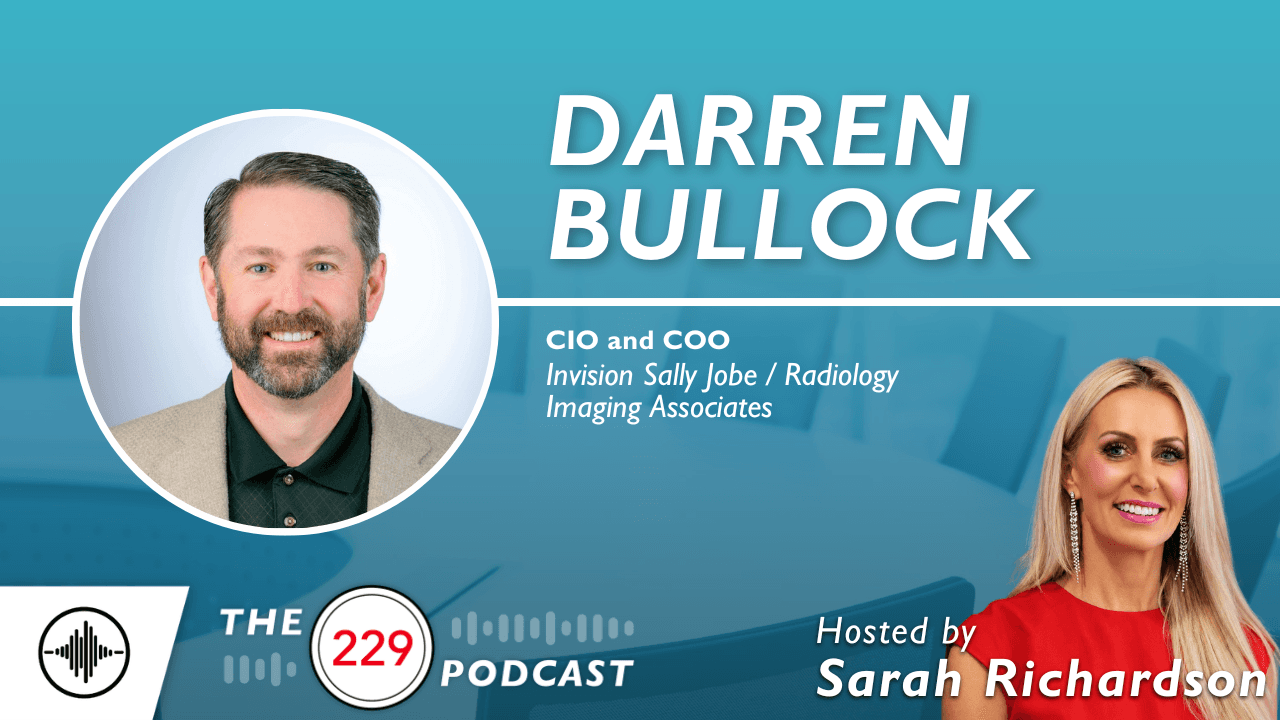
Solving Radiology Screening Bias and Ignoring the Shiny AI | The 229 Podcast with Darren Bullock
 Apple Podcasts
Questions Answered in This Episode
- How can AI address bias in radiology screening when training datasets represent only narrow populations?
- What happens when you deploy never-before-used AI workflows as the first organization globally?
- Why do radiologists need to remain accountable despite AI generating recommendations and reports?
- How do you resist chasing shiny AI objects without strong board-level clinical governance?
- Can AI tools boost radiologist efficiency while actually reducing cognitive burden simultaneously?
About This Episode
August 8, 2026: Darren Bullock wears two titles at once, COO and CIO of Invision Sally Jobe Radiology Imaging Associates, a multi-state radiology practice, and neither role stayed in its lane for long. Darren tells Sarah Richardson how that dual seat let him fast-track one of radiology's most overdue fixes: a breast cancer risk model that finally works for women who aren't white. Together they also get into what it took to deploy it first, how he keeps his board from chasing every AI shiny object, and what separates radiology practices that will thrive from the ones already falling behind.
Key Points:
01:44 Dual COO CIO Role
04:02 Bias and Risk Scoring
07:32 Governance and Metrics
17:05 Future of Radiology
Bring color and joy to a child’s day: https://augustsartists.networkforgood.com/projects/166901-everyday-giving
Thank You to Our Episode Partner

Contributors
People featured in this episode — open a profile for more.


Transcript
This transcription is provided by artificial intelligence. We believe in technology but understand that even the smartest robots can sometimes get speech recognition wrong. Solving Radiology Screening Bias and Ignoring the Shiny AI | The 229 Podcast with Darren Bullock229 Darren Bullock Speaker: [00:00:00] Most health systems are running cloud, like it's just someone else's data center. Cloudticity helps you turn cloud into a strategic advantage with deep healthcare experience across high trust and HIPAA and even FedRAMP. So instead of constant firefighting, you've got visibility into your security posture and confidence. In your environment and cloud spend, you can actually explain to the board cloud that works as hard as your mission. That's cloud ity. Find out more@cloudticity.com. That's C-L-O-U-D-T-I-C-I-T-Y cloud ity.com. Sarah RIchardson: Hi, I am Sarah Richardson, principal at this Week Health and the 2 2 9 Project and a former healthcare IT executive. I spent a lot of time in rooms with the leaders shaping this industry at dinners, round tables, and events across the country. And every so often someone says something that [00:01:00] stops the whole table. You can feel the room shift and everyone leans in. That's the conversation I wanna keep going. Welcome to the 2 2 9 Project podcast. Let's get into it. Welcome to the Two29 podcast. I'm Sarah Richardson and I have the distinct honor of being able to interview Darren Bullock today, who serves as the COO and CIO of Envision Sally Jobe Radiology Imaging Associates, which is a multi-state radiology practice serving hospitals, health systems, and outpatient sites. And Darren, we met at the recent Denver Two29 project dinner in June Darren Bullock: Yes, that's right, Sarah. Good to see you. Sarah RIchardson: Good to see you, and thanks for being on the show. I was so impressed by the type of conversations we had at dinner that night. That was the first time we had had you there. And you have the dual role, so I would love to hear a bit about, , an example where wearing both hats, COO and CIO, has changed the decision or accelerated an outcome for your organization. Darren Bullock: You bet, Sarah. So I think, um, you know, the, the dual [00:02:00] role was, , was really not by design, at least not in- initially. Originally when I came here, I was serving as the chief operating officer. We had a dedicated chief information officer who, , abruptly left the organization under, , less than ideal circumstances. And so, , in order to stabilize a very talented team, I stepped in to, to kind of take interim leadership. And I think we all know what happens with, , interim leadership roles. , It became permanent. And really what we, what we came to realize is that as an organization of about 500 people, we really aren't the size that require both a CIO and COO separately. And so holding both hats really lets me look at, , technology investments, , from both the operational and the technology lens simultaneously. It's allowed us to really accelerate a number of things that, that we've had, , in the works for some time, and be able to just move more, , nimbly than, than we were in the past. Sarah RIchardson: Well, radiology is often described as, , one of healthcare's earliest real-world proving grounds for AI today, and I'm curious where [00:03:00] you're seeing it genuinely influence either the diagnostic workflow, but also how are your physicians responding to the advancement of this type of technology? Darren Bullock: Oh, absolutely. Um, you know, when I attended RSNA, which is the Radiology Society of North America meeting in, , December of last year, it struck me at that time there was about 1,200 FDA-approved AI algorithms for healthcare. About 800 of those are in the radiology space. So what you said is, spot on. We are the proving ground. , The images, the, the workflow, the, the dataset is just really ripe for, , AI to be able to augment and improve that workflow. And so our physicians have been at the forefront even before my time here, , really starting off with using large language models to be able to take a dictated report and create an impression which summarizes that report really quickly and learns from each individual radiologist's, , patterns and adapts over time, which is great. , We've also started using it for diagnostic purposes and [00:04:00] for, , identifying risk, , scores. And so historically, for women who are having mammography, they've needed to fill out a questionnaire of their health history. Um, a- and it's a score called the Tyrer-Cuzick, and that gives them a lifetime breast cancer risk score. Well, that's great, except it was trained on European white women, so it's a very homogenous data set that it was trained off of. Um, the new technology that we just went live with last month is looking at the DICOM or the actual patient image itself, , so that it can give a five-year, so much more tangible, much more near term risk score. And it was trained off of a very, , diverse, , population of women so that it works better across Black women and Asian women and, and, and people that don't necessarily fit that really narrow subset that the original, , models were trained off of. That gives women the ability to take real action and be able to enhance their screening [00:05:00] process to, , get in front of it. But it also gives us the ability to start thinking about how do we model behavior, and how do we, , adjust risk, , strategies in order to hopefully reduce that risk of cancer. And so the following year they can repeat that exam and, and see, did my score shift upward, downward based off of the lifestyle changes that I've made? Sarah RIchardson: Oh, did you find that the, the hardest work with bringing in some of those new protocols was the technical integration, the workflow redesign, or the change leadership required to make it happen? Darren Bullock: Yes, yes, and yes. Um, we were actually the first outpatient imaging center to, , deploy this. It was just FDA cleared. It's the de novo of its kind for, , risk scoring, so nobody had done it, not only in our community, but internationally. Nobody's used this. We were the first to deploy it, and so we were inventing the workflow. We were working very closely with the vendor in order to, , develop the technology as far as how we send the images, , [00:06:00] into the, the right system, how we get the results back, where those land, how those populate the radiologist's workflow, how they impact the tech workflow. So all of those were, were, um, I would say coequal. Sarah RIchardson: Well, and it's greatly appreciated that you are being intentional about mitigating bias in the workflows and what you're already talking about because we hear so often about the trained models are one type of human being, and there's so many more people affected by it. So you're leading the charge on it. When you began standardizing PACS and RIS across the multiple states and sites, what broke first? And would you do something differently now if you were doing it again today? Darren Bullock: You know, it, it's, it's interesting that you ask that, Sarah. One of the early things that, , I was asked by our board of directors was, "How soon are we gonna replace our RIS?" We had a outdated RIS that has since been sunset. It's no longer even in the market. Um, and my response, having had pretty significant experience in the EHR space, was, , we will replace [00:07:00] it if and only if we have to because it's disruptive. , It, it affects our workflow, it affects our patients. And so, you know, looking back, and, and hindsight's always 20/20, right? But looking back, I probably should've, , made that recommendation sooner, um, as moving to a more state-of-the-art system has really enabled us to, , deploy workflows and capabilities that we simply could not have done in our old system. And so, um, moving faster is, is one of those things. And I think with AI, that's one of the key takeaways is it goes so fast that even if we think we're moving fast, it's really hard to keep up with it Sarah RIchardson: Well, and the, the AI-enabled tools influence like, I guess, the diagnostic workflow, but also where the accountability sits. So you've touched on the accountability factor from ensuring that the bias gets mitigated. But with physician operations tech, the, the vendor partner, how have you clarified lines of responsibility when it comes to what is being produced? Darren Bullock: Yeah. That's actually a really important aspect that our radiologists have had to take, , front and center, , responsibility for, is at the end of the [00:08:00] day, AI does not practice medicine. AI can, , generate recommendations, it can generate reports, it can highlight areas to, , facilitate the radiologist to focus on certain areas faster, but ultimately, the radiologist is the one who is signing that report and who is practicing medicine, and so they have to take that ultimate responsibility. And so having a very engaged board of directors that helps to evaluate that AI, , but also to, , validate it and to, , build that change management, , structure, , so that their peers are, are able to adopt it, they're able to leverage it. You know, we have a tremendous shortage in the radiologist workforce, and so, , one of the things that I'm tasked with is providing tools that allow them to be more efficient while not increasing cognitive burden, and the two of those don't always work well together. So really making sure that how we deploy it and what we deploy kind of meets both of those, , aims is, is really critical for us. Sarah RIchardson: You mentioned essentially educating your [00:09:00] board of directors or having them as part of the conversation to make informed decisions. What have been some of the wins in educating your board on AI and beyond? Darren Bullock: I, I think, , the biggest has been, um, it's allowed me to have real conversations with them to avoid chasing shiny objects. Because inevitably, um, everybody has the, the latest thing since sliced bread, and every tool, every algorithm, , will do everything. But when you really dig into it, they're, they're often much more limited in their capabilities or they simply don't produce what they tell you they do. You know, they have bias. They, , are error-prone. They, they glitch out. And so really being able to have that very candid conversation with our board as we're thinking about, um, introducing a new technology so that they are actively part of it, and that way when they're sharing that information with their peers, it's very clear that this was a clinical-led decision, not a technology-led decision Sarah RIchardson: Hmm, that's pretty darn key because radiologists are highly specialized. They are [00:10:00] often gonna have a strong preference about how they work. How do you distinguish between the meaningful clinical requirements and the individual preferences that can prevent the organization from scaling appropriately? Darren Bullock: Oh, that's, , one I wish I could say I've solved, right? Um, because, you know, if you ask five of any professional, , what their preference is, you may get five or six different answers, right? Same is true for radiologists. And so really identifying what are the must-haves, what are the nice-to-haves, what are the personal preferences out of the gate before you really begin engaging with a vendor to understand what, what, what are we looking for as an organization, and then finding a vendor partner that we can work with that either has that out of the box or can co-develop that with us in order to make it work to meet our needs. Sarah RIchardson: How are you involving the physicians early enough without allowing every decision that needs to be made, like, one that is consensus-driven? Darren Bullock: Representative leadership, and so really [00:11:00] engaging a small handful, , in each project. So you may have, , two individuals that are involved in one project and an- another set of individuals that are involved in another. And so really making sure that you, , first identify who are the key stakeholders within the organization and who are the key change leaders within the organization for that particular aspect. For example, I, I mentioned the breast AI algorithm that we use. That was obviously led by a couple of our breast radiologists, um, as well as our board of directors. As... A- another example is we used, , technology that allows us to accelerate the, the magnet of an MRI. And essentially what that does when you accelerate it, when you make it go faster, it creates, , blurriness and distortion, but the AI algorithm can predict where that algorth- where that distortion takes place and then subtract that distortion back out so that you get a as clear, sometimes clearer image of the, , exam while being able to speed up the scan, which means patients that have problems with [00:12:00] claustrophobia being in the tube or patients who just simply can't sit still for, for a variety of reasons, it allows that scan to be much faster. The other big advantage is we have capacity problems. , You can't, , provide enough MRs for the number of patients who are seeking them. And so by being able to accelerate that, you're able to meet the demand of patients a lot better. Sarah RIchardson: Well, you've got the business case for, for AI as an example, and- What it looks like in your environment. I wanna- do you measure productivity, turnaround time, quality, physician experience, outcomes, or combination thereof? Because what we hear so much about today is everyone's using AI to create all of their own personal business requests, and then it still has to go through the vetting for the right governance and right focus for the organization. What combination of those factors do you use in your org? Darren Bullock: Well, I think it depends on the particular, , use case, you know. Again, talking about just those two or those three. Um- Mm-hmm ... in the breast AI [00:13:00] algorithm, it is not about creating efficiency. In fact, to some degree, it slows things down because it is an additional data point that the radiologist and the technologist have to use to be able to provide that, that risk information for the patient. Ultimately, though, what it leads to is the ability for that patient to enhance their screening protocol, and so they can catch that cancer, , faster if they end up developing it, and it helps them to be more proactive in their care. Whereas with the acceleration protocol, that gives us the ability to really improve efficiency primarily at the technologist level, and so really looking at what are our scan times, how can we accelerate that, how can we, um, change workflows. Because when you speed up a scanner, the bottleneck becomes the technologist rather than the scanner. And so now you have to add in a lower licensed individual to help with, , prepping the patient, whether they need a intravenous line or other types of preps. And so introducing that into the [00:14:00] workflow. And so I think the metrics that you need to measure are wholly dependent on the outcome you're trying to achieve and what the capability of the system is. And trying to do a one size fits all, I think, is where a lot of organizations go wrong. Sarah RIchardson: Well, in so many organizations, especially the leadership, we hear this from CIOs often, they're curious about taking an operational lens or a different role within an org. And often we get, I don't want to say siloed into our roles over longer periods of time, but you have the COO and CIO titles. And so what advice would you give to a CIO who wants to become more operational, or an operator who reciprocally wants to be more fluent in technology? Darren Bullock: I wish I could say it was intentional on my part. Um, I was primarily a clinician that went into the operational leadership side of the house, and then, um, took a, what I call a 10-year detour into IT leadership. And, and it was, it was not by intent, but each of those different roles and each of-- and the skills that [00:15:00] you develop in each of those roles really kind of add to each other and, and serve me well in that regard. For somebody who has traditionally come up through the COO role that wants to venture into the CIO, they're probably already very closely partnered with their IT organization and their CIO today. And so just simply expanding that and learning more about how that workflow takes place, because the mindsets are different. Um, and, and same thing for the CIO. Really leaning in a little bit more closely to the operational aspect, and maybe even taking on some direct operational responsibilities to, to learn that and grow in that skill set, I think is, is probably what I would say for somebody interested in kind of cross-pollinating between the two Sarah RIchardson: How often do you, like, drive home from work in your car and just argue with yourself between the, the two domains? Darren Bullock: fortunately never. And, and the reason being is I think that operational and information should always align. And whether that is served by a single person or two individuals, it doesn't really matter. Um, ultimately, the, the [00:16:00] goal of the, , information technology should be to enable the end users. It should be... Y- you know, in healthcare it needs to be to enable the clinician so that they can care for the patients. And, and from an operational perspective, it's one in the same. It should be we're enabling, , whether it's, , people or process or technology. You know, that old, , , three legs of the stool for project management. We need to make sure that we're looking at all of those, and so having both hats on, on the same person or having those hats on two different people, they need to be lockstep with one another regardless of, of who's, , leading the charge. Sarah RIchardson: And the reason those three elements still exist in our conversations today is because they still matter so much in how we get things done organizationally. Darren Bullock: Well, and I think even more so today than ever, and, and, you know, as we look to implement AI, so much of that technology and, and so much of the workflow is unknown and untrusted. And so really making sure that we are putting in place the, the people and the process to validate and to vet and to shepherd that [00:17:00] technology becomes more critical today than I think it was even five or 10 years ago. Sarah RIchardson: Yeah, I agree. So my last question for you is when you look, I'm just gonna say three years ahead, because, I mean, that's- And that's like universes when it comes to what we're up against each day. Now, what will separate radiology practices that thrive from those that are struggling, and what are you doing now to make sure your organization is in the first group? Darren Bullock: Yeah. I think, , there's a couple things. Um, as I shared earlier, there's a tremendous radiologist shortage. Um, there just are not enough radiologists coming out of medical school, , to backfill the ones that are retiring and leaving the field. Um, similarly, there's also a tremendous technologist shortage, and so it's hard to gather the images and it's hard to get them interpreted. And so any capability, whether it is a process or a technology or new training for your team, is going to be really critical in making sure that [00:18:00] you can drive efficiencies. You know, as, as has been true in healthcare for a long time, we have to do more with less. And so I think radiology is at the forefront of that right now. We have to figure out how we can do more with less in order to meet the need, because demand continues to rise. Um, imaging exams are, are not declining in demand, but the capacity is, is either flat or, or declining. And so giving, , those tools to be able to drive efficiency and to be able to provide assurance that it's accurate and, and that trust piece, , is gonna be really critical to be able to be one of those practices that thrives versus one that's being left behind. Sarah RIchardson: Oh, Daren, you are absolutely fantastic guest. Thank you for all the things you have shared. If I was a patient utilizing your services, I would feel really good about it right now. You're ahead of so many of the things that we talk about but not always have an answer for achieving. So maybe it's the duality in the role, but also intentionality of your current things you've done. Thank you for bringing your perspectives, expertise, and points of view to our audience today. Darren Bullock: You're welcome, [00:19:00] Sarah. Thank you. Sarah RIchardson: Thanks for listening. The conversations happening in healthcare it right now are too important to stay in the room, and that's exactly why we bring them here. If today's episode made you think, share it with someone who needs to hear it. Subscribe to the 2 29 Project podcast at this week, health.com/subscribe and come find us at the next event 2 29 project.com. These conversations are better when more of us are in them. See you next time.