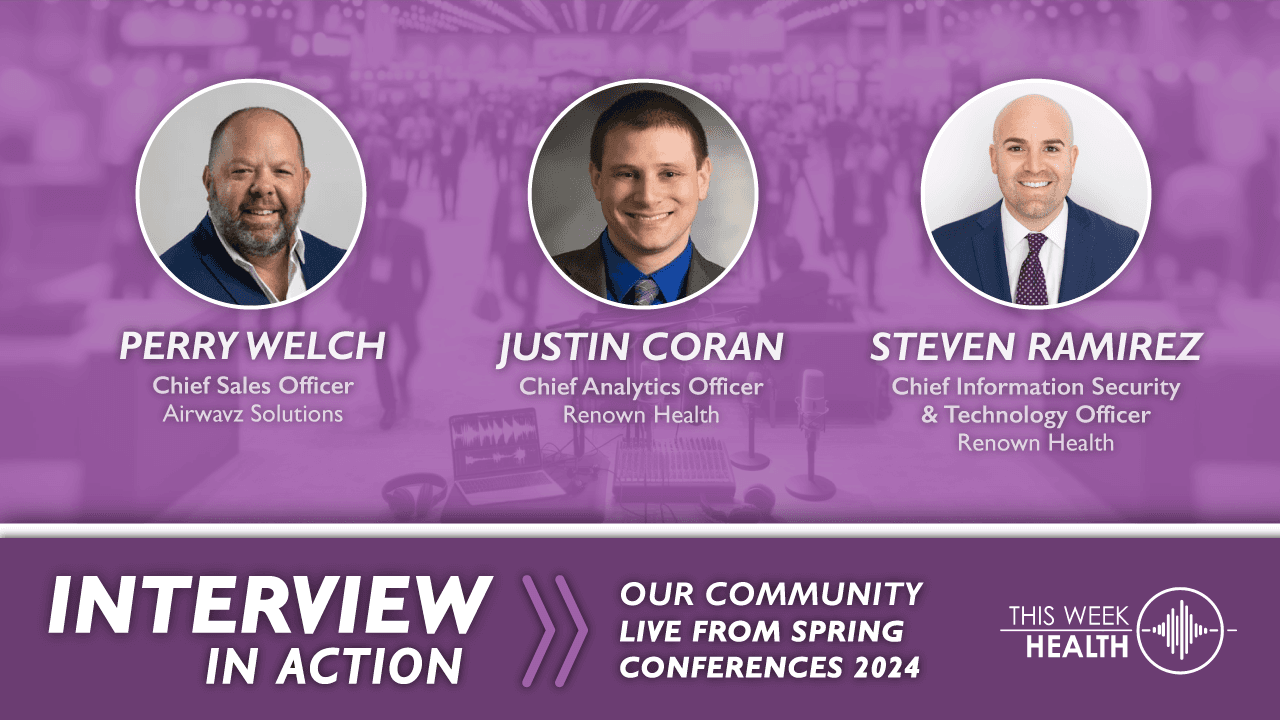
Interview in Action @ HIMSS '24: AI & Governance with Justin Coran, Steven Ramirez, and Perry Welch
 Apple Podcasts
Questions Answered in This Episode
- How do you balance AI adoption with robust governance and data literacy?
- What governance framework prepares clinicians for daily AI use within three years?
- Can multi-cloud strategy with AWS and Azure talk securely to Epic EHR?
- Why is cellular connectivity becoming mission-critical for physician satisfaction?
- Should health systems build or outsource their in-building cellular networks?
About This Episode
April 9: First, we join Justin Coran, Chief Analytics Officer at Renown Health, and Steven Ramirez, Chief Information Security & Technology Officer at Renown Health, at the HIMSS conference. The duo shares their ambitious initiatives for the year, focusing on transitioning to a multi-cloud environment with AWS and Azure, and the importance of building a sustainable infrastructure that ensures security and prevents data leakage. They emphasize the critical role of analytics maturity in healthcare systems, highlighting the integration of artificial intelligence and machine learning to revolutionize clinical and administrative operations. Governance and data literacy emerge as pivotal themes, underscoring the need to prepare the workforce for an AI-driven future. Then, we dive in with Perry Welch, Chief Sales Officer at Airwavz Solutions, a company at the forefront of solving in-building connectivity challenges within healthcare facilities. As hospitals and healthcare institutions evolve into sprawling complexes, the issue of reliable cellular service becomes increasingly critical, not just for convenience but for essential medical operations. Welch delves into how Airwavz addresses this problem by creating custom-designed, carrier-agnostic networks that ensure seamless communication within these complex environments.
Categories: Cloud, AI / Machine Learning
Contributors
People featured in this episode — open a profile for more.


Transcript
This transcription is provided by artificial intelligence. We believe in technology but understand that even the smartest robots can sometimes get speech recognition wrong. Welcome to This Week Health. My name is Bill Russell. I'm a former CIO for a 16 hospital system and creator of This Week Health, where we are dedicated to transforming healthcare, one connection at a time. Today , we have an interview in action from the 2024 conferences, the spring conferences, VIVE in LA, HIMSS in Orlando. Special thanks to our sponsors, Quantum Health, Gordian, Dr. First, CDW, Gozeo Health, Artisite, and Zscaler. You can check them out on our website, thisweekhealth. com. Now, onto our interview Hi, I'm drex and we're at HIMSS 2024. It's the pre conference, really, startup day, right? Monday, all the cybersecurity forums going on right now. I'm here with Justin and Steven from Renown. Chief Analytics Officer, Chief Technology Officer, and Chief Security Officer. It's interesting that you guys are here together at the same time. Tell me a little bit about that. Well, we've got a lot of key initiatives this year that we're working on together moving to our multi cloud environment with AWS and Azure. So, we've really been our theme and talking in the halls about me building the bucket and him putting in the water. in that. So, we're really making sure that, we're building a sustainable infrastructure and securing it. Yeah, no, no leaking water. No spilled water, right? That's right. Tell me more about the water. Sure. So, health systems and provider organizations are becoming more analytically mature, and we have to speed along that evolution of analytic maturity, especially with the adoption of artificial intelligence and machine learning. And so as we do a lot more integrations with third parties, but we're also starting to do in house development from artificial intelligence, which is changing the course of how we conduct clinical medicine. and even administrative operations. And you cannot do that without having a secure and sound cybersecurity strategy. And the information technology strategy just to be able to network and use all that data at volume. Yeah, one of the other things that we were talking about earlier was governance. Say a few words about governance Sure. So, critically important, a data and analytics governance program. And then with that, a data literacy program. In order to start training both your clinical workforce and administrative workforce and what's to come down the road, we need to make sure that we can upskill them, but then also provide the requisite knowledge so that, they're prepared for a world that's going to include artificial intelligence on almost a day to day basis within the next three to five years. It is amazing. There's a lot of stuff that you're going to see on the floor year. Giant HIMSS partner vendor. floor. What are you excited about maybe looking for while you're out there? We've got a lot of meetings scheduled, so we're really looking at components and pieces that fit into that bucket. So we're big initiative on DLP this year, of course, and then how we're going to secure these different components in the cloud as we're moving into AWS and Azure. But also just It's looking at kind of Bad guys are using AI. as we saw, so really seeing if there's any cool new technologies We know there'll never be a silver bullet for anything, but just seeing if there's anything that could help integrate into our, multi year strategy. We're looking at things from, The network to our data warehouse to 5G, to A lot of that. So really having some of those discussions to see where it fits into what we're doing here. Interesting. So, same question for you. You're going to, the floor, you're walking around, you said it's your fifth HIMSS yes. a lot of interesting stuff out there. What are you looking for? Sure. So, I'm really going to be looking at how can we make technology in different environments talk with each other more efficiently? So, as Stephen mentioned, we're actually in a multi cloud strategy. We have both cloud and IoT. AWS that runs our digital engagement and telephony applications, And then Microsoft Azure, which is our enterprise data warehouse. But then within the Azure space is where we're going to do all of our AI development with full computational power. I need to understand how all that will talk to each other and then even talk to the EHR from Epic. And so going out to the floor allows me to talk with executives and developers in each of those spaces to come up with a really clean strategy of how do provider organizations run this level of infrastructure for the health system of the future. Got it. Hey, thanks for your time. I'm going to ask you one more question. It's the bonus round question. If you could have any fictional character as a life coach, who would it be and why? I would probably do Batman. Okay, why? Being the CISO and CTO. Keeping that day job, wearing two hats on, how you can run a business, operationally and Right. Keep the bad guys out at night, so. Oh, I love that. Batman. Justin. For me, it's going to be Tony Stark and Iron Man. Since I'm an analytics guy and I'm also an AI developer, he created Jarvis and Iron Man, which he can talk to as an assistant that actually helps him in a day to day basis. That's exactly what I would like in my day to day. That's what you're trying to build for yourself. That's right. It's what you're trying to build for the whole organization. What a great life coach. Yeah, and secure a little. definitely. Tony Stark and Batman. I love it. Thanks for your time today. I appreciate it. Thanks. Thank you. All right. (Transition) 📍 📍 📍 (Interview 2) here we are from HIMSS 2024 and we are set up in the Carasoft booth and I'm talking with Perry Welch with Airwaves. I'm looking forward to the conversation. So, tell me a little bit about Airwaves and what you guys do in healthcare. What's the problem you're solving? Yeah, so we primarily solve for in building connectivity. Okay. And that can mean a lot of things for us and for our clients. We're solving for cell phone coverage, indoors. So we're AT& AT& T, Verizon, T Mobile. Oh, so you're agnostic, independent. Bring any of the carriers together. Yeah, the carriers of need, these are neutral host, networks, cellular networks. and not every hospital has the need to enhance them. Some have a need for some carriers and not others. We solve all that there about. This was a pretty gnarly problem for us. And as anyone knows, these hospitals have sort of grown over the years. This building, and then you have these areas that have because of. Imaging and other things. We've built these walls in there that signal itself. They are large structures that have been added on to over the years. That That signal has a difficult difficult time penetrating just in general, and then once you're inside, It's bouncing off of other things, So a lot of noise in the network is what we call it. our designs obviously solve for that. make sure everybody can communicate. each client, each building, it's a little different. So do you come in and map those out and make each one a little, customized? Yeah, they're all custom networks designed specifically for that venue or asset or hospital. We come in and do RF testing and show the data to the, healthcare team. And then we design for that. And the carriers approve that design. so it meets their needs. in building cellular feeds, and then the hospital. obviously. hospital. So are we saying cellular? I was told to say mobile. Yeah, we say cellular. It gets a little confusing. there's really large, several Wi Fi networks within these facilities that are really important to the care that they provide and the business that they do. We try to separate and delineate and say these are cellular networks. Okay. It used to be a nice to have. Hey, we provide that reception within there. But now so many of the physicians need access for the various things they're doing remotely. And not only that we now have some mission critical applications that are running across the mobile networks. Yeah, you're right. I mean, we're in 84 hospitals today and the number one reason for us to go in and solve cellular connectivity. is clinician or physician satisfaction. They're starting to do more with their individual devices. I just talked to their office. but look at files and patient files, and imaging. So, if it doesn't work, it's debilitating. and They're unable to, work. work. at the speed they want, and so it's becoming a really big need. problem. How How did the conversation start with you? Like, when a, I mean, do you get the phone call from, you're probably not getting a phone call from the CIO, you're getting a phone call from somebody who's been told, you need to fix this problem. Yeah, someone owns it, but they really don't want to own it, that's I'm being honest. And that's where we come in, because we actually do want to own it. for them. So, they call us and say, we're getting a lot of complaints. We've got some experience of this, or we have a partial system or an old end of life system. There's a lot of different variances. But we come in and assess what's going on. We do the testing. And then, this is a managed service, so it's completely turnkey, we de risk it. it's OPEX. They don't have to throw a bunch of capital at it to solve for it overnight. And we do all the work, and we actually own it. so we de risk it. for them. Which makes that person a hero, because they get to find the magic solution. But these things take time. They don't happen overnight. I'm more curious. I'm going to ask a question I don't know the answer to. Some of these health systems try to solve it themselves by like attaching something here and attaching something there. They do, For the longest time honestly in this space that was the way to do it they would put their dollars at work and they would try to Solve for it and design it and build it and someone in house would be responsible for the health of that network They just don't have the bandwidth today. They're outsourcing a lot as you know because of costs and these networks have gotten more and more difficult to kind of design and manage. Dealing with the carriers is, not an easy task. so there's a lot that goes into this. So we're really looking for ways to offload it. So if somebody's sitting out there going, we have that problem. first of all, let's give them the URL. Because we're saying Airwaves and people might not know how that's spelled. Yeah, so, Great question. Airwaves, A I R W A V Z, as in zebra. Airwaves Solutions, based out of Charlotte. And So how do They get into contact with you or someone? from you? They can go to our website, airwaves. com. They can. Look us up there, they can call us we'll get in touch with them really quickly. So you guys don't have a booth? We don't this is a really massive event. easy to get lost. You can get lost in here, your booth can get lost. There's a lot of great, opportunity here. But, we usually come here and meet with clients, or prospective clients. I had a great dinner last night, and They were talking about how debilitating it is when positions can't connect. Great solution. Appreciate it. Thank you, Perry. Thank you, Bill. Really appreciate 📍 📍 Thanks for listening to this Interview in Action episode. If you found value in this, share it with a peer. It's a great chance to discuss and in some cases start a mentoring relationship. One way you can support the show is to subscribe and leave us a rating. If you could do that, that would be great, and we want to give a big thanks to our partners who make this possible. 📍 Quantum Health, Gordian, Dr. First, CDW, Gozio Health, Artisite, and Zscaler. You can learn more about them by visiting thisweekhealth. com slash partners. Thanks for listening. That's all for now.