How Alex's Lemonade Stand Foundation Built a Movement | The 229 Podcast with Liz Scott
 Apple Podcasts
Questions Answered in This Episode
- How did one child's lemonade stand become a $200+ million force for childhood cancer?
- What makes people without personal connection commit 66 fundraising events annually?
- Why do siblings of cancer patients experience higher anxiety and depression rates?
- How does a nonprofit keep only 7% overhead while funding thousands of programs?
- What unexpected family struggles does the Super Sibs program help siblings overcome?
About This Episode
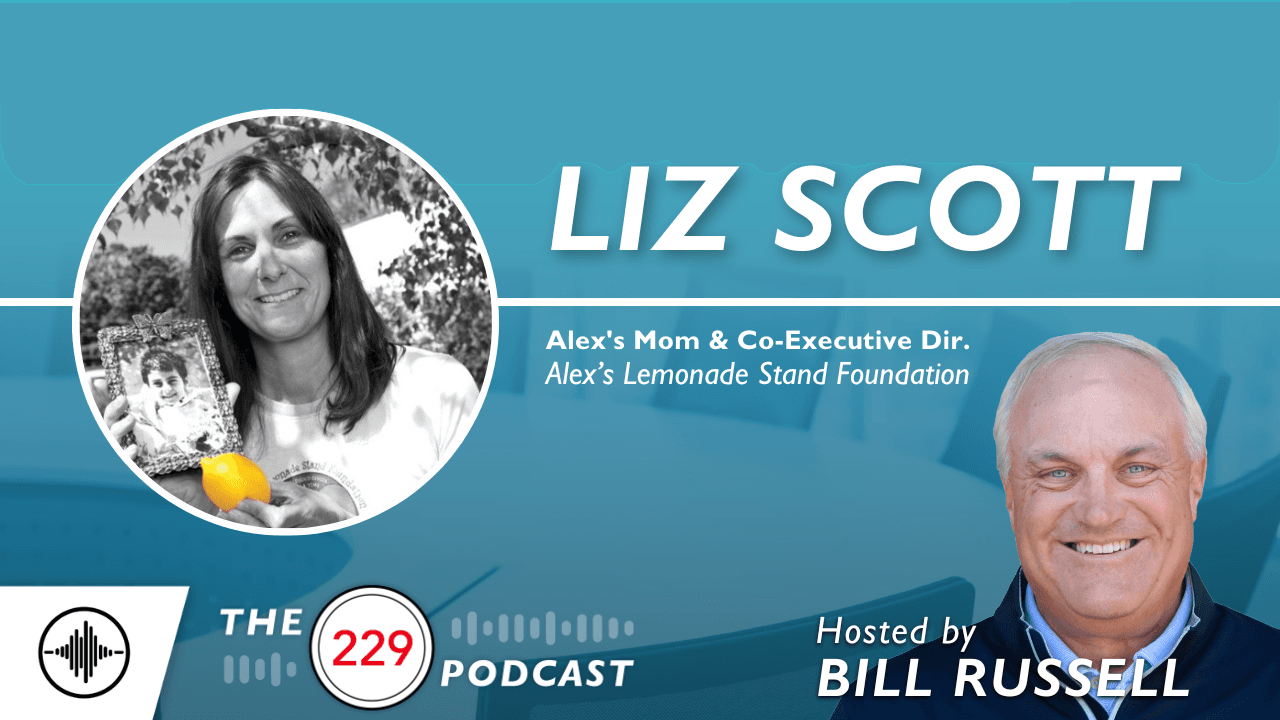
July 23, 2026: Liz Scott is the co-executive director of Alex's Lemonade Stand Foundation, founded by her daughter, Alex, a four-year-old cancer patient who promised to raise money for kids "like her." What started as a single lemonade stand has grown into a movement with over 15,700 community fundraisers and hundreds of research grants funded every year. Bill Russell and Sarah Richardson sit down with Liz to explore how a pure, tragic story became a national movement, what a $100 donation actually funds a decade later, and why she still hasn't burned out after 20 years of building something bigger than grief.
Key Points:
01:56 Alex Story Spark
12:06 Super Sibs Support
20:01 Research And Grants
25:10 Leadership And Future
Donate: Alex’s Lemonade Stand: Foundation for Childhood Cancer
Contributors
People featured in this episode — open a profile for more.


Transcript
This transcription is provided by artificial intelligence. We believe in technology but understand that even the smartest robots can sometimes get speech recognition wrong. 📍 📍 My name is Bill Russell. I'm a former health system, CIO, and creator of this Week Health, where our mission is to transform healthcare one connection at a time. Welcome to the 2 29 Podcast where we continue the conversations happening at our events with the leaders who are shaping healthcare. Let's jump into today's conversation. 📍 all right, this is the 229 podcast, and today I'm excited to be joined by, obviously Sarah Richardson is with me to co-host this. We don't do this often, I'm excited. But we're joined by, Liz Scott, one of the co-executive directors of Alex's Lemonade Stand Foundation. And, Liz, it is, uh, it's an honor to have you on the show. Thank you. It is truly an honor to be here because you are, you're, what you guys are doing is just amazing to me. we just tell the story. Like, we tell the story of, of the first lemonade stand and raising that money on the first, and, and people, y- you could see them in the audience sort of get, you know, they're, they're sort of like, "Wow, that's amazing. my kid never did a lemonade stand and, you know, made that kind of money." And then, and then you tell the story of, of Alex asking you where all, where did all the money go, and, and you, you know, telling her about, you know, it's going to your doctors and, and, and her, her response of, "No, it's, it, we really wanted this to be about everybody," and, uh, and, and telling them about the, the interview, with the, local news station and how she said, "We're gonna raise a million dollars," and you about came out of your shoes like, "How are we gonna do this?" But that's the kind of vision that, that s- uh, started it and turned a, uh, you know, a, a little lemonade stand into an, an amazing force for finding cures for pediatric cancer. And, uh, and, and we're grateful to be, um, be able to take that story out and tell people about it. And, I, I'm, I'm glad Sarah's here because Sarah had a great experience last year. We had, we had an event in, Atlanta, we had an event in Napa, and she got to go to the Napa one. And, uh, she, um, I, I'll let you tell the story, but you got that whole group going so much. They, I think that weekend, they raised close to, w- it, it was close to $30,000 in one weekend? We did. It was a competition. So n- with Atlanta being three hours ahead of us, Bill sends me a text. He's like, "Yeah, we raised five grand tonight." And I'm like, "Poof." I was like, "Let me see what I can do with some wine in Napa and some very fired-up attendees at our event." And so we literally used that last night, and we tell a whole story about the, about sacrifice and vision and strategy, and it really pulls on people. And we say, "Hey, we're gonna match what you donate." And so we ran around with the QR codes telling the story, and we raised a little over $14,000, and we had the match thrown in. So it was Bill's birthday, and I sent him a text that night. I said, "By the way, we just raised almost 30 grand for Alex tonight." And he was like, "That's, like, the best birthday present ever." So when you get people- Wow ... really connected to a mission, and so many of our, of our attendees are repeat. They buy multiple hats, multiple pairs of shoes, and we always have new stuff coming out that they can contribute and represent what they are doing on behalf of Alex's Lemonade Stand Foundation. I mean, this has become quite the force. I'm sitting here with the 2025 annual report, and it's, inspirational in its own right. I, I love the, Super Sib program is really awesome. The, the, information about, data, the use of data is really applicable to our group and, things that are going on. But I, I wanna talk about how it goes from a single lemonade stand to what it is today. How did, the building of a m- a movement, you know, I think it's, it's one thing to set, to, to create a nonprofit and start raising money. It's, it's quite another to, create what you guys have been able to create. I wanna hear your journey in helping to be a part of creating this movement. We are very fortunate because I think even today, one of the big ways we are able to get people inspired, motivated, wanting to give, wanting to get involved, is because Alex's story is so pure and tragic, but at the same time very inspiring. And I think it brings to life what we were all taught over the years, all the things you hear, one person can make a difference. you know, doing something good can create a ripple effect and others wanna do good, on and on, right? Be positive, overcoming adversity. But this is a real-life story. So that is a big part of our ability to still motivate people. But the second part of that is the cause itself. Childhood cancer is something that I think everyone can get behind because everyone unfortunately, at this point, has an experience with cancer in their lives. Many people have experience with someone they know having a child with cancer, or someone in their community having a child with cancer, being a survivor. So those two things combined. The third thing, I think, and one, something I think you've done and you've captured so beautifully, is giving people a way to help Right? Those three things together, from the day Alex started till now, are the ways that we get people to come on board. You don't wanna create a lot of obstacles. People are motivated, they're inspired. This is a good cause. "How can I help?" You want to give them a way to help that's, easy, that feels good, and that's gonna make a difference. You have 15,700 community fundraisers. That's, that's amazing. Do, do we count in that 15,700? I'm just curious. You do, yes. And if you have multiple events, and you've sort of let us know that you've had multiple events... Some people just kind of call it all one event, and they combine all their events into one. But if you told us, "Hey, we're doing the golf outing, and this and that and the other thing, and this wine event," we would count each of those as an event. So you absolutely count. What I don't know is if you count as one or- We, we, we- ... however many crazy events you do, 25 or something. 66. 66, okay. 66. 66. You might be 66, then. It is amazing to me. It, it's, um... I guess the question for you is what, what surprised you the most about, the generosity? You know, my, my personal story is the first year we raised 50,000 and the team came back to me and said, "I think we can do 100," and I'm like, I don't know that we can do 100. Like, that seems like a big number." and, you know, just, I, I think it was, it was, it was amazing to me. I think you're right. People do have a story. They're connected to it. It resonates with them. It is pure. And then it just flowed, and we just blew past that 100,000 number and I thought, "Yeah, that's a, that's a testament to my small thinking about human gen- generosity." I'm curious if you've had a similar experience or what has surprised you about the generosity of people? When Alex first started, and I would say in the early years of the foundation, I was incredibly surprised at the generosity of people, and especially people who don't have a personal connection. You know, as parents in the community, you will go to the end of the earth for your child, and likewise, you recognize the value of doing that for other children who are still fighting, right? If not for my child, then I need to help other children and other families. But what we saw early on was that people who didn't have a personal connection were doing so many incredible things, just like you all are. Like, above and beyond what anybody would expect you to do when you say, "Oh, yeah, you know, we wanna help. We're gonna get involved." the amount of effort and time and energy and enthusiasm that's put into raising money by people all across the country, that's the generosity that surprises me the most and continues to surprise me. You kind of think, like, "Who do- who does that?" You know, this is not, this is not your job. I mean, maybe you view it that way, but this is not your job, Sarah and Bill, to raise money to cure childhood cancer. But you put so much energy and time and passion into it that, you know, y- it is your job. You, you treat it like your job and that you have a commitment to it, and that to me is surprising. 'Cause I'm doing this be- frankly, because my daughter was affected, and she sort of dragged me into it. I don't know that I'd be doing it if... I'd like to think I would be, but I don't know that I would be sometimes I have to remind my team that we have a business also. Exactly. They, they get so- Absolutely their, their creative energies get going and they're, they're so excited. It's like, "Hey, hey, hold on a second. Like, we still have things to do over here." I think a couple of the reasons, um, that, you know, it becomes a movement is first of all responsibility. The, you know, the total fundraising and giving and whatnot, only 7% goes to general administrative. That's one of the things that jumped out to my team when they were saying, "Hey, who do we support?" They said, "Oh, no, this is..." You know, that's one of those metrics in the, in the world of giving that you look at and you're like, "Okay, this is an, a top-heavy organization." In fact, I tell the story that one time I was interviewing you and you had to put me on hold. I was interviewing you. I was doing one of these, and you put me on hold. You're like, "Hold on, I'm, I'm working the phones." So you put me on hold to go to the phones. And I thought, "Yeah, that's a good example of general ad- administrative." but the, the other is the, is the impact. I wanna talk about some of these programs from the, from the report. I don't know why I'm drawn to this, but 3,000 Super Sibs. When w- the first time we met, we didn't talk about this much. What... Tell me about the, the Super, Sibs program. I would love to, and you bring up a good point. It isn't talked about as much. Frankly, I don't talk about it as much as I should. The Super Sibs program is a program that we actually took over from a, a woman, a wonderful woman named Melanie Goldish founded Super Sibs out of her own struggle with having two children, single mom, one child with cancer, one struggling with everything involved with that. For the family, she couldn't find any support. She started this organization. She got to a point in her life where she needed to go do other things and she said, "Will you, will you take my baby?" Basically, "Will you take on Super Sibs?" And our initial reaction was, "It's not what we do," mission creep, you know, all of those things. And then we learned from her more about the siblings, and this is coming from a mom who h- has three other children, and the effect childhood cancer has on the siblings. We know it affects the whole family. We say that, but to learn about how siblings are shadow survivors and how siblings have a higher rate of anxiety and depression than their surviving siblings do. a higher rate of addiction. And, I mean, it's not all bad news, believe me. You know, there's many, many siblings. There's many benefits, too. You get resilient, and you become e- more empathetic, and there's all these positive things. But we felt like we needed to do something to continue this. So this program is free to all families whose children are going through childhood cancer. They enroll with us. We send the parents... First thing we do is send the parents information about what the siblings might be experiencing and what that might look like, especially depending on the age, and how they can support them. And we also send the siblings, every two months they get a mailing from us, age appropriate, with things they can do with their parents, things about coping, empowerment, caring for their, for, for themselves, even at a young age, and basically just recognizing that they're going through something. And the feedback we've had from parents is just recognizing that is the single most important thing. One mom just told us last week that she was reading the materials and, you know, with her younger sibling, the younger sibling saying, you know, "You might feel like this is your fault," or that you got mad at your sibling, and that's why they got cancer, to, like, the age appropriate younger. And the eight-year-old said, "I do feel that way sometimes," and started crying And she said it opened up an entire conversation. It never occurred to the mom that her daughter would be feeling like somehow this was her fault because she got mad at her younger sibling right before he was diagnosed with cancer. so it's, it's a program that has to exist, and we're just so fortunate that we're able to continue it. And though it's a two-year program and then they can-- they roll off. Sometimes they become ambassadors and speak on our behalf. We also have a bereavement program for siblings, so if their sibling passes, they transition over to the bereavement program. It's a really important program, and it's relatively inexpensive for the impact it has. We are gonna talk about grants and, and, some of those things because the, the research that's going on is exciting. But I, I wanna keep on this theme of, because originally you didn't have this whole helping the family thing. You were really focused in on research and finding cures, and now you have families being helped through Travel for Care. And, and knowing the family conversations I've had, the care isn't always down the street that, that they get, and there's a whole lot of complications associated with that. Talk a little bit about, I mean, you talked about SuperSibs, but other ways you, you, support families that are going through this. So we have several family services programs. Travel for Care was our original one, and you are correct. Originally, we said, "No care," you know, "No direct support to families. We wanna fund research. We need cures." And, and we still primary part of our mission is funding research and our budget. But the Travel for Care program is a direct complement to that. So as you pointed out, uh, treatments are not always available everywhere. So if a child has a really difficult to cure cancer, a rare cancer, a relapsed cancer, they often need to travel to another hospital for either a clinical trial or an expert who's seen cases of this rare cancer, and that's where the Travel for Care program comes in. It's pretty special because we pay upfront, so we're not asking families to book something and then they'll get reimbursed. We work quickly, so once a family is referred, if they need to be somewhere in two days, our s- team is on the phone booking their airfare for them to make sure they can get there when they need to get there. They walk the families through what happens at the airport. Many of the families have never flown before. You're talking about an average family income of forty thousand dollars a year. average family size is over four, so the families are, not families who are accustomed to having to travel anywhere, by plane. We also will give them gas cards, pay for hotel. All of that is done upfront so that the families do not have to worry about it, and they can get back and forth to these treatments without that exorbitant cost. And the way travel has been lately, it's been, you know, incredible to see how we can step in and help the families. So if we took the inflationary aspect out of it, because there's always so many factors that happen, someone's in at our event, they're giving $100 to the foundation today. What happens to that dollar over the next 10 years? $100 Yeah So, I mean, you know, depends how you look at it. That would be, our average grant size, that would be two hours of research fully funded. for a Travel for Care family, it would be an average Travel for Care family utilizes, even though we will provide much more, they'll utilize about seven or $800 a year. So you're literally helping a family probably travel, you know, f- half a trip if they're going by car. half a hotel room. But the impact of that over 10 years is what is so significant, right? Imagine, you know, we've helped a family travel with a, say, $100 gas card, and they had to get to another, uh, the eye hospital here in Philadelphia to, for a specialized, doctor, a treatment that could save their child's eye who has eye cancer, and we've had many of those referrals. That treatment has been successful, we know families like this, um, not only in curing the cancer, but in saving the child's vision. So you fast-forward 10 years, you have a child who's now been cancer-free for many years and has 20/20 vision, compared to before, where the option, would not have been to save the eye, and the child may be cured, but they have no vision. So the impact has a huge... You know, I talked about ripple effect. It has a huge ripple effect, on the families. On the research side as well, 'cause everything builds on it, each other, right? This leads to that, leads to that, and we always say, like, "You never know if your dollar or your $100 is gonna be the one that found the cure. That's gonna be the one that made the difference on top of all the other ones that have been given." and the nice thing about our $100 is our partners, our corporate partners match those. So $100 quickly becomes 200 and, and then it's, goes a little farther. Where is... I, I want to talk about the grants, but, I, I, let's talk about it in terms of research. Where is pediatric cancer research today? Pediatric cancer research today is at a very exciting place compared to when we started. Not that it wasn't exciting 20 years ago. But we are all seeing what can happen with newer, less toxic therapies, which is very, very important for children who are battling cancer. So we've been curing kids, you know, for decades. The kids who g- are lucky to get cured for decades with chemotherapy, radiation therapy, and surgery. And I heard a researcher say at one of our summits, she probably wouldn't love me sharing it, but I thought it was really powerful. She said, "Let's face it, we are curing children, but we are poisoning them, burning them, and mutilating them to do that. We need to do better." And the treatments that have been successful, the new treatments that have been successful in the past several years have been doing just that. They've been effective cures with less toxicity. So we're talking about immunotherapies. We're talking about other biological therapies. We're talking about treatments that really allow them to target the cancer without all of the toxicity in the rest of the body, like chemotherapy and radiation therapy has. We're talking about treatments that allow them to know, have a much better sense, because of the technology of, studying the biology of tumors and looking at, you know, a child's DNA to see what might predispose them. All of these things. We have so much more knowledge about each child, and all of those things are leading us to smarter, more effective cures. the survival rate's increased 10% since we've been doing this. We think we can, in the US, we can get another 10%, you know, before, in my lifetime, which would put us, you know, in the high 90s for the US. we need to do better, but the other reason that those non-toxic, less toxic treatments are so important is they have to be delivered in low- and middle-income countries, because the benefits we've had from these decades of chemotherapy, radiation therapy, and surgeries are not widely available in those other countries because of the infrastructure that's required to deliver them, and the risk of infection and things like that, that, in low-income, countries especially. So these therapies that could be potentially, like, a pill delivered to other countries could completely change the paradigm for treating children with cancer in those countries. And you've done over 300 grants this year alone, with over, I think, 130 of them being net new. How do you and the team decide where that next dollar goes and which ones are gonna do the most good? Our grants team works with our scientific advisory board of 10, who are experts from across the US, and we put out an RFA. We receive many applications. We have another, you know, over the course of a year we'll have several hundred reviewers, and we assign them to reviewers, and each one's read by three reviewers, and they score them, and they discuss them. And the ones that score in the excellent or above range and get many more yes, yes, fund this, versus no, fund this, after all of that process, which takes months, we, we fund. And then we require them to do progress reports, so the future funding is contingent upon them reporting back on their progress, and those progress reports are also reviewed. So it's a very, um, it's a thorough process. It's never a perfect process, I always say, but it's a thorough process, and it's really- cool when you see it play out. We just had one of our final calls for our latest ones at revie- review today and we, you know, to discuss sort of the ones on the bubble. and we decided to fund all the ones on the bubble because they were all excellent projects and yes, you know, some of the scientists disagreed about some of the science, but I think that's the nature of science. They're- they, they don't all agree on what's gonna work or we would've figured this out by now. so yeah, it's, it's a, it's a really great process, and because it's so thorough and peer-reviewed, we have a designation, one of two organizations that are dedicated to pediatric cancer that have the National Cancer Institute peer review designation. And that's important to no one except the researchers, especially our young researchers, because it's a qualifying grant. So in order to get these larger grants from the government, they need to show that they have received other funding that was peer-reviewed and been successful. so we're a qualifying grant, and it's a pretty big deal for those researchers in terms of giving them a s- another opportunity to get leverage what we've done and get additional funding. , This is gonna be uncomfortable for you 'cause I know you don't wanna talk about you. You wanna talk about Alex, and you wanna talk about all these other things. But, the, you know, w- we, the podcast is, for us, is for leaders in leadership. And, and there's a couple aspects of this I wanna talk about. And when I t- tell this story, by the way, I mean, Alex is, is a hero in the story, but the hero of the story f- that I try to tell is them giving money. They become a part of the journey. They become a part of, of, of finding cures, and I, I want them to see themselves as part of the, of the hero in the, in the story. Um, but I wanna, I wanna talk a- about leadership a little bit. How do you turn an event like this into, something that's positive and, and moves forward as opposed to something that you retreat and sort of, you know, I don't know, g- go back into a, into a corner? As you said, you have other kids. You could've just gone back to your life and, and this could've just been, you know, a moment, in your journey. but you, you, you chose to move out. And I know you're not comfortable talking about yourself, but from a leadership standpoint, how do you make that, how do you make that transition? I would say it's been a process. You know, the first, the first step we took in that process was deci- deciding, talking, Jay, my husband, and I, talking and deciding that we wanted to try to continue what Alex started, and that decision was based on two things. One was what we were going through ourselves, what we had just seen Alex go through, what our other kids were going through. So wanting to make a difference, and we knew we had an opportunity to. And the second part of that was we were very fortunate, you know, it's some partly luck, I guess, and partly opportunity that you make, to have people that we knew who had some expertise in starting foundations and said, "Here's what you need to do." And it didn't sound too bad. It didn't sound like something we couldn't do. We had already ha- started our own business when we were 24, so that wasn't scary to us. so we decided we had this opportunity. That was step one. And then every step of the way, I think, you know, we just continued to make decisions that we think are going to lead to better things for kids with cancer. And it has... it's not been easy. Believe me, I mean, there were many times, especially early on, where I questioned whether we were doing the right thing for our family because of the amount of time, mental, emotional, and physical time it took, and times I questioned whether what we were doing was gonna make a difference. But through all of that, I think just focusing on the fact that nothing is going to change if we don't try to change it is really what it comes down to. But let me ask you, how do you avoid burnout? speaking for myself, not Jay, 'cause he's very different in the wa- how he avoids burnout, which is like creating new things and making them awesome and then handing them over to somebody else. Um I would say it, it can happen. I mean, I've had moments where I felt burnt out. I'm pretty good about recognizing when I'm, you know, I need time off, or I need to just say no to something, or I need to step back, or I need to talk to a friend or whatever it is. But it's, it's important, I think, to tell yourself that you, you can't do everything, and to kinda give yourself a break, and believe me, I don't follow my, my own advice all the time. I've gotten better at it in time. I would say I was burnt out. There were times I felt very burnt out and felt that I didn't know, you know, the year, the idea of, like, another year of doing this was pretty daunting, and I don't have that feeling anymore. I feel like we're on the verge of doing even more incredible things, and I'm, I'm ready for it. Also have a lot more people working for us now. So I would say as a business leader, I, I'm sure anybody who started something can say those early years are tough. Like, the only way you don't avoid burnout is to assume it's gonna get better if you just do more. I mean, frankly, that's what I felt like. If we just work harder, it'll get better, and then maybe we can hire somebody to do this, right? And, and things will grow, and then we won't be burnt out. You're, you're preaching to the choir here. Yeah. Uh, Sarah, I'll give you, I'll give you the last, last question. I love this because we have the honor of interviewing you every year, so thank you for always giving us a slice of your time, which we love to share with our audience. But five years from now, we're having our ninth interview with you at that point, what do you hope has become true? I hope that the words I'm saying today about less toxic therapies and we're on the verge, I hope I can point to many of those that have since happened. Many of those less toxic therapies that are curing cancers that were incurable. that is what I wanna be able to talk about in five years I'm thankful for what you've done, and I'm thankful for the opportunity to, to be a part of it. Liz, thank you for your, for your time. And Sarah, always great to, uh, to do these, interviews together. So thank you, uh, thank you both very much. Thank you both. And I mean, your whole community is just gotta be full of great people with the amount of money you're raising. Yeah. Well, it's, it's healthcare, you know? They- True ... they, they, they, they get it from the onset. Mm-hmm. And, they appreciate the, as you say, the purity of the story is, is really something else, so. Um, thanks, thanks again for your time. Thank you. Thanks for listening to the 2 29 podcast. The best conversations don't end when the event does. They continue here with our community of healthcare leaders. Join us by subscribing at this week health.com/subscribe. If you have a conversation, that's too good not to share. Reach out. Also, check out our events on the 2 29 project.com website. Share this episode with a peer. It's how we grow our network, increase our collective knowledge and transform healthcare together.