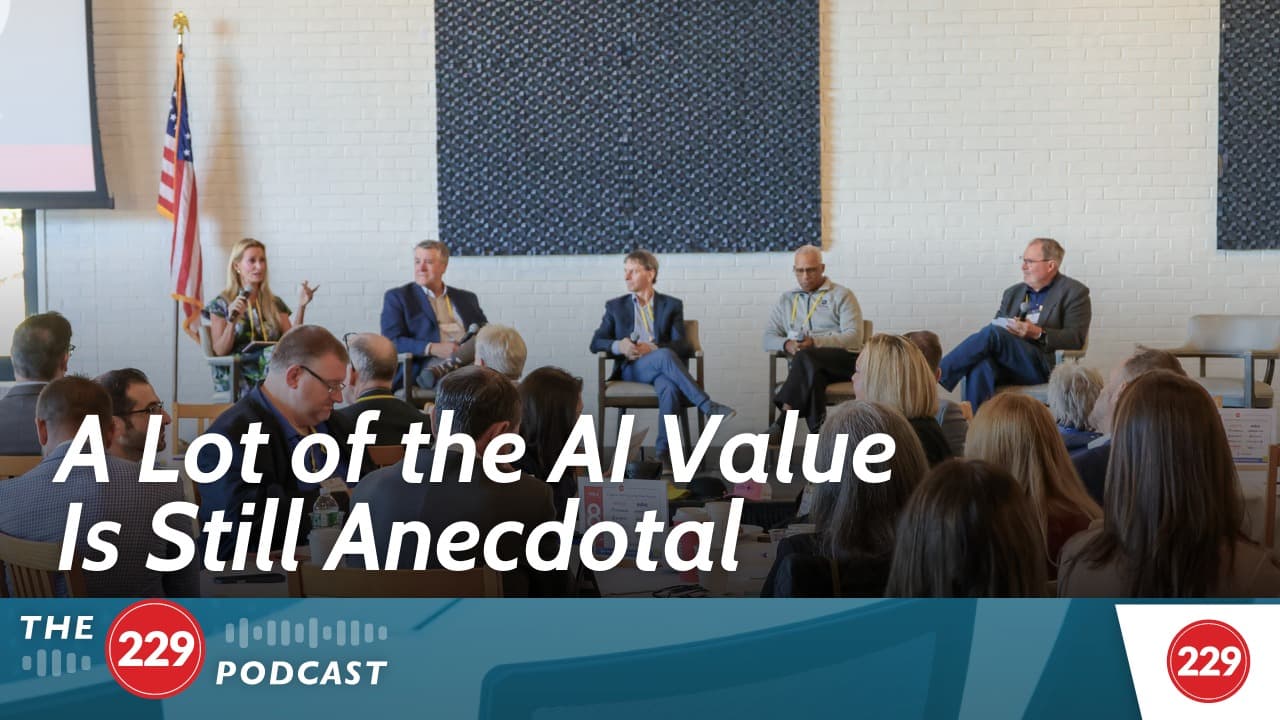
A Lot of the AI Value Is Still Anecdotal | The 229 Podcast
 Apple Podcasts
Questions Answered in This Episode
- What do you do with a tool a physician already built, on his own time, that IT cannot support?
- Where does AI work have to sit when capacity is the constraint?
- What changes when the goal is a lower cost per encounter, not more revenue?
- Why does the same Epic summarization tool fail in one ambulatory group and land in another?
- What process are you about to speed up before you fix it?
About This Episode
October 15, 2026: The same AI panel opened four 229 Regional Staff Roundtables in September: New Orleans (September 10), Portland (September 15), San Diego (September 17), and Atlanta (September 22). Health system IT leaders on stage. Their teams at the tables. This episode pulls the four rooms together by topic.
Sarah Richardson opens it the way she opened Portland, with the Signal Check the room filled out before it walked in. In Portland, 65% named competing priorities and capacity as the top challenge.
Shane Thielman at Scripps Health went after cost, not revenue. Autonomous coding on emergency department facility coding. About a 50% decrease in the cost per encounter. About 70% coverage in certain areas of that work. It has since moved into professional billing for radiology.
A Piedmont physician built a mock ICU tracker on personal time. Fake patients, a personal AWS server, a GitHub account, so he could show what the tool should look like. He knew the governance. Lacy Knight: "something we can't support today."
Takeaways:
Julie Eastman (PeaceHealth) would defend the initiative that gives clinicians more time to be present with their patients, and that gives the evidence the time was truly returned. A lot of the value is still anecdotal.
Lisa Johnson (Providence): about five minutes saved per patient contact on the provider side, before the workflow was refined. An operational leader had set aside four to five hours to compare policies. Copilot did it in about 10 minutes.
Falyn Curtis (Ochsner Health) turned on Epic's billing assistant and saw fewer calls about bills, and more of those bills paid once patients could ask what the bill was for. Will Landry (FMOL Health) saw the same drop the day they turned it on. He put it at 60% fewer calls on that topic.
Glynis Cowart (Woman's Hospital): ambient listening has to be turned off for a phone call, or the conversation lands in the chart.
Lacy Knight: the EHR made bad processes obvious, and "AI has done that a hundredfold." The value is in rethinking the work.
Drex DeFord: take a train wreck of a process and it becomes a fast and efficient train wreck.
Josh Glandorf (UC San Diego Health): the bottleneck is operational transformation time, not IT time, "with much bigger boulders."
Bonnie Boles (Tanner Health) will not move a project until an EVP names the top three. Julie Eastman asks why AI is governed separately from the rest of the portfolio.
Same tool, different result. Epic chart summarization in ambulatory was not helping at Tanner. Clinicians found it slow, mistrusted a miss, and could not turn it off. Lacy Knight called the same tool a home run at Piedmont. Her first Copilot rollout went the other way: access went to people who do not live in Microsoft tools, and adoption was poor.
Will Landry chose not to block ChatGPT, so FMOL could see the traffic, including on guest Wi-Fi. Pete D'Addio (LCMC Health) is watching the token bill. Steve LeBlond (Prisma Health) treats shadow IT as a need IT did not meet.
Jeremy Meller (Children's Healthcare of Atlanta) has hired more AI literacy specialists than AI engineers. On ambient listening for nursing, the more experienced nurses are having an easier time, because the tool requires them to talk to the patient. Lisa Johnson: this is the time to double down on clinical informatics.
Will Landry is telling FMOL's 250 certified Epic analysts that he will not need 250 people building in Epic three years from now. At-the-elbow support on the floor is the work he tells them will last.
John Henderson (Rady Children's Health) spent a Saturday coding a check-in app for a middle school running club, then stopped. He could not support it. The club uses a spreadsheet.
Maili Boynay (Legacy Health): start with the people who have to deploy it. They need capacity, and they need to know what is in it for them.
In this episode:
Sarah Richardson, Principal, 229 Project
Julie Eastman, SVP and CIO, PeaceHealth
Lisa Johnson, VP, Clinical IT Solution Delivery, Providence
Falyn Curtis, VP, IS Clinical Systems, Ochsner Health
Will Landry, CIO, Franciscan Missionaries of Our Lady Health System (FMOL Health)
Glynis Cowart, SVP and CIO, Woman's Hospital
Shane Thielman, Corporate SVP, Chief Information and Digital Officer, Scripps Health
Terri Couts, SVP and Chief Information and Digital Officer, Sharp HealthCare
Drex DeFord, Principal, 229 Project
Lacy Knight, VP and Chief Health Informatics Officer, Piedmont Healthcare
Josh Glandorf, CIO, UC San Diego Health
Bonnie Boles, SVP and CMIO, Tanner Health
Pete D'Addio, CTO and VP, Technology, LCMC Health
Steve LeBlond, Chief Information and Digital Officer, Prisma Health
John Henderson, Chief Information and Digital Officer, Rady Children's Health
Jeremy Meller, CIO, Children's Healthcare of Atlanta
Maili Boynay, VP, IS Applications, Legacy Health
Bill Russell, Founder and CEO, 229 Project
Key Points:
0:00 Four cities, one panel
0:46 One initiative to defend
2:36 Where the value shows up
7:46 The bad process, a hundredfold
11:19 Capacity
16:06 What did not work
18:45 Shadow AI
23:36 The people
28:02 Why these rooms exist
Donate: Alex's Lemonade Stand: Foundation for Childhood Cancer
Thank You to Our Episode Partners


Contributors
People featured in this episode — open a profile for more.


Transcript
This transcription is provided by artificial intelligence. We believe in technology but understand that even the smartest robots can sometimes get speech recognition wrong.
A Lot of the AI Value Is Still Anecdotal | The 229 Podcast
[00:00:05] Good morning. Thank you for being here. I am Sarah Richardson. I'm one of the other principals here at the 229 project, and also a former CIO, HCA, Optum, been all over the country in several different geographies.
[00:00:16] That's Sarah Richardson, opening the AI panel at our regional staff roundtable in Portland. In September, we ran that same panel in four cities, New Orleans, Portland, San Diego, and Atlanta.
[00:00:30] Health System IT leaders on stage, their own teams at the tables.
[00:00:34] This episode pulls the four conversations together by topic.
[00:00:38] Sarah started with the survey the room filled out before the event.
[00:00:42] The first question went to Julie Eastman, CIO at PeaceHealth.
[00:00:46] And we did a signal report. We sent you a survey prior to this event occurring. We'll do a follow-up as well.
[00:00:52] In Portland, 65% of this room says their number one challenge is competing priorities and capacity
[00:00:57] being the greatest concern, for sure. And only 23 of you in the room even have a budget that is allowing you to grow.
[00:01:04] to support the expectations inside of your organization.
[00:01:07] So, Julie, I'm going to start with you on this question.
[00:01:10] And if only one AI initiative can survive the next budget cycle, the way you're thinking about deploying
[00:01:16] something beyond a pilot, something that can truly scale organizationally, which one are you going
[00:01:21] to defend or bring to the table? And then how are you going to use the right evidence or metrics to
[00:01:27] show its efficacy inside the organization?
[00:01:36] But I would defend the initiative that gives clinicians more time to be present with their patients
[00:01:42] and gives us the evidence that that time was truly returned.
[00:01:47] So the reason why I wanted to say that very specifically is because we, there's a lot of
[00:01:53] anecdotal conversation about the value of AI and really the value of technology tools that we give
[00:02:01] to our clinicians, but it's so hard to measure.
[00:02:04] So right now, AI is a little bit of spaghetti on the wall.
[00:02:09] Everyone's out in conferences across all of our organizations.
[00:02:13] There's an AI tool for everything.
[00:02:16] So we're focused on ambient listening at the moment and some AI tools in the administrative space for our teams.
[00:02:25] And it's a satisfier.
[00:02:28] Everybody wants it.
[00:02:29] It is actually giving them time back, but it's anecdotal.
[00:02:34] We're not measuring, you know, doing time studies.
[00:02:43] First, where it's paying off.
[00:02:46] Julie's problem, value you can feel but can't prove yet, came up in all four rooms.
[00:02:51] Here's what it sounds like when people can put a number on it.
[00:02:53] Lisa Johnson, VP, Clinical IT Solution Delivery at Providence.
[00:02:59] Five minutes per contact with the patient is saved on the provider side.
[00:03:06] at Providence. And I wouldn't say we're perfect. So let's just say, like, that's before
[00:03:12] really refining the workflow. The second thing around co-pilot, I just want to share a story
[00:03:17] because I think in my whole career in technology, I've never had this experience. And it was like an
[00:03:24] aha moment. And I had an operational leader come in and I could tell she was stressed and she sat at the table
[00:03:29] and she said, I'm sorry, I didn't think I was going to be able to make this meeting because we have this
[00:03:34] big policy initiative where we're trying to basically streamline policies across a Providence
[00:03:40] large footprint. And I've got all these policies I have to weed through to try to figure out
[00:03:45] what's different, what's the same. And I said, hey, can I show you something with co-pilot? Can you
[00:03:50] give me two minutes? And I shared what she could do. And she almost was in tears. She said, Lisa,
[00:03:57] that would have taken me four to five hours to do. And that's what I was prepared to be locked in my
[00:04:01] office doing. And I've done that basically in
[00:04:04] 10 minutes. And so that to me is what matters. And I think we're finally realizing some
[00:04:11] of that value and we're seeing it in real time, which makes me just love my job more.
[00:04:15] In New Orleans, Falyn Curtis, who leads clinical systems at Ochsner Health and Will Landry,
[00:04:22] CIO at FMOL Health, both turned on Epic's billing assistant for patients. Falyn first,
[00:04:29] then Will. On the rev cycle side, it was a rev cycle and patient access with Emmy's billing
[00:04:34] assistant, we've noticed a significant decrease in the number of calls go into the
[00:04:39] call center about patient bills by turning that on. And then we have actually seen more bills
[00:04:45] being paid by the patients that are asking the questions to understand, you know, what the bill
[00:04:49] was actually for. So those are other. Yeah, we saw that same, like that, the day we turned
[00:04:54] that on, like the dropping calls, it was incredible. Like, how could we go 60% less calls about
[00:04:59] this topic? It was like drastic. Even the wins come with fine print. Glynis Cowart,
[00:05:05] CIO at Woman's Hospital. Ambient listening is a big one for us that we rolls out.
[00:05:10] But you need to also make sure that the providers, you know, funny story, they have to remember
[00:05:15] to turn it off or when they're taking a phone call so that their entire conversation doesn't end up
[00:05:19] in a patient chart. So a lot of little things like that. But, you know, when you're dealing with
[00:05:25] a patient population or with the health industry, a lot of people don't want to talk to that AI.
[00:05:29] You know, if they're calling the hospital, they want to get to a person. They want to talk to a person.
[00:05:33] In San Diego,
[00:05:34] Shane Thielman, Chief Information and Digital Officer at Scripps Health, went after cost, not revenue.
[00:05:41] One use case that I think is really fascinating is autonomous coding. We set out to sort of think about
[00:05:48] ways in which we could automate the coding process. And it wasn't about finding ways to increase
[00:05:52] revenue. It was actually about how can we decrease the cost per encounter associated to all of the
[00:05:59] manual touches that go into coding a chart and preparing that bill to go out the door.
[00:06:04] And we started very narrowly within our emergency departments on the facility side.
[00:06:10] So really the technical coding aspects. And I think what's been really exciting is, as we've
[00:06:16] brought back some of the results of that experience, what we've seen is is about a 50% decrease in
[00:06:22] the cost per encounter with the incorporation of autonomous coding. In certain areas, we're achieving
[00:06:28] about 70% coverage, just in that facility ED coding example.
[00:06:34] And that sort of generated what I'll call a virtuous cycle, which is what are the additional
[00:06:40] areas in which we think we can, with confidence, deploy this coding solution. And so that's now
[00:06:46] extended into the professional billing side for radiology.
[00:06:49] Terri Couts, chief information and digital officer at Sharp HealthCare and a nurse, went next.
[00:06:57] That's a hard one to follow. I don't think about AI as a technology tool.
[00:07:04] I actually think about AI as a clinical transformation tool.
[00:07:08] And the reason why I say that is because this is one of the only technology enhancements
[00:07:13] that we've had in my time as being a nurse, that actually can have real true clinical impact
[00:07:22] down.
[00:07:24] But value for me, particularly in the clinical setting, is not just about, you know, can I create
[00:07:30] more efficiencies so you can see more patients or do more documentation?
[00:07:36] Next, what AI shows you about your own processes.
[00:07:40] In Atlanta, Drex DeFord, one of our principals and a former CIO,
[00:07:44] ask the panel for an AI project with real ROI.
[00:07:48] Lacy Knight, chief health informatics officer at Piedmont Healthcare,
[00:07:52] took it somewhere other than ambient listening.
[00:07:54] So I feel like I can't talk about ambient listening.
[00:07:58] Yes, you can.
[00:07:59] Because everybody's talking about ambient listening.
[00:08:02] So I think what I would talk about maybe,
[00:08:08] exploring front-end voice AI for phone calls, inbound phone calls.
[00:08:13] But I think the most successful part about it is that it actually gave us better understanding
[00:08:17] of our business.
[00:08:19] So we had bad processes before we implemented the HRs.
[00:08:24] We put the EHRs in and thought it would fix everything.
[00:08:27] It didn't fix everything, but it made those processes, those bad processes more obvious.
[00:08:32] And AI has done that a hundredfold.
[00:08:35] and the best, the most important way to get value out of AI is to rethink how you do the work.
[00:08:44] It's not, I think, skimming on the top of those things.
[00:08:46] So while I am also excited about the impact of ambient listening,
[00:08:50] I'm even more excited about how, for those organizations that are extending beyond just ambient,
[00:08:57] how it's allowing us to rethink what the workflow is for patient care.
[00:09:01] Josh Glandorf, CIO at UC San Diego
[00:09:04] Health, on the part the team underestimated.
[00:09:08] But we had very high expectations in terms of our turnaround time to turn these systems on to do the process transformation, and we have really underestimated that work.
[00:09:19] That process transformation, this isn't just, you know, turn on an EHR module like we're used to.
[00:09:24] This is, you're basically, you have to get down to every line item's task in a, in a process, and it becomes a real.
[00:09:34] really uncomfortable for a lot of reasons, right?
[00:09:37] Folks, now you have the fear, I know we're going to get to that, you know, fear about, you know,
[00:09:43] what happens to my job, you know, fear about how efficient am I versus, you know, the robot,
[00:09:49] now you're going to look at that, you know, kind of like UPS does when they follow their drivers
[00:09:53] and time them.
[00:09:54] You know, we've got all these different things that we're really, you know, putting a microscope on,
[00:09:59] and it's uncomfortable for folks.
[00:10:01] I think the difference that I'm seeing is the expectation,
[00:10:04] are higher, right? So everybody, probably in this room, and most people you interact with
[00:10:12] your daily lives, have used AI, and they have some wins, they understand the power.
[00:10:18] I don't know that we've really had a technology like that in the healthcare world where people are that exposed to it.
[00:10:23] When we're looking at costing these out, we're having to look at operations and how much load it's going to take on them.
[00:10:29] A lot of times, that can be the bottleneck, right? It's not the IT time. It's not the
[00:10:34] the engineering time. It's the operational transformation time. And so that's, you know, I think,
[00:10:39] really been eye-opening for us. So it's, you know, similar, similar clip, similar demand,
[00:10:45] but with much bigger boulders and things that, you know, we have to deal with.
[00:10:49] Drex had the short version.
[00:10:51] You take a, you take a train wreck of a process and now it's a fast and efficient train wreck.
[00:10:56] But it also helps you figure out where those problems are so you can maybe solve them more quickly than you would in the old slow motion version.
[00:11:03] version of the train wreck.
[00:11:08] Which brings every room to the same wall, capacity.
[00:11:12] Back in Portland, Julie Eastman asked why AI gets its own governance at all.
[00:11:16] I think it's really surprising from organization to organization, where our executive teams
[00:11:27] understand capacity as it relates to OR rooms and beds, and you can't have more patients than
[00:11:35] you can have beds, although you can leave them, put them in stretchers in the hallway.
[00:11:39] But the concept of capacity, demand, capacity, etc., is very well understood except when it comes to IT.
[00:11:47] I keep coming back to why are we governing AI projects separately or differently than everything else?
[00:11:55] You have finite supply and you have significant demand, and AI projects are, I mean,
[00:12:02] they're clinical decision support projects of the old days.
[00:12:05] right? But everything falls, everything has to be evaluated in the context of the
[00:12:12] full portfolio. And until we're doing that holistically, I think we're at risk of creating
[00:12:18] another little silo of decision-making absent, you know, the full picture.
[00:12:25] Drex, on what to do with too many good ideas.
[00:12:29] The prioritization thing is kind of a whole different problem, too, because
[00:12:35] A lot of the things that you're ultimately going to have to deprioritize are things that
[00:12:39] are really good ideas. They're like no-brainers. We absolutely should do that. The problem is there's not
[00:12:46] enough capacity. There's not enough water in the bucket. Back to my stupid analogy brain. There's not
[00:12:52] enough water in the bucket to water all the flowers that we want to plant. And we want all the flowers.
[00:12:58] We love flowers, but there's only this much water in the bucket. If we plant all the flowers and we
[00:13:03] use up all the water, all the flowers die.
[00:13:05] We got to pick the flowers that we really, really want. So it's figuring out which flowers we're
[00:13:10] going to plant. And then it's sort of like actively saying I used to have in my department and
[00:13:16] around the hospital these signs that said, we're actively doing these projects and we're
[00:13:21] actively not doing these projects. We know you guys want them, but we're de-prioritized them.
[00:13:26] We're not doing these. So it's sort of like, these are the priorities. These are not the priorities.
[00:13:35] So we don't have 40 projects. We have 40,000 projects apart. So we have taken our project
[00:13:40] governance committee to the next level for us. And that is where we have our executive vice presidents
[00:13:47] are assigned to every single project and which pillar it fits and which goal it may support.
[00:13:54] And then we have had to ask them, you know, there are 15 projects under you, Mr. CFO.
[00:14:00] What are your top three? Because we can't do all 15. And that's a lot of you. And that's a
[00:14:05] not really, it's AI and unai related, although they all have AI now. But we have really
[00:14:11] gotten to the point that we have so many projects that we don't let them move forward unless an
[00:14:16] EVP tells us what's number one, two, and three. Will Landry at FMOL Health runs AI past
[00:14:23] three committees. Then there are the contracts.
[00:14:27] About a year ago, any contract that has any mention of AI, like that comes to me for review,
[00:14:34] regardless of what it is and what the contract is. It's a lot. But we do a pretty good job of policing that.
[00:14:40] But one of the things that we're probably unique, we only have 10 authorized signers in our entire
[00:14:46] organization. So that's for 20,000 plus people. So everything, like all contracts funneled through
[00:14:53] legal, like for review. So we do a pretty good job of catching that stuff. Like, you know, five or six
[00:14:58] years ago, this would have been impossible. Lisa Johnson at Providence stopped running AI requirements.
[00:15:04] through intake at all.
[00:15:07] And then lastly, I think instead of saying no and having people throw things over the fence
[00:15:18] because we have this intake, which is my least favorite word.
[00:15:23] And then it sits there, right? And our teams can't even get to it because there's so much
[00:15:26] intake. And so no, like we're going to flip the script. Things don't just get thrown over the fence
[00:15:32] anymore. And if they're coming in and saying, we want this widget, when you flip the narrative
[00:15:37] and say, okay, what capability are you really looking for and what are you trying to accomplish?
[00:15:42] If you have that buddy, that IT exec buddy, that can speak those languages and understand
[00:15:48] basically what they're trying to accomplish, a lot of times it's a win because we can back into,
[00:15:53] oh, we already have that capability because we're rich in technology and poor in adoption.
[00:15:59] And I'm sure many of you are as well.
[00:16:04] Fourth, what didn't work? Drex asked Atlanta for that, too.
[00:16:09] I asked the earlier question, what's something that you've done with AI that's been very successful,
[00:16:15] going back down to Bonnie to start with this one.
[00:16:18] What's something that you've done with AI that turned out not to be so successful?
[00:16:23] Something you tried and then you were like, now we're going to blow that up.
[00:16:26] Sure. So we, one easy example is some of the epic summarization tools and the
[00:16:34] ambulatory setting, they are automatically turned on. And our ambulatory clinicians do not find
[00:16:42] them helpful. They take too long. Unfortunately, you can't turn that off and you pay for it.
[00:16:48] I think the summarization took too long, and some of the clinicians were so used to knowing what
[00:16:54] they wanted to see as the patient came in. They wanted to do it on their own, and there was a little bit
[00:16:58] of mistrust as to whether it might miss something. So we didn't turn it off because we couldn't.
[00:17:05] but we're looking forward to it being turned off for us.
[00:17:09] Lacy Knight had the opposite experience with the same tool, and a co-pilot rollout that went sideways.
[00:17:15] So this has been fascinating for me to listen to on the end because, Bonnie, when you mentioned the chart summarization on the outpatient side,
[00:17:21] for that, for us it's been a home run. So I'm fascinated by the idea that we know the new AI is probabilistic.
[00:17:29] We just didn't think it would be probabilistic across our own organizations.
[00:17:34] that that what you have success with may not be directly repeatable with me, which is very
[00:17:40] unusual with the same product vendor. And then I'm going to list our first iteration of co-pilot
[00:17:45] as a failure access. And so my workaround of that was to say, you know, why don't we just
[00:17:51] give it to start with people that have access to all of, you know, all of our secrets, because
[00:17:56] then we don't have a security risk. Well, it turns out that those folks don't really use Microsoft tools.
[00:18:03] So, you know, not
[00:18:04] Not a lot of emails sent by the CEO, not a lot of Microsoft Word documents.
[00:18:10] And so the adoption was atrocious.
[00:18:14] I think that, to me, is probably the best part of the conversation so far.
[00:18:21] And that is the, we are not culturally designed in healthcare IT traditionally.
[00:18:28] Once we start a project, we're in on the project.
[00:18:30] This is it.
[00:18:31] We've got to go.
[00:18:32] It's budgeted.
[00:18:32] We've got to run it all the way to the finish line.
[00:18:34] And we're creating this new world now where it's sort of like, it's okay if we try some stuff out.
[00:18:43] Fifth, Shadow AI.
[00:18:46] Every room got here.
[00:18:48] Will Landry's team made the call early.
[00:18:50] Well, we've been, the last couple years, been very focused on what we can see.
[00:18:55] Like, we, like, our minor attack surface is, like, we want to, like, we have to be able to see more and
[00:18:58] understand more.
[00:19:01] I guess, is it four years ago, the chat GPT4, it'll be four, maybe four years in November,
[00:19:06] losing track of time, but whenever that was announced, we made a decision to not block it specifically
[00:19:11] because we said if we, if we block it, we won't know what they're doing on our guest Wi-Fi.
[00:19:17] Because, like, as an academic medical center, we know they're just going to go to the,
[00:19:20] they're just going to go to the guest Wi-Fi and do it that way.
[00:19:23] So we specifically didn't block it.
[00:19:26] We made that decision because we wanted to see the traffic and we wanted to go have conversations
[00:19:29] with people about what they were using it for and just understanding it.
[00:19:32] So it.
[00:19:36] on usage policy and the bill.
[00:19:39] So I think for us, it's visibility is one, but I think we have established a usage policy to at least
[00:19:44] establish something instead of saying, you can't do anything.
[00:19:47] Let's have a usage policy.
[00:19:49] And then, you know, you brought up a great point with tokens.
[00:19:51] Is that like, that's the next thing.
[00:19:52] Like, cool, it's using, oh, why is our bill now $100,000?
[00:19:56] Well, somebody went and coded and really had a lot of fun and we're using, you know, the fable model
[00:20:01] and it's like, well, we need to back that down.
[00:20:03] In Atlanta, Steve LeBlond, chief information.
[00:20:06] and digital officer at Prisma Health isn't trying to kill it.
[00:20:11] But every one of those is like a real need that the user had,
[00:20:15] that they weren't getting a solution from IT, so they created their own.
[00:20:17] And so I actually, like, as a CIO, I have this, like,
[00:20:20] different perspective of shadow IT, because sometimes I can't get resources,
[00:20:23] but they can, and they build their own little shadow IT group.
[00:20:25] So I'm like, oh, supportive.
[00:20:26] You go get those IT folks, I'll scoop them up in a year or two, and they'll become mine, right?
[00:20:31] You know, I remember I was talking with somebody once,
[00:20:34] and they were sort of complaining about this squeaky wheel.
[00:20:36] And I'm like, the squeaky wheel isn't a problem.
[00:20:39] It's literally the unwritten rules and politics of the organization is clearly coming to you.
[00:20:43] What's the problem?
[00:20:44] Like, you're being reprioritized appropriately because you don't have a sophisticated governance mechanism to give you that.
[00:20:51] So, like, don't look at it as a bad thing.
[00:20:52] That's a good thing.
[00:20:53] Lacy Knight has a physician at Piedmont who didn't wait for permission.
[00:20:58] We had one physician, you know, create fake patients, create his own AWS server,
[00:21:06] GitHub account to represent what he wished the ICU tracker looked like.
[00:21:13] You know, so this is someone on unpaid time was motivated enough to create a prototype
[00:21:20] so that he could show us what he wished he could do for the health system.
[00:21:25] And this is somebody that knows the rules, understands the governance, understands the approval,
[00:21:29] understands the promotion, understands the training component.
[00:21:31] And it's something we can't support today.
[00:21:35] I'm not sure I know what it takes to do.
[00:21:37] it, but I just, I don't know, this is more of a confession than I think an insight.
[00:21:44] Terri Couts thinks the bigger risk is saying no.
[00:21:48] I think the risk is actually higher if we don't allow some of them to use and develop tools that
[00:21:56] we give them and that we trust and that we've already vetted and have the controls around
[00:22:01] because we all know that everybody is using AI tools in their personal life.
[00:22:07] And to take that outside of our system where we don't have visibility is a huge risk
[00:22:13] if we don't foster this model to allow them to innovate within their own space.
[00:22:21] John Henderson, Chief Information and Digital Officer at Rady Children's Health,
[00:22:26] coaches a middle school running club on the side.
[00:22:29] One Saturday, that turned into a coding project.
[00:22:31] I'm an assistant coach for a volunteer running club from middle school in Orange County,
[00:22:35] and we don't have a good.
[00:22:37] way to check in the students every day when they run, to track them out, to check gear,
[00:22:42] all these different things. And I try not to be, you know, I don't really tell people what I do
[00:22:47] with, because then I'll become the help desk. But I volunteered and I said, let me create something.
[00:22:53] I'll, I'll do it. And I found myself by coding over the weekend, creating this app and created
[00:22:59] my dev environment, and I was just going all in on a Saturday. And I don't know what it was,
[00:23:04] but something just clicked. And I was like, what am I doing?
[00:23:07] I can't support this thing. I'm not going to be able to support it. They're going to be
[00:23:10] ask me for edits and changes and modifications. I'm just not going to be able to do it.
[00:23:14] So I wound up creating a very elegant spreadsheet. So we use that. I went low tech.
[00:23:20] But you have to be, I mean, these things can really get you caught up in doing some really fun
[00:23:24] things. And so it's, it's fun, but you just have to have some little bit of boundaries.
[00:23:34] Which brings it back to the people. Steve LeBlond again on re-skilling.
[00:23:39] Yeah, we've actually been talking about reskilling and upskilling a lot. I think those are two different things. But we've done some work to identify, like, what are the jobs that are going to be most disruptive by AI? And then what are we doing to train those folks to be the workforce we need in the future to deploy AI? One of the things I told my boss was like nobody out there has like 20 years AI experience, right? Like we're all learning this. So why would we hire people off the street to be that AI workforce in the future? What are we doing to like reskill and train our folks now?
[00:24:08] So if we know AI is going to attack, like, going to make this job less of a need, how do we start looking at the
[00:24:15] refill request for that and not maybe improve, maybe it'll improve 75% of those requests?
[00:24:20] In the meantime, gives those same people, AI tools to skill them up so they can also move and become
[00:24:24] the AI workforce for the future for us. So Jeremy Meller, CIO at Children's Healthcare of Atlanta,
[00:24:31] saw something unexpected with ambient listening in nursing. Ambient also in, you know, for nursing.
[00:24:37] We're finding that that that is super.
[00:24:39] It's saving nurses a lot of time, but we're finding interestingly that it's the older nurses, the more experienced nurses who are having an easier time with it than the younger nurses.
[00:24:50] That's really interesting.
[00:24:51] Yeah, it's like the younger nurses are having a hard time like, because, you know, part of, to make that work, right, you have to verbalize what you're doing.
[00:24:58] So you have to talk to the patient. You have to make eye contact and connect.
[00:25:02] And so we're finding that there's, you know, some rate limiting skills there that we're having to having to have.
[00:25:08] address that. We've hired actually more AI literacy specialists than we've hired
[00:25:15] AI engineers at this point. Will Landry is being straight with the FMOL team about where this
[00:25:21] goes. So we have 250 certified epic analysts and I that's we are not that's not going to be needed
[00:25:30] three years from now. We just know that it's going to change that environment is going to change.
[00:25:34] It doesn't mean that the that we're going to not need 250 people. I just know that I'm not going to need 250
[00:25:38] people building in Epic. Because Epic's going to change. But the one thing that we've been telling
[00:25:44] them that I've been very vocal about is if you are focused on at the elbow support and if you're
[00:25:50] focused on being on the floors and being with the users, like you're good. Like those positions never
[00:25:55] changed. Like we always will need more in person on the floor support. But if you're like a hyper-focused
[00:26:03] IT introvert that just wants to sit behind a computer on a keyboard, like you're in trouble. Like
[00:26:08] that's going to change long term.
[00:26:11] Sarah closed the Portland panel with a rapid-fire question.
[00:26:15] Maili Boynay, VP of IS applications at Legacy Health, went first.
[00:26:20] Next 90 days, when you think about what you're saying to your team is you want this room to take
[00:26:24] away. What should we either stop, start, or continue to do when it comes to AI conversations?
[00:26:31] I think you better start getting your employees on board because they're the one that are going to
[00:26:37] help make it happen. You're out there talking with your leaders and you're moving things
[00:26:42] through initiative-wise and making executive decisions on behalf of your organization, but your people
[00:26:49] are the ones who are deploying it. And they need to understand, A, how are you helping make capacity
[00:26:57] for them to do that, and then B, what's in it for them. And the underlining of it all is people
[00:27:04] are scared that their jobs are going to go away or that you're going to be making decisions
[00:27:10] that they don't trust. You do that and they'll, you know, run through a wall for you. And, you know,
[00:27:15] you can make as many decisions you want all day long. And if your people aren't going to do it for you,
[00:27:19] you know, then you're kind of dead in the water anyway. Then Lisa Johnson, on the one role nobody should
[00:27:26] be cutting right now. With the tight budgets we have, I keep hearing over and over, which really worries me.
[00:27:34] We don't need as many clinical informatics. And I'm like, you guys, this is the time to double down
[00:27:39] on clinical informatics. We are struggling We've got to do it with
[00:27:47] them. We are not going to get more nurses. We are not going to get more providers. We need to be able
[00:27:53] to deploy meaningful tools that actually help make them more efficient and hopefully bring the joy
[00:27:58] back to what they're doing because they can focus on their patients, which is why they got into this work
[00:28:03] in the first place. Bill Russell closed out the New Orleans panel with the reason these rooms
[00:28:10] exist. This is like one of my favorite things, right? The reason we're doing this, everybody gets together.
[00:28:16] You get to talk to each other. You get to know each other. You get to start to work on these things.
[00:28:21] If there's a team Crawfish collaboration work group specifically around this stuff, that would be
[00:28:29] amazing because why do the duplication effort? Why do I have to learn that lesson? I have to learn that lesson.
[00:28:35] to learn the lesson. You have to learn the lesson. We don't have time for that.
[00:28:40] We don't have resources for that. So I hope you guys, one of the things you take out of this is,
[00:28:46] yeah, maybe you get a work group together and start pounded on that. It's pretty awesome.
[00:28:50] That's the AI panel from 4229 Regional Staff Roundtables. Thanks to the chairs and panelists
[00:28:57] who brought real numbers and real misses into the room and to the partners who make these days possible.
[00:29:05] If you want your team in one of these rooms, find us at 229project.com.