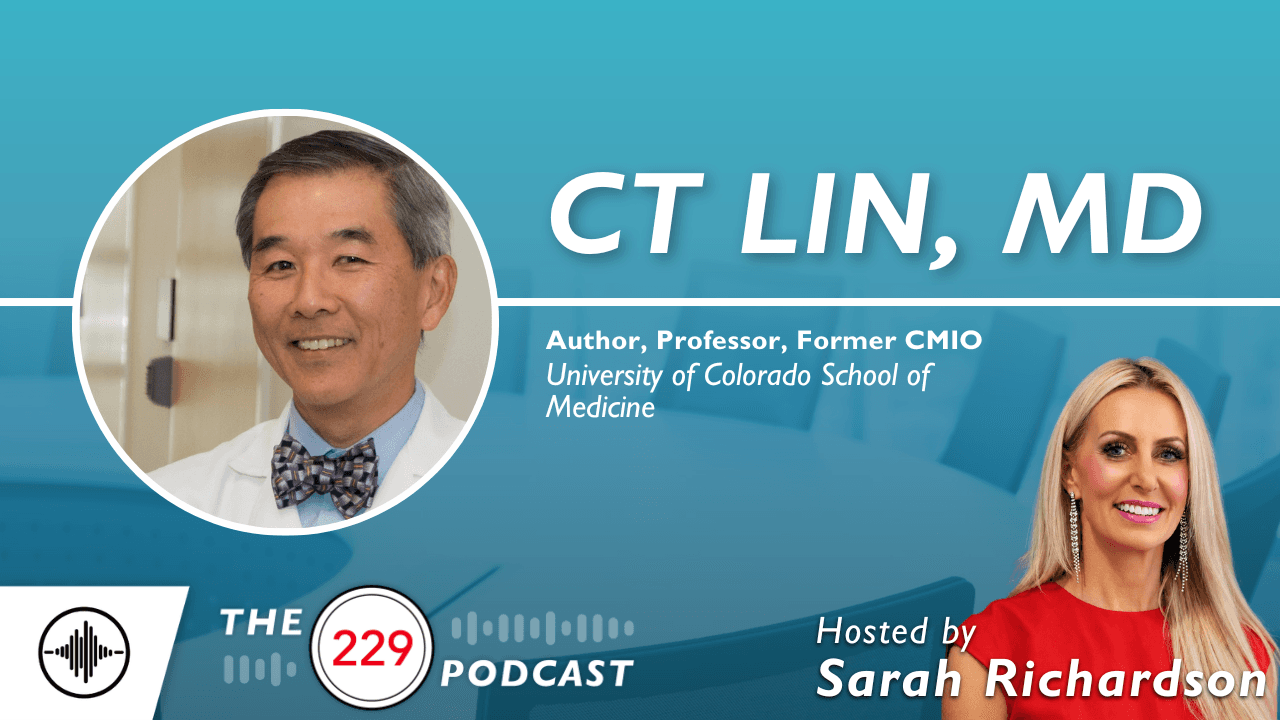
From Potholes to Piglets: CT Lin on Why Health IT's Hardest Problems Aren't Technical
After 30 years at UC Health, the outgoing CMIO reflects on failure, institutional memory, and why technology fails when the people work gets skipped.
Success with an electronic health record project, CT Lin says, is roughly 20 percent technology and 80 percent psychosocial and political skill. That ratio, refined over three decades as chief medical information officer at UC Health, sits at the center of Lin's new book, It's Not About the Tech: From Potholes to Piglets, Real Life Lessons in Health IT. It shaped nearly every project he touched before he stepped into what he calls "preferment": not retirement, but a deliberate move to professor emeritus at the University of Colorado Anschutz Medical Campus.
Lin said he spent the first half of his career assuming physicians and technologists, as fellow scientists, would follow the evidence: show them the statistical significance and the graphs, and adoption would follow. It didn't. He described building tools in isolation, unveiling them fully finished, and being caught off guard when colleagues resisted instead of adopting them. Those repeated failures, he said, changed how he approached every project that followed.
Two failures, one lesson
Lin illustrated the point with two stories from his tenure. In the first, a physician colleague asked him to add a mandatory "hard stop" requiring every primary care visit to record minutes of weekly exercise as a new vital sign. The idea had never been discussed with primary care leadership, and UC Health runs roughly two million ambulatory visits a year. Lin's team asked the requesting physician to get primary care leaders to sign off in writing. They never heard back.
The second story is the one Lin points to as his biggest failure. About a decade ago, his team built an alphabetized list of pre-approved "indications of use" for radiology orders, designed to let insurance authorizations clear automatically at the moment a study was ordered. The list ran five or six pages, organized alphabetically rather than by how ordering physicians actually think through a case. "Worst headache of my life," a common and clinically significant indication for a head CT, sat near the bottom of the list. Within a day of going live, hospital records showed a sudden spike in acromegaly, a rare pituitary condition the hospital normally saw only a couple of times a year. Sixteen cases appeared in a single day. The cause wasn't a medical outbreak: acromegaly simply sat near the top of the alphabetized list, and clinicians under time pressure grabbed the first plausible entry rather than scrolling to find the one that actually applied. The feature was pulled within four days.
Lin's takeaway was not just to test more. It was that solving one workflow problem often just relocates the problem somewhere else.
Writing failure into the record
Lin's blog, nearly 700 posts over eight years, became the raw material for the book. He credits his daughter's study of mindfulness for pushing him to write about failure directly, pushing back against what he called the tendency to only post the wins. He described a junior informaticist on his team assuming that everything he touched succeeded, simply because she'd only joined after he'd already learned the harder lessons. The book exists to correct that record.
Leaving without losing the memory
Asked what he tried to hand off beyond documentation, Lin pointed to the committees he built, and named, with what he admits is contested humor: a "large PIG," or Physician Informatics Group, of 25 members, and a smaller "senior PIG" of medical directors. In a recent transition meeting, new UC Health leadership questioned that senior group directly about ongoing projects. Lin said he barely spoke. His team fielded every question and carried the full context of the work themselves.
The governance problem inside the AI opportunity
Lin is enthusiastic about generative AI as a personal tool. He described using Claude conversationally to rebuild parts of his own WordPress blog, asking it to change layout and styling and watching it walk him through changes he'd never learned to make himself. He sees the same potential for clinicians: asking AI, in HIPAA-protected ways, to improve their own smart phrases and workflows.
His caution is about what happens at scale. Individually useful customization, without curation, produces the same disorder Lin has spent his career fighting in cluttered, duplicate-riddled problem lists: something that belongs to everyone and is therefore tended by no one. Letting every user optimize for themselves, he argued, is how organizations end up with enterprise-level chaos built entirely out of good individual decisions.
What carries forward
Lin is still seeing patients a few afternoons a week while he figures out his next chapter, with a cross-country bike ride and a book tour both on the list of possibilities. But the argument he kept returning to throughout the conversation is the one he's carried since long before this transition: the technology cycle will keep turning, from EHRs to generative AI to whatever comes next, faster than most organizations can keep up. What doesn't change nearly as fast is the underlying work of adoption, governance, relationships, and trust. For the leaders inheriting that work, Lin's 30 years reduce to a single operating principle: get the people part right first.