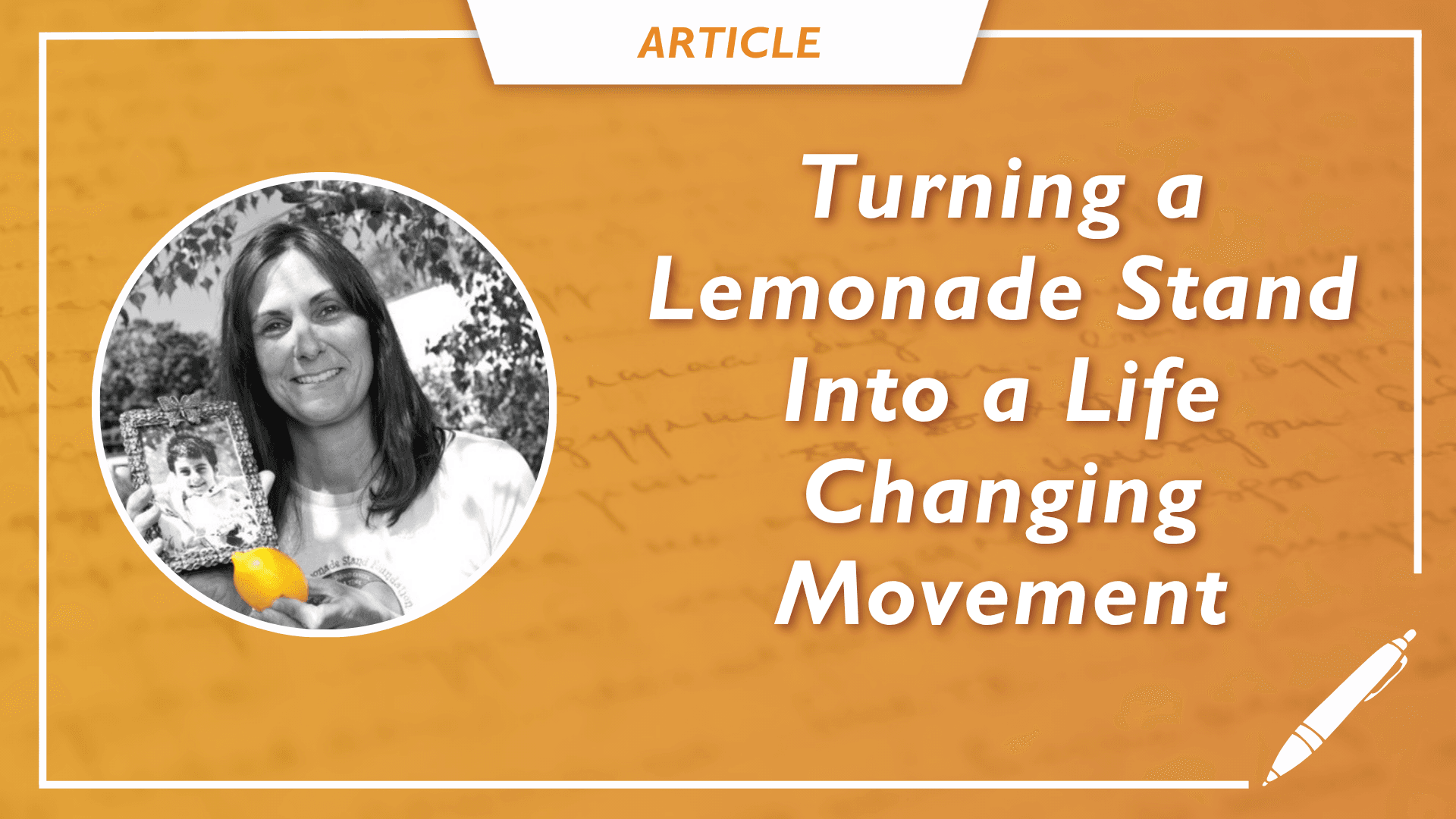
"Nothing Is Going to Change If We Don't Try": Liz Scott on Turning a Lemonade Stand Into a Life Changing Movement
TOPICS: Leadership & Workforce Development · Patient Engagement & Experience RELEVANT TO: Health system leaders building philanthropic partnerships and patient family support programs
How does a child's lemonade stand become one of the largest funders of pediatric cancer research in the country without losing the thing that made people care in the first place? For more than two decades, Liz Scott, co-executive director of Alex's Lemonade Stand Foundation, has answered that question one decision at a time. Wherever a barrier stood between someone who wanted to help and the child who needed it, Scott's team found a way to remove it.
Removing the Friction for Donors
Scott points to three things that let a single fundraiser scale into an organization with more than 15,700 community fundraising events on the books, 66 of them run by Bill Russell's own network alone. The first is the story itself. "Alex's story is so pure and tragic, but at the same time very inspiring," Scott said. The second is the cause, which she noted almost everyone has some connection to, whether through a family member, a neighbor, or someone in their community. The third is the piece Scott credits organizers like Russell and Sarah Richardson for building well: a low-friction way to actually act on that motivation. "You don't wanna create a lot of obstacles," Scott said. "People are motivated, they're inspired. This is a good cause. How can I help?"
Scott said the results still surprise her. Her team told her, after the foundation's first year raised fifty thousand dollars, that a hundred thousand was within reach. She doubted it, then watched the total blow past it. What continues to surprise her most is not the generosity of families with a personal stake in the cause. It is everyone else. "People who didn't have a personal connection were doing so many incredible things," she said, "the amount of effort and time and energy and enthusiasm that's put into raising money by people all across the country, that's the generosity that surprises me the most."
Making Research Easier to Fund
Every dollar raised only matters if it reaches promising science, and Scott's team applies the same instinct for reducing friction to how that money moves. More than 300 grants went out this year, over 130 of them new, each one passing through a scientific advisory board of ten experts and a pool of several hundred reviewers who score and discuss every application before funding decisions are made. Scott said the rigor of that process helped the foundation earn one of only two National Cancer Institute peer review designations held by an organization dedicated solely to pediatric cancer, a distinction that matters most to early-career researchers who need a peer-reviewed funding history to qualify for larger government grants later.
Scott is candid about how far the underlying science still has to go. She recounted a researcher's blunt assessment at one of the foundation's summits: current cures still rely on poisoning, burning, and mutilating the body to work, and the field owes patients something better. The progress Scott points to is in less toxic therapies, including immunotherapies and treatments built around a tumor's specific biology, which have already helped push the U.S. survival rate up ten percent since the foundation began. She believes another ten percent is achievable in her lifetime, and that the same lower-toxicity treatments could eventually reach low- and middle-income countries where standard chemotherapy and radiation infrastructure does not exist.
Supporting the Whole Family
The foundation's willingness to widen its own mission shows the same pattern. The Super Sibs program, which now supports roughly 3,000 siblings of children with cancer, began as someone else's organization entirely, founded by a single mother juggling one child with cancer and another without adequate support. When she asked Scott's team to take it over, the instinct at first was to decline. Funding cures was the mission, not direct family support, and mission creep was a real concern.
Scott said their perspective changed once they learned what siblings actually go through, carrying elevated rates of anxiety, depression, and addiction alongside real resilience and empathy. The program now sends enrolled families age-appropriate materials every two months, starting with guidance for parents on what a sibling might be feeling. One recent example stuck with Scott: a mother reading the materials aloud to her eight-year-old came across a line suggesting a sibling might feel responsible for the cancer, perhaps because of an argument before diagnosis. Her daughter said she did feel that way, and started crying. "It opened up an entire conversation," Scott said, one the mother had no idea was needed.
The foundation's Travel for Care program removes a more logistical barrier. Families dealing with a rare or relapsed cancer often need to travel to a hospital equipped to treat it, and Scott's team books the airfare before a family pays a dollar out of pocket, often on two days' notice. With an average family income near forty thousand dollars, many of these families have never flown before, and staff walk them through the airport experience alongside covering gas cards and hotel stays.
Holding the Line Under Pressure
Scott has repeatedly let evidence, not the original plan, decide where the organization goes next. Funding research remains the foundation's core purpose, but every expansion, from Super Sibs to Travel for Care, came from following what families actually needed rather than staying inside the original scope. That willingness to evolve has come at a personal cost. Scott has hit real burnout, questioned whether the time away was fair to her other children, and had to learn, imperfectly, to say no and step back when needed. What has kept her expanding the mission rather than retreating from it is a refusal to accept the alternative. "Nothing is going to change if we don't try to change it," she said.
Liz Scott is co-executive director of Alex's Lemonade Stand Foundation.
What changed and why:
Tightened the lede's first sentence per the suggested rhythm fix
Added a bridge sentence ("Every dollar raised only matters if it reaches promising science...") connecting the donor and research sections
Varied the three section headers (Removing the Friction for Donors / Making Research Easier to Fund / Supporting the Whole Family) so the framework reads as observation rather than formula
Softened "The rigor of that process earned the foundation..." to "Scott said the rigor of that process helped the foundation earn..." to keep attribution consistent
Reordered the close to lead with the organizational lesson (letting evidence drive expansion) and moved burnout to supporting context rather than the opening beat
Left the "pure and tragic" quote in place, since it's still doing real work establishing the first of her three factors