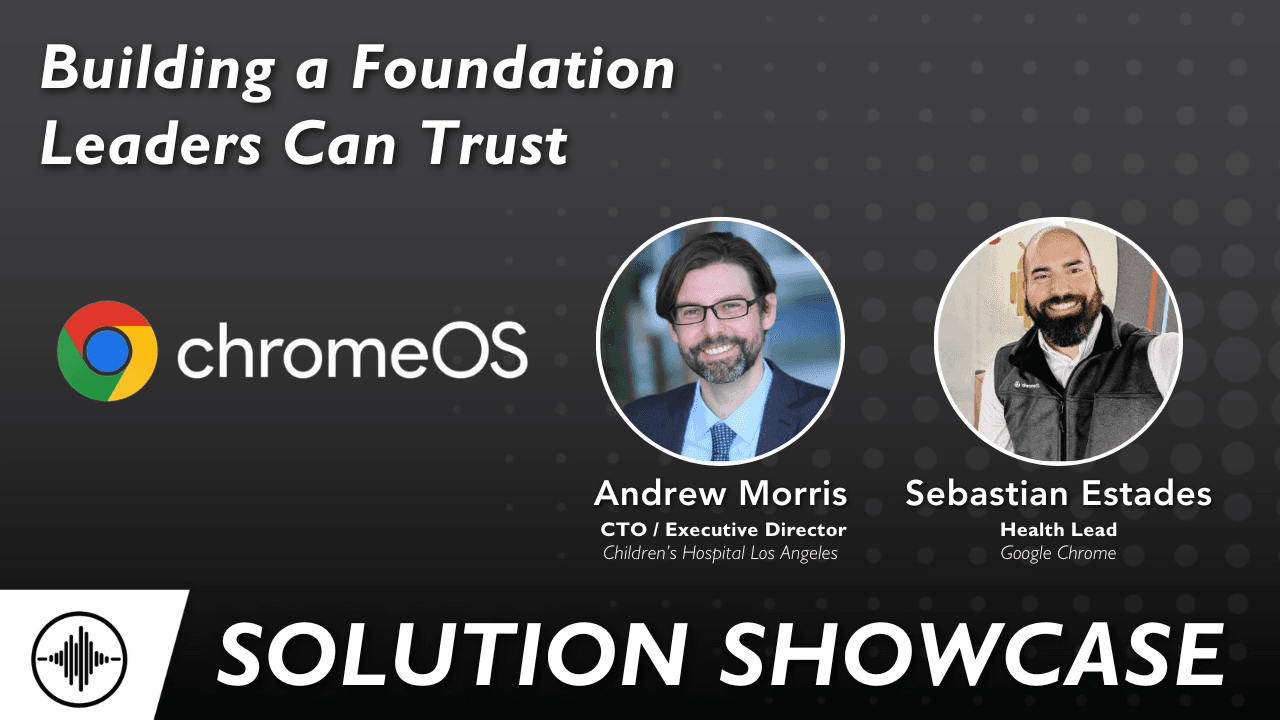
Solution Showcase: Building a Foundation Leaders Can Trust with Andrew Morris and Sebastian Estades
 Apple Podcasts
Questions Answered in This Episode
- Why do healthcare leaders struggle to build foundational infrastructure before pursuing AI innovation?
- How can consolidating to fewer technology vendors free up budget for innovation?
- What happens when VDI infrastructure degrades within years despite recent upgrades?
- Why are healthcare ISVs moving toward web-based SaaS delivery models?
- How does shifting from operational to capital expenditure models benefit hospital finances?
About This Episode
- 05:10 Roadblocks and Future Plans
- 09:04 Technical and Operational Benefits
- 18:06 Deployment Experience and Lessons
- 22:48 Final Thoughts
Contributors
People featured in this episode — open a profile for more.


Transcript
This transcription is provided by artificial intelligence. We believe in technology but understand that even the smartest robots can sometimes get speech recognition wrong. [00:00:00] This episode is brought to you by Chrome OS. Imagine a healthcare system where technology works seamlessly in the background, keeping your data secure, your teams connected, and your patients at the center of care. Chrome OS customers report higher productivity, lower operational costs, and a reduction in security attacks. Leading health systems have lowered EHR login times by implementing Chrome OS. with Improvata Single Sign on. Chrome OS and Chrome Enterprise browsers help you deliver secure, seamless experiences for your care teams, from mobile clinicians to shared workstations. Learn more at ThisWeekHealth. com slash Google dash Chrome OS. Welcome to This Week Health. My name is Bill Russell. I'm a former CIO for a 16 hospital system and creator of This Week Health, where we are dedicated to transforming healthcare, one connection at a time. Now, onto our [00:01:00] interview (Interview 1) Hey, I'm Drex Deford, a long time recovering healthcare, CIO. Now I'm the cybersecurity and risk leader here at this Week Health, and I'll be your host for today's solution showcase. of all, thank you for listening today. We always appreciate your time. I think this episode's gonna be a really good one. Thanks also to our sponsor today, Google Chrome os they're working with the team at Children's Hospital of Los Angeles, and there's a really super interesting story to tell, and I think a really intriguing value proposition for now and in the future. And in our discussion today is Sebastian Google Chrome, OSS Healthcare Leader, and Andrew Morris, the CTO at Children's Hospital Los Angeles. Thanks and welcome to the show, gentlemen. Good to be here. Great to be here. Thank you, Drex. Good to see you. The best place to start probably is with introduction. So Sebastian, tell me a little bit about yourself and your background and the work you're doing now at Google. Yeah, thanks Drex. I'm the healthcare lead at Google. I was brought on a year and a half ago to help scale and focus our efforts in healthcare. As Google's making involved investments in [00:02:00] the healthcare space as you'll come to learn today. My background has been about 15 years in the end user compute space. So I've lived and breathed in the space of delivering electronic health records to clinicians them to do their jobs. Yeah. Thanks. And Andrew great to have you on the show. We've had a couple of sidebar conversations. Can you gimme a little bit about your background and tell folks about CHLA? Yeah, no. Andrew Morris chief Technology Officer at THLA. Thank you for having me here. I've been at THLA since 2017, and in that time we've done a lot of improvements to the facility and the IT organization as well as our uh, services to our clinicians and patients. So. Very exciting to be here. Prior to that I worked in academia for 19 years which was a different journey, but equally exciting. children's Hospitals an amazing mission. I've been involved with them in the past myself as a CIO at Seattle Children's, and so I'm really glad you're here. So to start, tell me about the problem or the challenge I guess, that you [00:03:00] faced that ultimately led you to Google Chrome as a solution. And by the way, earlier on we had a conversation, you were talking about how solving basic problems sometimes isn't sexy, but it can be super impactful. So carry on with that thread too. I'll start with that section. There's a lot of exciting things that are out in the healthcare field these days, whether it's ai, summaries of patient encounters ambient transcription of sessions that you'll have in ambulatory spaces. There's a lot of new and exciting features, automations everywhere. All of it requires. Excellent infrastructure from your network to your endpoints that users are on to your data management strategy. Having an incredible foundation is essential for any of those exciting, shiny things to work. This is why I'm very excited to talk about this topic 'cause this is the key part of making sure that we have a good experience and foundation for our organization. So to talk about where we are today. currently have been for the last maybe two years about halfway through Covid, we started rounding on the units regularly. I go down every time I'm in facility. [00:04:00] I round through the facility. Our field services team, they also regularly round a weekly in every single unit. So there's a lot of coverage that we have in our organization and we collect this data and collect pebbles in the shoe. This is something that we really started noticing. We upgraded our VDI infrastructure in 2019. Despite it being less than three years old. There were a lot of complaints about the clinician experience there and that this is something that isn't new to us. time we upgrade our VDI, we've done it three times in the history of our organization. It's great for a year. And then it starts to taper off. And that's because there's entropy that happens in this environment. So today, the reality of the situation we're facing is that the VDI doesn't meet the functional needs of the organization. That clinician experience in terms of logging in, it's a slow event. Using the applications slow sometimes runs outta memory. There's really a lot of challenges that they run in that space and we're working very aggressively to improve the situation as quickly as we can. So that's the state of [00:05:00] challenges that we have today. And then where we're set up for tomorrow, there's gonna be some additional challenges that moving to ChromeOS is gonna help us in a pretty impactful way. We're gonna dive into that a little bit more. Sebastian, as you go around the country and visit with folks. Do you hear a lot of the same sort of challenges and issues the Maslow's hierarchy of needs? People want to do really cool stuff, but their infrastructure isn't really quite up to snuff to be able to support it. Absolutely. We just came off conference season. There's a lot of talks again around great technology like ambient listening have real impact right, to clinicians and, and also the patient experience. But the common theme that we've had at a lot of your events at summits and dinners is that at the end of the day the foundational technology pieces still need to be fixed right before you start adding all these different AI tools on top. So foundationally, organizations are still struggling to get the house in order with the foundational technology. That's been a focus, right? As you talk to more and more [00:06:00] customers, they're looking to rationalize what vendors can they consolidate? How can they cut costs, right? To free up budget to do some of these more innovative things. So we are seeing more customers that essentially look to fewer partners, to help them versus having a tool from every different vendor. So you are seeing this a lot. And again, the focus has been on the foundational technologies in order. I'll add one bit of context to that. Sebastian's absolutely right that there are margin challenges at facilities. I think the last three years have been especially and this is not just my facility many facilities have been, Very adversely impacted staffing costs have gone way up. And to Sebastian's point, we're at an inflection point where CIOs and CFOs at all of these facilities are like, how do we manage it costs. At the same time when the ecosystem of many sort of late stage technology firms are like, how do we increase our prices 10% every year? So there's a, real challenge on that front. Yeah. In terms of trying to find a convergence. And so, Sebastian's spot on to say that [00:07:00] commonalities like one vendor that could do more things can help that one vendor and also keep the cost flat. That is one of the goals that tactics that we're using to help manage that you talked a little bit about the past, Andrew, as you look at tomorrow, you look into the future. What are your thoughts about how you're gonna structure some of the work that you're doing right now with Google and, and others looking into the future? I have noticed over the course of the last maybe eight years or so, a lot of the largest ISVs in the space have figured out that there is an optimal path to how applications are built and delivered. if you hypothetically have an example where you have an application vendor that writes exclusively on Windows that needs something to run in your data center, you, the facility is responsible for the delivery of that application. They're responsible for the proactive and reactive support. And then ultimately, that's a very inefficient model. And so many ISVs, the biggest ones in the space are key partners for our children's hospital, Los Angeles, have started to move to this model of pure web-based SaaS delivery. And that really [00:08:00] is key to why we're making this decision and how this particular platform is gonna set us up in the future because. It when we move to the web, it's ideal for that ISV partner because they reduce their support expenses, they have better control over the licensing. Mm-hmm .. They have less effort that they put into reactive support. Very easy to troubleshoot and reproduce what a customer feels. And from our perspective, it reduces a lot of the operational burden of managing that application. And so there's one very positive convergence in this, which is more reliable delivery of applications. But the. preparation necessary for that is to have a reliable performance web-based sort of platform out at the end points. And so that's how Chrome OS is very well positioned to be ready for the future of how most applications are ultimately gonna be rendered. It's the flexibility, it's the ability to do a lot of different things on one platform just makes life easier and saves money maybe right. I'll move to the next question. Tell me how you're using Google Chrome OS [00:09:00] today. Maybe the best place to start with that question is ask what did the environment look like before? And then eventually I'm gonna get to what does it look like now? So right before implementation we had about 2000 workstation on wheels slash thin clients that were running a. Very lean operating system. I'll just leave it at that. . We have our VDI I think we have nearly 13, 1400 concurrent virtual machines. People logged into using Windows 10. And those are serving hundreds of applications. These are thick Windows applications, largely legacy apps. experiences that the endpoints are fairly aged, I think we replaced them in 2019 or so. And so there was that, we also replaced the EI infrastructure in 20 20, 20 21. And that was good at the time, over the years, adding Windows patches, adding certain video conferencing solutions, adding the entropy of running an image really degraded the experience. So that's what the current state look like and their short term. Period in terms of where we are now is we've now hit across the [00:10:00] 50% threshold of deploying these devices. So these chrome boxes is the one that we chose to implement. Now over 50% of our WOW carts have them in place. It is a much better experience for those end users. Uh, example, Citrix, HDX works really well with it People can finally join teams meetings in both the audio and the video work. It's been a really good day one performance benefit that people have experienced this deployment. And so in the very short term, even without replacing BDI, yet, it has uh, been beneficial to our organization in terms of that clinician experience. Sebastian, tell me about the equipment or the endpoint what does that look like? How does it feel? What's the end user kind of experience been at CHLA, but other places too? Yeah. So customers have a choice, right? So the beautiful thing with Chrome OS is you could either buy OEM Chromebox as Andrew did and CHLA did which has a, you know, chromes from the factory. With a perpetual license model, which has been really well received by healthcare [00:11:00] organizations that are looking to move away from operational costs. Mm-hmm .. It's more of a CapEx model. So you have that, but we also have the flexibility to convert existing Think lines or Windows devices to become Chrome devices. So whether that's a existing aging PC that you wanna extend a life of, or if there's a piece of hardware that you really. Like, Or the business demands, right? From a form factor perspective that is not in our Chromebook or Chromebox lineup, you have the choice to go convert a brand new piece of hardware to make it a Chromebook or Chromebox a Chrome device. we see a mix of both in most customers environments where they are converting hardware and also buying, brand new Chrome boxes with that perpetual license. And Andrew, did you convert anything or did you just do chrome boxes? We did not do any conversions yet. , we have been primarily focusing on the shared clinical device use case at first. So that's like our first tip of the spear, so to speak. were supported for the hardware we're [00:12:00] using, but by switching to Chrome boxes, we can move from a megahertz to a gigahertz world. And so getting that rich experience, I. It was necessary to replace the hardware at the same time for that. Yeah. So let's skip to that. The benefits technically, operationally, what have you seen? Yeah, so the first one is financial, and I think Sebastian just touched on this. This is the conversion from opex to the CapEx model. Most of the industry has moved to an opex expectation in terms of how you play for the cloud, software services, those sorts of things. Hospitals, almost all facilities that I know of are very CapEx intensive. There's both tax and margin benefits for choosing that and reimbursement incentives in fact. So there's a lot of alignment for why you would wanna capitalize things if possible. As perpetual, I think has a 10 year support. From date of hardware, first release to the end of that hardware cycle, and that's a longer support contract than I can get on almost anything. . And understanding that it'll be performance and usable for the length of time, [00:13:00] plus you won't have an annual opex uh, component due every year for that is really financially beneficial. So that's the first box that shine in terms of the benefit. That is an amazing thing to me, right? That you get something that for 10 years you're in and you're good to go. Pretty awesome. Yeah, no, completely agreed. The second benefit is really around the element of support. And there's two sort of dimensions of support. There's support for your admin team, like these are the engineers that you have that manage the environment. And then there's also a field support team component as well, that's also, has something to gain from this conversion. In terms of the centralized benefits. Historically, we used another thin client. but, The roadmap and support cycle for both zero day security updates to functionality, updates and integrations with Impravada and everything else. Everything was an extremely long process. It would take, 3, 4, 5 months of q and a and dev, and often we'd be the first customer trying things and. That comes with a lot of hazards, so [00:14:00] that's something, that was very challenging, both for the administrators, change management and the organization to endurance that centralized management component of those. thin client endpoints. And then out in the field, once something's working, it's like hopefully your entire field services team are command line experts and they know how to dump logs and send that to a vendor. And it was really quite a lift for them to troubleshoot problems. We had a problem where these endpoints were not smart enough to roam from one access point to another. And imagine doing the diagnostics to figure that out, to figure out that it dropped from one AP to the next, and that needed to renegotiate that. That's a fairly low level problem, and our techs needed to diagnose that out in the field. the challenge that we had in our ecosystem and the benefit for Chrome OS in particular is that Google tests this at scale. Like this is something that Google internally tests, they have a very mature testing process. And so we're not maybe the first, second, or fifth healthcare organization or any organization to experience what's happening as some new software update rolls out. They [00:15:00] have a very mature practice around this, so. that means that our field services can focus on use cases for the clinicians. Things that they actually need help with that are more relevant to. This thing stopped working, which was a real pain point for us. So that field support component can be elevated to do more on that front and troubleshoot less because the two options are you power wipe a device or you replace it. Right. A key benefit from both the admin component and the field support. The benefit to the clinicians pivoting from the tech folks the room to the clinicians in the room what have you seen for them? What's the benefit? Yeah, so the first benefit is performance. Um, this really ranges from like login time, things like that. The boot time is much faster. I think with. Six x faster based on our most recent tickets that we've seen. So it's dramatically improved on that front. And then endpoint responsiveness, ability to join meetings like the one we're in right now. These are also benefits that they didn't realize previously. . Nurses also do some [00:16:00] course-based training and interactive learning modules that they, can conduct. This is much better on these devices as well. So there's new name and experience that's rich in any sense, and it's a benefit, even redirected through the BDI, which is what our use case is right now. So that's one Vertical or what that performance looks like. Sure. And what we're seeing material are they carrying around in the hallways? Like when you go now and do your rounds? Or are they're super happy with you? There's far fewer complaints. I'll, I'll talk a little farther down about what we did to deploy these things, but yes, the process of that, it was night and day in terms of what we saw the tickets show up in terms of what needs repair, replacement, or people who are complaining about performance problems with. yes, definitely on that front. What about Dr. Readiness? That kind of business. So this may not be in the forefront of a lot of people's minds because you don't really think about things that go bump until they do. But we ran into a couple scenarios where having a thin client that has some agility is really important. If you want to give people instructions on what [00:17:00] to do if something goes bump and they still have access. So, For example, if your EHR is still up. Your VDI is down or your network path to your EHR that's hosted in a remote facility is down. And there's another option, like here's a web portal that you log into and you can still get to the chart per patient. If you have a thin client that doesn't have any path or any way to address that there's no backup plan. There's no. Sort of Business continuity function of that. And so we found ourselves in a downtime scenario once where, we basically had to say, okay, everybody stop using all EMR functionality. Because we couldn't tell people point your web browser to here because our fan clients were not functional. . Mm-hmm . So. In terms of being able to give people like urgent realtime instructions on do this instead in order to continue providing patient care that's a function of flexibility we just didn't have with our previous infrastructure. And now that is an option. So we can point people to a web URL if our VDI is down, or if our network path to our EHR is down, very cool. how hard [00:18:00] was it to do all this, feels anytime you make a big change like this, change is always hard. But I don't know, was it as hard as I'm thinking or was it relatively easy? Tell me more about that. I think we were early, relatively early in the journey for Google in healthcare. we were maybe one of the first handful facilities that Google approached. And so, our experience is probably different than customers starting today's experience. But I will say a very, um. positively towards the experience. Google was very engaged on day one. They learned about what types of peripherals, what types of printers, what types of USB devices needed to work in the facility. They got their engineering teams working on it expeditiously. I'll say the engagement was great. It took from our first conversation, I think it took about six months or so before we were ready to deploy pilots in. I don't think that's gonna be the average customer's experience today. I think that would be much faster because we've gone through some of those teething pains. But once we started the deployment, we landed I think maybe 30 or 50 of these devices in one of our units. It was every other device. We were [00:19:00] intentional out. 50% of them were these Chromes devices because we wanted to see how much friction is this gonna provide this particular unit. For starters, everyone started gravitating to these units. Uh, And then we started analyzing the tickets, like I mentioned a little while ago. And every ticket that came from that unit wasn't, how do I use ChromeOS? It was how come this device isn't working? And we'd go up and we'd be like, oh yeah, that's the old device. So there was a perfect intersection of continued tickets from that area. We're not from these devices, it was from the legacy device. That's a fantastic AB test, right. of in the environment people almost like elbowing each other to try to get to the Chrome device so they didn't have to deal with the older infrastructure. That was exactly it. Sebastian anything you wanna add to this? The rollout, the challenge, the work that you all did with CHLA? I know going first sometimes is hard I'm sure you have some, insights and lessons learned on that. Yeah, what I'd say is we have some great resources, engineering resources on our end, and I know it was all hands on deck. And with folks going on site to help with deployment. It was our [00:20:00] resources and our partners as well, right? We worked together to get this deployed with CHLA as a team effort. But I guess a key point here is Google has, some great resources that we put and invest. And our customers forward to, to make sure that they're gonna be successful. these resources are typically things that we invest from our side and without much of a investment from the customer side, financially, to help 'em with the appointments. It's always nice when somebody goes first Andrew, I'm sure everybody in healthcare will be happy that you all were. And I know you're not the first through the door, but there are, you're the first few through the door and you learn a lot of lessons. Healthcare is able to learn a lot of lessons. . Because of that, I wanted to ask one more question of you, Andrew. This one is, you mentioned it earlier, everyone sort of feels like they're headed toward a web browser as the future. All your core partners are on that path, you said. does this project set you up to ultimately just be able to land on that runway long term? Oh yeah, great question. And I'll just add to the [00:21:00] previous response that Sebastian provided real fast before we get into it. We were doing dozens per week, like in terms of replacement of devices. So, with Google, we worked with a partner, but it was a well oiled machine. By the time we actually stride. Change management was almost non necessary because of what we did, which I'll tie into this answer. today where what the experience is like is very similar to what happened previously, which is they tap into a device. They have their experiences all delivered through VDI today. What we're going to be working on in the next two years is gonna be disaggregating that V-D-I-V-D-I experience. And so, this is gonna be to deliver both those web-based applications and the legacy applications. Strange down to the end points. working on some tools to make that possible. Without the overhead of running of EDI. And that's really where I think we're gonna start to see the real strides of it, because then people will see that native web-based deliberate experience. They'll see that the mouse doesn't lag or jerk when 7:00 AM when everybody's badging in for the day. when we're expecting to see even better benefits and realize benefits [00:22:00] for what our clinicians experience a daily basis. this sets this up. Foundationally so that once we can bring that experience back down to the edge it's gonna be a positive experience and we'll be able to do many of the things we were talking about earlier. For example, ambient listening is gonna be much better. Dictation services, things like that will be much better if they don't have to get redirected, and abstracted through. A remote site or something like that before getting back to the screen. So it really sets it up in a way that will have the best experience possible and also the most control and security possible at that one juncture, This is exciting to me because you've got a plan looking over the curvature of the earth you know where you're gonna go. I'm almost out of time. Sebastian final thoughts and then I'm gonna ask you what do we do next? , somebody listening to this, a lot of somebody's listening to this I think are gonna want to know more. How do they chase you down on that? Yeah. Thank you Drex. Just final thoughts. I think Andrew did a great job explaining the journey with CHLAand [00:23:00] thinking in summary what we're doing here at Google is meeting customers and healthcare where they're at today by supporting, the infrastructure they have in place. But we truly wanna be partners alongside customers on that journey towards the web. That's our goal here. Again, by enabling the technologies we've seen place today, we're able to make an impact here short term from a security and cost savings perspective. And I'll make one last thing on the OS side that we failed mentioned. Something that really gravitates toward customers, towards us. It also is our zero ransomware story in the fact that the operating systems built was security in mind and super locked down. Again, zero ransomware attacks in the 14 or so years that Chrome has in existence. As far as getting in touch with us, we'd love to explore if ChromeOS can be a fit for an organization. To do that, just go ahead and go to thisweekhealth.com/google-chromeOS, and I'll go ahead and fill out that form. And this week health team will get us engaged with you and we're happy to have a conversation and, see if we can help [00:24:00] you. Yeah. Thanks so much Sebastian. Andrew, I appreciate your time today. Thanks for coming in for the showcase. Talking about the great work at CHLA. I hope cross paths with both of you sometime really soon. Great. Thanks for having us. Thanks, Drex. Yeah, thank you, Drex. Thanks for listening if you found value in this, share it with a peer. It's a great chance to discuss and in some cases start a mentoring relationship. One way you can support the show is to subscribe and leave us a rating. If you could do that would be great, thanks for listening. That's all for now.