 Apple Podcasts
Questions Answered in This Episode
- Who acts when the CAC tool flags a case?
- How did UTMB go from 1 to 22 agents in 12 months?
- If the agent is mission-critical, who takes the 4 a.m. call?
About This Episode
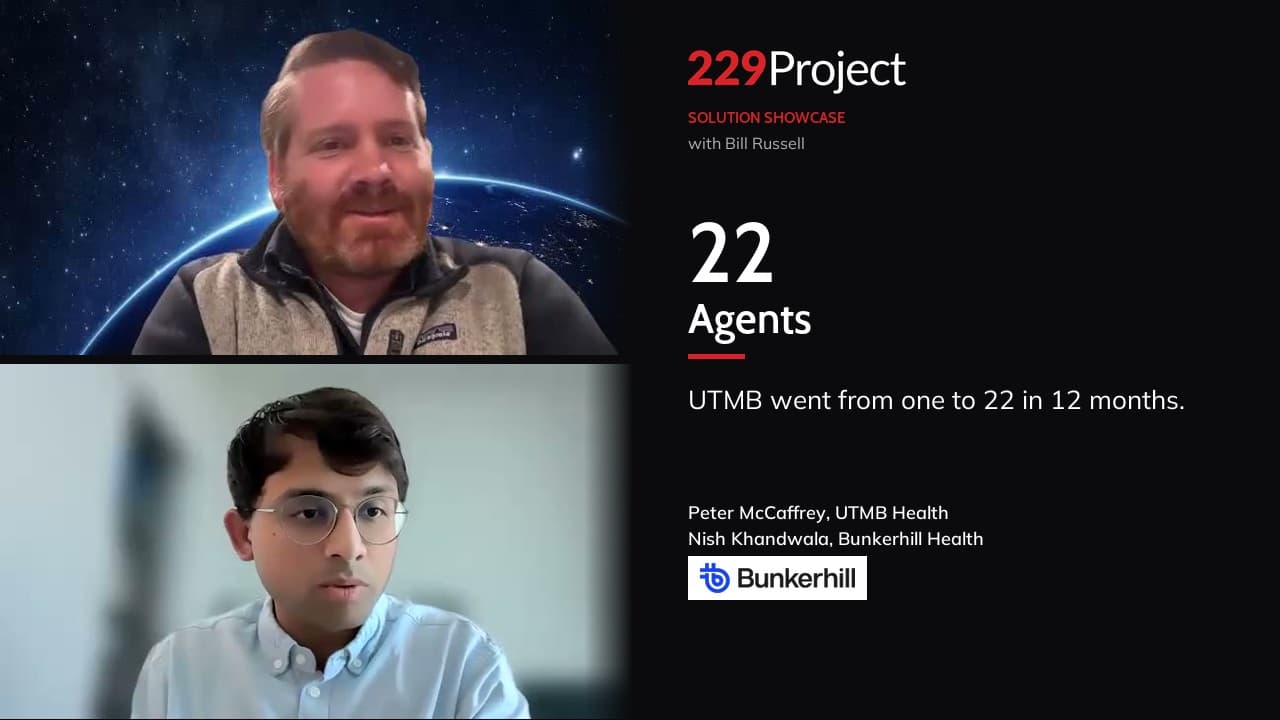
September 16, 2026: Nish Khandwala, Co-Founder and CEO of Bunkerhill Health, and Dr. Peter McCaffrey, Chief Digital and AI Officer at UTMB Health, join Bill Russell. UTMB started with an FDA-cleared incidental coronary artery calcium algorithm. The next question was the workflow: who sees the flag, who acts, do you hire a navigator. Agents now pull the image, the chart context, and the downstream tasks. In 12 months UTMB went from one live agent to 22 on a single instance: missed patients, prior auth, care pathways, referral access.
Key Points:
0:00 Open
0:06 Solution Showcase
0:39 What Bunkerhill is
3:10 Incidental calcium, then what
5:56 Open systems vs Epic
9:10 What's this going to cost
11:25 22 agents in 12 months
13:29 You can also build expensive RPA
16:55 If the agent is a toy
20:05 Forward-deployed engineers
23:17 Close
Donate: Alex's Lemonade Stand: Foundation for Childhood Cancer
Thank You to Our Episode Partner

Contributors
People featured in this episode — open a profile for more.

Transcript
This transcription is provided by artificial intelligence. We believe in technology but understand that even the smartest robots can sometimes get speech recognition wrong.
22 Agents in 12 Months | Solution Showcase with UTMB
[00:00:06] Bill: All right, today we have a Solution Showcase, and I'm excited. We are going to talk about something that we rarely talk about. We're going to talk about AI. Just kidding, we've been talking about AI pretty much, this entire year in our 229 project meetings. Just got back from UGM, they talked about AI. Today, we are joined by Nish Khandwala, co-founder, CEO of Bunker Hill Health.
[00:00:28] Bill: And, Dr. Peter McCaffrey, Chief Digital and AI Officer, UTMB Health. And, gentlemen, I'm looking forward to this conversation.
[00:00:39] Nish: Yeah. Thanks for having us, Bill. Yeah, I'm happy to give you a quick brief on what we do here at Bunker Hill. The name actually comes from a TV show called Pure Genius that aired in, 2017, I believe. And it was around a hospital called Bunker Hill, where ideas that people had in the morning were used in clinical practice in the afternoon.
[00:01:03] Nish: And that speed of translation of taking half a day, when it was taking me half a decade at Stanford in my prior hat as a researcher there, was… I was very envious of that. And so, Bunker Hill's entire origination came from being envious of that TV show where ideas moved at the speed of
[00:01:23] Nish: At the speed of thought, and, like, ideas moved from being in people's heads to something that's used in practice that rapidly.
[00:01:30] Nish: More concretely, what we do at Bunker Hill is that we offer two value propositions. The first is an AI agent that lives in all of your systems, your EHR, your ERP, all the long tail of portals that you use as a hospital, so all the applications. And that agent is a long horizon agent.
[00:01:53] Nish: What I mean by that is that it actually tries to solve for an objective as opposed to perform tasks. So it goes across different systems, and it solves for an objective that you have as a health system. It does that work end-to-end. And most high-value workflows actually require you
[00:02:14] Nish: To have that amount of breadth across different systems. And actually solve for that objective. That's the first value proposition. The second value proposition is our team of forward-deployed engineers. Who actually work with
[00:02:32] Nish: operational leaders, clinical leaders that are recommended to us by the C-suite at the health systems that we work with.
[00:02:40] Nish: to actually take our product and build that agent to solve for that particular objective. So these forward-deployed engineers build agents, they are the ones who are accountable, they are the ones who get called if things go south at 4 in the morning, and they are the ones who are responsible for change management. So, these forward deployed people use our product, To build that agent.
[00:03:05] Nish: That lives across all of the systems and solves for an objective. That's what we do.
[00:03:09] Bill: So, Dr. McCaffrey, I'd love to pull you in here, because you have, some live deployments already in… give us some color around how you're utilizing this tool, and why you brought this tool in.
[00:03:25] Peter: Yeah, so, it's an interesting story. When we originally started, working with Bunker Hill in particular, we were looking in almost a… pre-agent era. We were looking, of course, we were ideating what agents could be and what they could do, but we also deployed a specific FDA-cleared diagnostic tool that's not itself an agent. This was the…
[00:03:47] Peter: incidental coronary artery calcification, or ICAC, module, and it's, so Bunker Hill does, agents, but also non-agent things that are FDA-cleared algorithms, so we were interested in that. We deployed that. And it sort of provoked us to think about navigation, as with anything, right? So you deploy a tool, you have to have a workflow around the tool.
[00:04:07] Peter: And, it was interesting timing, because right as we were considering, well, you know, we've deployed this ICAC tool, it generates flagged cases, then what? You know, who reviews this context and takes action? Where does it go? Who notifies whom? Do we need a nurse navigator, and where does this team come from?
[00:04:26] Peter: That we recognize, kind of, the need for agents to serve net new work, and we began to reflect a lot on the fact that healthcare is facing a tremendous amount of net new work in many ways. Talk about that later, but there's a lot of new jobs to be done.
[00:04:40] Peter: So it was fitting to begin in that segment with agents. Can agents retrieve those flags and images, contextualize them from the chart? Is the patient on a statin? Have they seen cardiology before? And so forth and so forth. and really bring this dossier to the clinician to review and agree, and then effectuate the downstream tasks. Make that note, file it in the chart, trigger an in-basket notification, and so forth, and saving those clicks. What began there.
[00:05:05] Peter: really showed us that this… a lot of the work we do in and around our EHR in our health system is inherently identical. That… that is, happens to be a CAIC-based workflow.
[00:05:17] Peter: But it is not a CAIC-based concept of work. And so, now we see things spanning, I would say, a surprisingly diverse set of uses. So it was once imaging and CAC, it's now things like benefits prior authorization, referral triage, inventory management, lung nodule classification and prognostication, and many, many, many other kinds of things.
[00:05:39] Peter: And so, what we have seen is… a tremendous potential to standardize the way you compose work out of a common, reusable set of ingredients or components, and that has really taken off a lot laterally across the enterprise.
[00:05:56] Bill: And, Nish, I'd love to hear from you. How you feel like this compares to something like Agent Factory for those who are epic shops?
[00:06:06] Nish: Most of the health systems that we work with are Epic First as well. I… go back to this interview that I saw with Jeff Bezos a couple of years ago, where somebody asked him. What do you predict will happen, like, 10 years down the road?
[00:06:23] Nish: And he actually flipped that question and said, I do not know what's going to happen in 10 years, but I can tell you what won't change about our customers. Our customers will always want things to be cheaper, and would always want deliveries to be done faster. And no matter what happens, those two things are going to remain invariance with time. And so, rather than us trying to predict
[00:06:46] Nish: how the Epic Agent factory is going to look. What it's gonna do. how what the current demos look like, it's more important for us as a company and as an ecosystem to ask the question of what Epic won't do because of their DNA, because of their stated priorities, who they are as an organization.
[00:07:05] Nish: And the first one is that Epic prefers to own systems as opposed to be open about systems. Like, they would much rather build an ERP of their own as opposed to work with one. Is a big example. And so, one of our axioms is that Our product must
[00:07:26] Nish: interact and be incredibly open. It must work with every system that the hospital has. most… and why is that important, right? Like, why should we just do things for the sake of doing it? It's not that. It's that most high-value workflows actually require the agents to be able to work with them in multiple different systems.
[00:07:47] Nish: I will give some examples, like Dr. McCaffrey mentioned, prior auth for pharmacy. Sure, the record of the patients is in the EHR, but the questions the… what the payer is asking is in the software called Cover My Meds, which is… which lives outside of the EHR. Let's take registry data obstruction. Again, yes, the data about the patients is in
[00:08:09] Nish: the EHR, but the portals, like the ones from American College of Cardiology, the American Cancer Society, those are portals that live outside of the EHR. you take…
[00:08:22] Nish: other examples, like even some basic ones, like, let's say a PCP leaves the health system, how do you assign all the patients that were being treated by their PCP that were being managed by their PCP to other PCPs? Now, that requires you to actually work with the ERP as well as the EHR. So very few workflows actually start and end inside of the EHR without leaving the EHR.
[00:08:46] Nish: And so, rather than… taking the position that the agents must only do in the… must do work in the EHR, or anything owned by specifically EFIC, we take the stance that it should actually span different systems. So that's the first thing. Most high-value workflows require your agents to span multiple different systems. And we are open by definition, by construction.
[00:09:10] Bill: What's this gonna cost? Right? And you're talking about this trade. It's like, it's okay if it costs this, as long as it, you know, as long as your denials go down, as long as… there's some… there's some balancing of it, but when people walked out of there, I'm not sure they understood
[00:09:28] Bill: what turning it on in Emmy or Penny or whatever was going to cost them. I mean, Nish, could you talk a little bit about how you… how you addressed that concern of this variable costing with regard to AI?
[00:09:42] Nish: So… I think there are different business models that work based on the objectives of the company. Our objective is to reduce the cost of iteration, to increase the speed of iteration.
[00:09:54] Nish: We do not want health systems to feel like they're being locked in for any specific use case. Especially if you have an experimental idea, things are just, like, cool, that you want to do, but are experimental. We don't want you to feel like you need to sign a 3-5 year contract that you can't get out of. That you have to commit six figures, 7 figures on an annual basis to do something like that.
[00:10:16] Nish: And so what we instead do is, we say, let's make it super simple. We are gonna have a pool of AIC credits, a fixed pool. A defined pool that is bought by the hospitals at the beginning of the quarter, beginning of the year, depends on how you want to frame it. And somebody like Peter McCaffrey at the hospital would decide which use cases get how many credits.
[00:10:40] Nish: And it's a fixed pool, so you're not getting, like, a bill at the end of the quarter that you were not expecting. You've already paid for the credits, you already have the credits.
[00:10:49] Nish: And then what that allows you to do is rapidly iterate, rapidly double down on the things that are working. So if you try an experimental use case, and it doesn't work out, you're not tied to it, you just stop spending AI credits on it immediately, and then repurpose the allocated credits to a different use case that you have in mind. Those credits also never expire, so they roll over if you
[00:11:11] Nish: end up not spending all of them, and what that ends up happening is that you see a place like UTMB that has gone from 1 to 22 agents on Bunker Hill within the span of 12 months.
[00:11:25] Nish: 22 agents that are live in production, that are delivering core functionalities, all the way from picking up patients that otherwise would not have been found, to prior authorization, to care pathways, to referral access and patient access. Like, all of these use cases are enabled on a single agent, on a single Bunker Hill instance, that… and it's based on that portfolio that Dr. McCaffrey manages at UTMB.
[00:11:51] Bill: I was talking to someone who said, this is just the next iteration of RPA.
[00:11:57] Nish: And I thought.
[00:11:58] Bill: Hmm, I'm not sure that's accurate. So I want to dive into this a little bit. When you say agent, what does that actually mean, and how is that different from, like, the next level of automation?
[00:12:11] Nish: Yeah. Maybe we can take an example outside of healthcare to explain this. Like, here's how we think about an agent, and we specifically call them long horizon agents, for that matter. Which is, imagine you could give an agent saying, here's $100. Go make me $1,000 in the next year from this $100.
[00:12:31] Nish: You haven't given it any explicit instructions, which is go invest 50 out of this 100 into Nvidia, another 25 into an ETF, another 25 into some other stock. You've effectively just given it an objective. And you have given it what the inputs are and what the parameters need to be, and the agent is figuring it out.
[00:12:52] Nish: And RPA would be closer to what it would be if you had to say, here's $100,
[00:12:59] Nish: go, and, you know, use RPA to now invest 15 to Google, 15 to NVIDIA, and I've told you exactly what to do. You're just basically running the computer on my behalf. We're effectively creating a structured data out of unstructured data, but then still following a deterministic process from there.
[00:13:19] Nish: So, like, the difference between those two is the difference between agents and a fancy or next iteration of an RPA. We can now translate that to healthcare, but I'll pause here.
[00:13:29] Peter: Yeah, so I think, we have lots of thoughts on this, and Nish and I talk about this a lot. So I think it is very possible that you can implement agents in such a way that you have effectively just created a much more expensive RPA. And I think what health systems should recognize is
[00:13:47] Peter: Agents will be, I think, a very powerful tool for the workforce, but we… we may be overly reductive in saying, oh, I just turn on agents, and I do the agent things. It's like, you are inheriting sort of a developmental mantle to do this in a certain way that has a spectrum of being done well or being done poorly.
[00:14:06] Peter: What's interesting about that is the temptation, especially when you locate agent creation in the same place you locate steady-state configuration of something as critical as your system of record. Not that it can't be compatible, but one of the challenges are
[00:14:21] Peter: you'll tend to view agents as an imperative, cleanly structured thing. Like, this graph is the workflow. It has these steps, and they go here, and that's how this work is done. But I think if we reflected honestly on the way
[00:14:38] Peter: Work happens in all of our enterprises. Anytime you have tried to do a workflow mapping exercise, you realize that none of your representations are universally accurate. They are, in some ways, an illusion that management has about what happens on the front line.
[00:14:57] Peter: What happens on the front line is an emergent outcome of individual, rational entities knowing what they must do, and constrained by what they must not do.
[00:15:07] Peter: And I think that, yes, even today, with something like CAIC, we have agents that are more constrained and more imperative in a simple way. Yes, you know, take the image and extract this calcium score and pull whether they're on a statin and do these things and craft the note fine. But where I think this is going, very, very quickly. Is to where what agent work looks like is less and less
[00:15:31] Peter: usefully amenable to something that, like, a typical IT enterprise would be comfortable seeing. They're saying, I want to be able to define the state, define the work, that's a thing, it looks like this. And that probably isn't where really, really effective agents look in a year from now. And I think this is a bit antithetical to sort of how we view centralized kind of IT control, because an agent might say, hey.
[00:15:55] Peter: your team is supposed to get this done, and be mindful that you get this done without transgressing error XYZ. But you may decide that, let's take a payer example.
[00:16:06] Peter: Payers are not, they're not a thing in the way that, like, the growth of a brain tumor is an objective thing. It happens at a certain pace. You want to discover it, you want to deal with it. Payers are a marketplace. There's behavior and counterbehavior. Instability and pivoting is critical for success, actually.
[00:16:26] Peter: So you can't just say, that's what we do, and we automate it. You have to be responsive to perturbations, you know? This is inherently difficult to define in a way that is typically comfortable for the top-down enterprise, which is why, as a last point, if you go to leadership and you say, tell me, as the VP, what you think the work looks like on the front line.
[00:16:45] Peter: It is never in anything like work that happens at the front line. And so I think that will just recycle this with agents, very potentially, in the world we're going into.
[00:16:55] Bill: Even with all the tools that are available, you have some health systems that are sort of sitting on the sideline right now, saying, hey, we don't have the capability, we don't have the staff, we don't… we're not sure we're going to be able to stand this up, and… Be able to, really,
[00:17:14] Bill: I don't know, vouch for the quality of the program. And I'd love for you to talk to those organizations right now that are sort of sitting in that camp.
[00:17:23] Nish: Yeah. I think when we think about a build-your-own-agent. People get excited about the idea of the building part of it, but then These are agents that are going to continue to work, and… the world is evolving, circumstances evolve, things break, AWS goes down.
[00:17:44] Nish: It's like, if the agent is not a toy, it's a mission-critical function. You know, which is what the North Star is. If these agents are nothing but toys, I think we as an industry have failed healthcare yet again.
[00:17:57] Nish: But if these are truly mission-critical pieces, and they go down, there's a whole aspect of customer support and customer success that is not a part of the conversation when people think about building your own agent.
[00:18:12] Nish: Your researcher, your service line lead, the head of pharmacy, the head of cardiology, like, everyone gets excited about building the agents. Nobody gets excited about the idea of getting a call at 3 in the morning or at 4 in the morning when something critical goes down.
[00:18:30] Nish: And that's the part which I really, hope that people consider as they consider these, like, DIY tools to build agents. That's one aspect. The other aspect is, and I can't believe it's someone from outside the hospital advocating for this, is change management. When you have a new agent, when you have an agent having new capabilities that is performing a new task.
[00:18:54] Nish: that is performing a new, sort of type of work, there is going to be inherently some change management involved. You have to ask people to incorporate that into their work, you have to ask people to respond to it, you have to ask people to not do certain things because the agent is taking care of it. Who's going to do that?
[00:19:13] Nish: Right? Like, even if… even if you have the simplest of the simplest agents that are doing very simple work, even for those, there's going to be some change management involved. So I think I urge people to consider, not when you think about building our own agents, not just the building part, but also the customer support, or the part around maintenance, and then the part around change management. And this is even… all assuming…
[00:19:38] Nish: that the company that is providing the agent is abstracting away things like monitoring, things like AI drift, things like, oh, you should not be worrying about, should I be using GPT 5.6, or should I be using Fable 5?
[00:19:53] Nish: You know, like, none of those need to be things that the health system is necessarily worrying about. Like, that is all assuming the company's abstracting that away from the health system.
[00:20:04] Bill: So, dr. McCaffrey, the, the… the value proposition of working with Bunker Hill is tied significantly to these four deployed engineers. I'd love to get an idea of what it's like working with that team on a day-to-day basis.
[00:20:22] Peter: Yeah, so I think for deployed engineers, I had believed this before, I'm extra convicted of it now, are not only ineffective, but I would say probably an essential component to do this successfully. I think…
[00:20:35] Peter: As of many things in the past, totally build your own is fun, but unlikely to scale, and probably not capital efficient for hospitals to do. Working with an informed FDE makes a lot of sense, but FDEs can vary, I think, in their utility, so is it someone who understands
[00:20:54] Peter: they never understand your problem as well as you do, per se, but do they understand at least the toolset they're working with, and are they receptive to your problem? And can they… do they have, I guess, the social IQ to work well with your organization, with people? And I'm sure you've seen any kind of relationship, be it consulting, FTEs, vendors that can go north, that can go south.
[00:21:13] Peter: And so, this advocates for, I think, a meta sort of axiom that we've seen with tools, very… it's exceptionally true of Bunker Hill in our enterprise, which is that working with a platform versus point solutions would be just a blanket piece of advice I would give to people here, because it's the consistency.
[00:21:31] Peter: Not just of the integrations, and the attack surface, and the cybersec, and the, you know, the contract's fine. But it's the cultural consistency of who's talking to whom.
[00:21:42] Peter: who's working on what, what it looks and feels like to build together, that you begin to, for lack of a better word, like, vibe together well over time. And this is really, really critical. And it's one of the things where if you don't have it really well, it eats away at your momentum and your organizational effectiveness anywhere it occurs in your workforce, whether it's between you and a vendor, or internally in your own teams. And so what we've observed with sort of the way the
[00:22:06] Peter: FTEs have worked in our enterprise. is very much have built, yes, observable relationships, but independently meaningful, high-trust, useful relationships, laterally with champions across our enterprise, where they will go and work with a champion-need area, ideate and prototype together.
[00:22:27] Peter: And ultimately, that's what you're really trying to get, you know? And a good platform should get your organization into a mental place where you're doing that kind of thing at that kind of cadence. But I will say, you gotta pick the right team to work with, absolutely, and then you should consistently
[00:22:46] Peter: show progress with that same team, because you have to acculturate the broad organization to this way of doing things. We have 18,000 people at your TMB, you know, it takes time, right? It's with consistency that you build that comfort, but man, when it's there, and when it's aligned.
[00:23:03] Peter: It's amazing how efficient you can be at executing with common protocols in a aligned way to bring ideas to life in a way that is not chaotic. That has been really, really eye-opening to see.
[00:23:17] Bill: It's an exciting time to be in healthcare. I mean, to have those tools, to have… Really does open up innovation. to the front lines, and to really think about things differently, and to build those kinds of tools. Nish and Dr. McCaffrey, I want to thank you for your time, and I look forward to following up with you guys and hearing more about it.
[00:23:38] Nish: Thanks, Bill.
[00:23:39] Peter: Thank you so much.
[00:23:40] Nish: Thanks for having us.