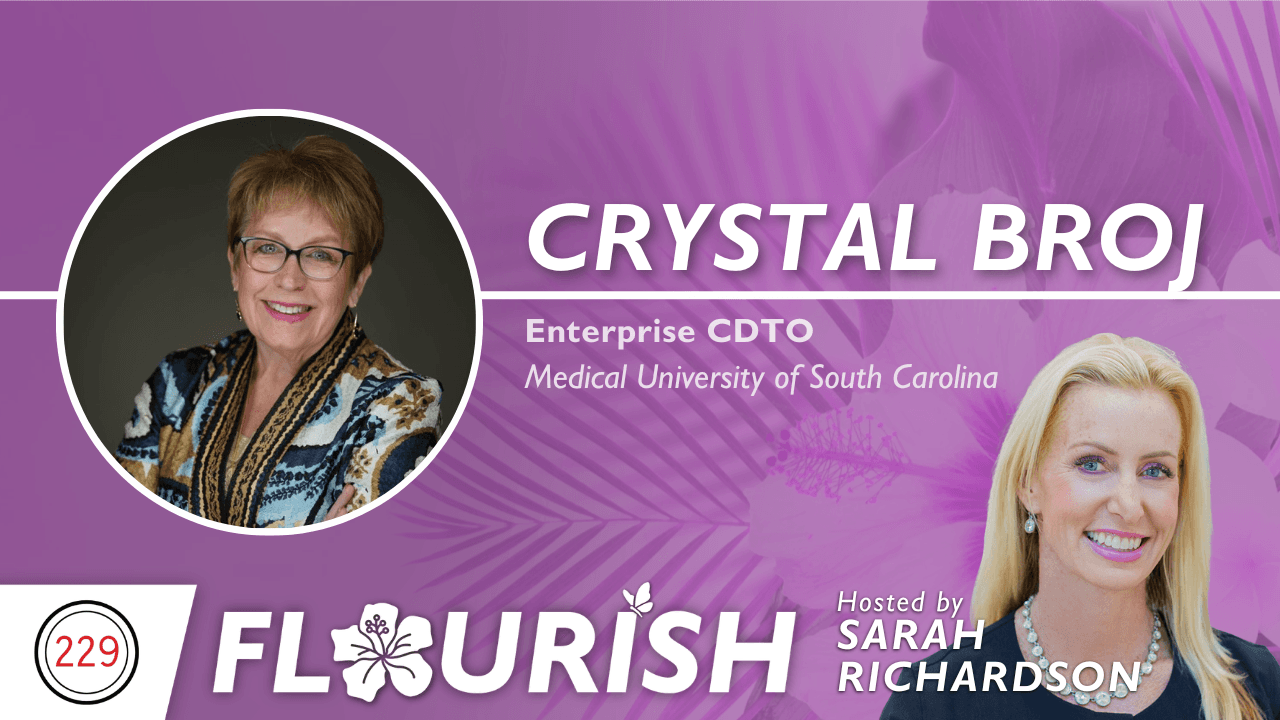
Leading Change, Growing Leaders, and When AI Actually Works | Flourish with Crystal Broj
 Apple Podcasts
Questions Answered in This Episode
- How do you translate complex strategy into action that actually moves people forward?
- What's the one mistake leaders make when driving organizational change?
- Why does treating change as a people problem first transform technology rollouts?
- How do you build teams that stay loyal and grow into future leaders?
- What makes AI adoption stick when most implementations fail?
About This Episode
June 2, 2026: Crystal Broj, Enterprise CDTO at MUSC, is an IT executive, Becker's 2026 Digital Officer to Know, and Top 50 Women Leaders in Healthcare honoree who has built her career on one core belief: start with the problem, not the technology. In this episode of Flourish, Sarah Richardson sits down with Crystal to explore what it really takes to lead complex change, develop talent that outlasts you, and call out AI hype for what it is. From growing a team of one to ten at MUSC, to sharing the Lotus Notes failure that shaped her career, Crystal brings candor, energy, and a rare clarity to what great leadership actually looks like in healthcare today.
Keep up to date on the latest in health IT:
https://thisweekhealth.com/news/
Key Points:
01:31 Leadership Energy and Mentorship
11:37 Building Talent and Team Rhythm
21:01 Vendor Partnerships and Pushback
26:33 Career Growth and Final Takeaways
Donate: Alex’s Lemonade Stand: Foundation for Childhood Cancer


Transcript
Leading Change, Growing Leaders, and When AI Actually Works | Flourish with Crystal Broj [00:00:00] GMT20250714-172930_Recording: I'm Sarah Richardson, a principal here at this week Health where our mission is healthcare transformation powered by community. Welcome to Flourish, where we share the human stories behind healthcare leadership because thriving people build thriving systems. Let's begin Sarah Richardson: Welcome to Flourish, the podcast where we explore bold journeys, brave leadership, and the art of building a career that is impactful and deeply human. I'm your host, Sarah Richardson, and today's guest is someone I'm lucky to call both a colleague and a friend, crystal Bro. Crystal is a dynamic IT executive known for translating strategy into action and leading complex organizations through meaningful change. Experience spanning healthcare, pharma benefits and beyond. She's built a reputation for delivering results while developing strong, capable teams along the way. Crystal, welcome to the show. Crystal Broj: Thank you, Sarah. What a nice introduction. Sarah Richardson: Well, and uh, also a top 50 women leaders in healthcare 2026 Driving [00:01:00] Change, uh, and Becker's 2026 digital officers to know. Crystal Broj: Thank you. I was very honored. There's some really interesting people on those lists and I'm just happy to be considered among them. Sarah Richardson: Well, it's always fun, especially when you're not expecting it Crystal Broj: Yeah. Sarah Richardson: these awards and recognition, because that's not what we do it for, but it's nice when somebody else notices too. Crystal Broj: I like it because it shows our team and what our team has been doing, and I think that really speaks to the type of work that we do and the type of team we've developed here. So, um, it's a, it's a win for everybody. Sarah Richardson: And also for anybody who's met you, I mean, you bring a very unique energy into every room, and always said she's a firecracker. She's amazing. She gets things done. And where does it come from? How has that, how has that shaped your leadership style? Crystal Broj: Um, probably because I was the oldest of six kids and I was really bossy as when I was young, so it could come from there. Um, but also 'cause I'm deeply passionate about my work, I really take my work personally. And so, um, you know, I just wanna make sure that I'm make doing something [00:02:00] for the better, whatever that is. And I'm making something better. And so I'm gonna work really hard to get it there and I'm gonna try to sell the ideas and move things forward. And I think that's what gives me a whole lot of energy. Sarah Richardson: How do you balance so effectively being assertive and also approachable? Crystal Broj: I'm a type D on that scale of whatever it is in the upper right hand corner, probably one of the highest ones in, um, our senior staff. Um, so very dominant, very, you know, wanting, um, just a get things done kind of person. But I also wanna make sure that people feel safe to bring their ideas and know that, you know, concerns or even push back on some stuff. 'cause you know what, I'm not always right, sometimes I'm wrong, and I wanna hear that. Um, the goal for getting stuff done and being assertive, approachable is not to be the loudest, just to get the best outcomes. Sarah Richardson: And when people have those experiences with you, they get a chance to show up, they get a chance to share ideas, et cetera. they leave an experience with you, how do you want them to feel? Crystal Broj: I want them to feel like they made a difference. I want to them to think that they grew in that [00:03:00] time together, whatever it was, I want them to feel prepared for whatever next role they've chosen to take. Um, most of the people that I work with or I've worked with, I've mentored, you know, as, as boss. But also in a friend type situation, and I still can stay in contact with a lot of them. They contact me years later, or they're still, I've monthly, you know, the bluebirds group that we're part of is all about mentoring and bringing people up. I still have a lot of people across the country that I've worked with, either as a partner or direct, and just try to keep lifting them up and, and give them, you know, the space to shine. Sarah Richardson: I love that as well. You'll get the phone call from someone you worked with like 10, 15 years ago, and they'll still say. Like, Hey, you were an N of one. I'm like, I didn't even think you liked working with me that much. And they'll be like, you're really tough on me. And yet because of that, now I can do those things. Crystal Broj: Yeah, exactly. I think if we can, if they leave, it's a, it's a testament to us If they leave and they take a better job that we did something right to help them get there. Sarah Richardson: And you've, I mean, you've built your career on [00:04:00] taking big complex strategies. You make them real for people. How do you turn that vision into execution? Crystal Broj: by really looking at what the problem you're trying to solve, right? So you can have this big thing. We wanna have a digital strategy. Sarah Richardson: I. Crystal Broj: Give us our digital roadmap. It's like, okay, but why, why do you need it to be digital? Is it 'cause you don't wanna give clipboards out at the front desk? What is it you're trying to do? And is it because the patients are frustrated? 'cause the staff is frustrated? You know, what is it that you're trying to do? Is it you're trying to get access for people? You're trying to do, you know, whatever those things are. And once you know the problems, then you know how to start attacking it. And so usually when I do that, I, I do a big work session. And this is something that was new here before we started. We had a couple people that did it around. But, getting people in for the entire project, uh, it marketing, because you know, marketing needs to know this stuff, legal, um, stakeholders, all that, all in one room at the beginning of a, Hey, we're trying to solve this. Let's talk about the workflow. Let's talk about what we'd like it to be. Let's talk about how we'll measure success. [00:05:00] And then working towards that. I think that's, once you do that, then you can bring in the technology and make it a technology project. But first it's always a people problem. Sarah Richardson: It's easy to talk about the strategy. So you said that when you got there, they didn't have maybe the, the rigor and the planning that you have brought forward to them in a structured format. How did you get them to wanna do it that way? Crystal Broj: Um, well, it was my mantra to, to do that, but I wanted to make sure that, you know, I, I. I find it offensive when leaders come into an organization and they just are gonna bring their agenda and just plow through and they know everything. And it's the most important thing and never talk to anybody about, well, why do you have this and why are you doing it this way? Because probably there's a reason we've always had this software because it's the, you know. Manager's, brother's software, so we have to use it or whatever that could be, you know, it could be a hundred different things. Um, but instead of doing that, you're just gonna be like, I'm gonna get rid of everything, or I'm gonna do this, or I'm gonna push through. This way, think's much better to, to lay the land and figure out what's going on first. Ask a lot of questions and [00:06:00] then figure out how you fit into that organization and how to take this strategy and make it your own. Sarah Richardson: How did you help the organization learn to prioritize? Because. You probably have a, you walked in, there's all these ideas, and what happens too, and I guarantee with you it's like we have this new person here who's hired to do all of these activities and you're not gonna just foist your agenda on them. There's a process that through all of it, what were some of those initial wins that really made the most sense organizationally, but also gave you the traction you needed to be able to implement what needed to be done? Crystal Broj: We started with, we had a software to do patient outreach, but it wasn't getting the traction needed. And so I said, well, I'll take that, I'll make it work. And they're like, okay. And uh, we did patient outreach and we did a very small pilot and it was successful and then we added onto it and we added on functionality. We very agile approach. Um, going from four offices to over 700 offices now that actually send out patient outreach to register, stuff like that. [00:07:00] And, uh, it brought down no show rates. It got more patient engagement a hundred times more than what we had before. Um, and once you start seeing that and seeing the results that we were trying to achieve and getting feedback scores from pa from your patients, saying 97% thumbs up, we like it. Then it's like, oh wait, no. She was able to do this. She was able to roll it out. She was able to add and add and add functionality. So when I come back with the next one, then it's like, oh yeah, I think, you know, start small. You know, you can kill it if it doesn't work. And the next one was successful and the next one was successful. I've a knock on wood, really haven't had a unsuccessful rollout since I've been here, which is very lucky. But it's also because I lean on people that I know go, Hey, who's used this? How do you use it? How do you make it successful? What, what hiccups have you had? Um, and I think that helps too. Sarah Richardson: Definitely helps when there's champions who wanna be a part of something and you're including them, and you're so good at managing and leading change through multiple industries. People will say, oh, well, healthcare's harder, or This industry's harder, or This group is unique, et cetera. [00:08:00] May or you and I are both gonna say, no, not really. There's some principles that apply no matter what. What are some of the lessons learned about leading change that most people just mess up every time? Crystal Broj: You know, the biggest thing I learned about leading change is when I worked for an athletic club. Um, we were putting in a new, software, new software for tennis pros, new software for fitness pros, new software for salespeople. And you know what? They weren't technical. A Tennis Pro is not thinking he's going to spend his whole life on the computer. So when you go, you have to run this report and you have to enter this here, and you have to do that there, they're like, uh, whoop, whoop. You know, that's what they're thinking about. They don't wanna have to think about the software. So you have to figure out how you're gonna do that change and teach them and tell them what's in it for them, and story. Tell them through, this is gonna be good for you because you'll be able to see your sales, or you'll be able to see, you know, make sure all your things are together or whatever. Um, and then make sure that they, that they trained well enough so that they don't look stupid. Because everybody's good at their job, but when you get a new piece of whatever and you [00:09:00] don't know how to use it, and you're doing it in front of your client, your patient, your boss, you don't wanna look dumb. So you've gotta make sure that they know how to use it and use it well so they can be successful at it. And that, I think is the biggest part of change, is that communication, that training, um, planning with the end in mind. Sarah Richardson: What are some of those artifacts or perspectives that you share so that momentum stays? 'cause sometimes these are multi-year endeavors. What are some of the things you have learned along the way that the momentum to actually carry something forward, maybe even faster than planned? Crystal Broj: I think first it's that kickoff meeting to make sure that everybody knows why we're doing it, what we're doing, and what to expect at different stages of the thing. It's not like we're gonna take all your stuff and go away for a year and then come back and give it to you. We want you to. We have expectations that a month from now you will be part of this and we'll give you a test environment and you'll look at it and you'll give us feedback and we'll continue to work through it and that kind of stuff. So I think good communication isn't just, oh, I made the prettiest email, or, oh, I sent out a [00:10:00] newsletter with ROI stuff every month. It's, it should feel like a conversation. You should always feel like, you know, and are part of whatever that project is. So it's not like, oh, what's going on with this? No, I, I know I'm gonna test next week. Because we've had meetings and we've had conversations and stuff like that. I think that's what keeps it going. Sarah Richardson: And our industry's moving faster than ever before. I mean, truly the Crystal Broj: Yeah. Sarah Richardson: of the technologies coming forward, and again, you and I like to create change. We're good at managing change and helping people get there. And. How, how are you keeping up right now? Because it, it is quick. It's like I, I share that I talk about AI every single day Crystal Broj: Yeah. Sarah Richardson: my neighbors don't, they're in a different industry, so for us it's commonplace. How are you staying up to date right now? Yeah. Crystal Broj: I spend every morning on LinkedIn to see different articles. People write some amazing stuff on LinkedIn and just to get feedback. I play with AI in my spare time as well as at work. Um, and I'm just like, just constantly learning. I have, since I started this, I probably have 40, 50 books in my office.[00:11:00] Various perspectives, various things of how to do technology, how AI should go, how it's growing. Um, so, 'cause I live in South Carolina, I like to get a business book as much as I like to get a fiction book. And I'll go to the beach and I'll spend some time at the beach reading just to stay caught up. Sarah Richardson: That's one of the things I say is like, you have your fun book and learning for learning can be fun, let's be Crystal Broj: Yes, it is. Sarah Richardson: I call it my responsible book and then my like. Fun book. Um, and they, they parallel each other all the time to your point, because the ability to always be absorbing new information takes a, it takes a little bit to assimilate it still today. Crystal Broj: Yeah. Yeah. So you need that downtime too. Sarah Richardson: Yeah. And you're so good at bringing people with you. You develop them to your point, they call you 15 years later. This is just about their technical acumen. This is about as being a human being. Um, I'm curious about your philosophy on growing talent. Crystal Broj: I think that in general, especially when we get up to this level, Sarah, where we're managing people, we're directors, whatever. Um, it's not just to deliver outcomes, but it's really to build leaders and [00:12:00] build people that can take it on. We should always be succession planning. We should always be thinking about, you know, oh, so and so does this. What do we need to do for her in her career so that she can grow? Whether it's a stretch assignment, whether it's, you know, getting her to go speak at a meeting or go do something else so that she learns to be on that platform. He too, I have met on my team too, but, um, just, just being able to make them stronger than before they join the team. Sarah Richardson: What do you use as benchmarks or hallmarks of seeing someone's potential, even if they don't see it in themselves? Crystal Broj: Well, I like to look at, um, you know, when I hire somebody, the very first thing I do is see if they're passionate, if they can be passionate about something they're doing and they, they really are curious about things. I, I can teach them the tech, I can teach them how to do change management. I can teach them how to project manage. But if they don't have that passion and that fire and they want to make things better and they want to learn, um, I, I have a really hard time with that. Um, they just, you know, just shut down. And, uh, they might be certified a hundred different ways, but if they, if they can't show me that they, they would go for it and they would really do it. That's, that's a thing. Um, I also look for willingness to try hard [00:13:00] things. Um, and, and being okay to fail. And if you do fail at something, I always ask the question, um, tell me about a time that you did something and it failed. And some people will just be like, um, no, I can think of anything. And it's like, if you haven't failed at any point in your career, then something is wrong or you're lying to me. And then I always follow up with it. And what did you learn from it? If they can't take the problem to go into, I learned not to do this anymore. I learned to check, um, early in my career. I, uh, I was on a project and it was, it was Lotus Notes way, way, way back in the day, Sarah. And we, uh, we were working on a client. We built this system, we were doing all this stuff, and then we were gonna integrate the records and they had millions of records and Lotus Notes couldn't handle. That volume. Nobody had ever checked to see what their input was going to be to the system. And we had to go back to the client. We had refund money. Um, it was a hot mess because we just didn't check and there was nothing we could do. They had to look for another solution and they lost like months of work. But I learned that, you know, always know [00:14:00] everything about where are things coming from, where things are going to before you kick a project off so that, um, that doesn't happen again. So burned but learned. Sarah Richardson: Well for sure because Crystal Broj: Yeah, Sarah Richardson: those are those times when. You're like, I didn't even know I needed to ask that question, Crystal Broj: exactly. Exactly. Sarah Richardson: and it pops up. It's kind of about what did you do about it in the moment? stretch assignments are too much for people, and how do you decide what criteria, what level of stretch is appropriate for someone without burning them out or having a catastrophic failure? Crystal Broj: By giving them small stretches before you give them big stretches. Like you're not gonna go and run a marathon before you've walked around the block. Um, so you've gotta kind of give them baby steps to grow up. Right? Um, and then, and then really, you know, you're part cheerleader, part coach, um, but you don't wanna micromanage it. You kind of gotta go, okay, here, do this. Come back to me when you have questions, and then, okay, good. And sometimes they're really timid about coming back because they don't wanna let you know that [00:15:00] they don't know something. It's like, no, it's okay. And tell me what you're gonna do about it. Tell me what you think. Um, and, and I have a, a rule on my team that's like, if something goes wrong with anything that you're working on, tell me first and I'll help you figure out what we're gonna do. But what I don't wanna have is. Somebody walk down the hall in the office and go, Hey, did you know that x, y, Z system's down? Um, what are you doing about it? Right then I can't. Then it's like, ah. Um, but it's like, it's no, there's no blame. Things happen, things break. And when people learn to get that trust and they're like, oh, okay, I can do this. I can take on more. I can, I'm like, well, what will you do about it? How are you gonna communicate it? That kind of stuff, and just start leading them along the way. Um, I had a relatively new team here. I hadn't worked with anybody here at MUSC. I started as a team of one, we're now a team of 10. Um, we just hired two new, two new project managers, which is fantastic. We also have fellows, administrative fellows that come on our team every year. We have an intern every year, so we're constantly training people up, which is super fun because I learned as much from them as I do from, from, uh, teaching people. Um, but also like now the team is really [00:16:00] running themselves. They, they all have their programs. They run them through, they know, they've learned the, I don't wanna say the crystal way, but the, how Crystal would react to some of these things and how I should do, um, and I a hundred percent trust them. 'cause I know I've seen them grow and take those projects on. Now I know that like I can give them pretty much anything and they'll be able to handle it. They can be in a room when I'm not in it. And I think that's the thing I really wanna teach people. Sarah Richardson: It's an exponential effect for the efficacy of your team as well. I had a boss who said, I'll always have your back as long as I'm never surprised, Crystal Broj: Yeah, Sarah Richardson: and I was Crystal Broj: basically same thing. Sarah Richardson: was my boss at like 19. So I've always carried that forward because it was true. And you could, you couldn't text her back though. Let's be honest, this was like 1994. Um, but these are the moments where now if you get a text, if that's part of your ethos, you get a text from somebody and like this just happened, you're like, okay. I mean, you start to roll with it. 'cause to your point. They know and you Crystal Broj: Yeah. Sarah Richardson: to respond in that moment. I would love for you to share, uh, a story of one of your biggest successes in terms of someone [00:17:00] you have developed. Like who is the perfect person that you launched from the Nest that has just soared. Crystal Broj: my executive director right now, he started with me a year in when I was here and he came from revenue cycle. He hadn't done digital, he hadn't done transformation, but he had an interest in it. He had a passion for wanting to do something more, and he has taken the world by storm. He goes and speaks around the country also. He, uh, comes up with good ideas. He goes and finds other vendors that we should talk to. Um. He just, he's inter, he is a better networker than I am. Um, and so I learned from him on like, well, yeah, I talked to this person. They, I said, you know, that person, like, just, he's just, just really grown up and I think, you know, he's, he's gonna be going places. Um, and so Franco big shut up. Sarah Richardson: Oh, I love that. I can't wait till he hears this episode. And so you've got big portfolio, lots of competing priorities. A team that's empowered to likely almost go and create more, uh, in any given scenario. Area for all of you. How do you all stay [00:18:00] focused and connected without losing sight of what your intent is? Crystal Broj: We do, Franco does one-on or one-on-one meetings with his staff. I do one-on-ones with my direct staff. And then he does a team meeting on Mondays, and then I do a big team huddle, um, once a month to kind of do something educational, something fun, um, bring the team together, talk about where we're going as a strategy, what's happening in the organization. They might need to know that they might not hear, um, from their vantage point. Um, and so I think that really works for us. Sarah Richardson: How are y'all solving problems together? And this is more specific to, there's not a clear answer to something. How have you built this team of 10 to solve a problem when there's a bunch of ambiguity around it? Crystal Broj: first if the problem is with something that we've already had, like what was it? What were we trying to do? Can we do it? What is the data that brings us there? Um, and let's brainstorm some options. We all have whiteboards. We're very good at, you know, I know it's technology, but we [00:19:00] still write on the whiteboards, don't you? Sarah Richardson: Yeah, I, yes, I do. Crystal Broj: Yeah, I'm a big whiteboard, but it's clean now, but usually not. Um, and so just try to work around and work together and it's like, you know, there's. Open door policy all the way around. So you wanna toss an idea out or, Hey, you know what? I was, I was, and the interesting thing is, we're in healthcare, right? So we also go to the doctor or the hospital and all of a sudden you see like, you know, that doesn't work. Hey, do we have something? Or is there something we could do to make that better? I was talking to this nurse and blah, blah, blah. I'm like, yeah. Let's think about that. I mean, we've rolled out our voice bot and I Kudos to Corey for the stuff that he does. He rolls out the voice bot and people like see him and talk to him. It's like, could we do this in facilities? Could we do this here? And he's got like a list of people to talk to that he's just met, that he is like, okay, yeah, let's go solve some problems for them if it's possible. Um, you know, it's just, just teamwork. I think we also know that we're a small team and we started as a very small team. It was, it was. Franco and me, and then we got Allie and we [00:20:00] got Peter and Corey and uh, and they, we all did everything because we had to, it was like, oh, I've gotta, I gotta roll something out. I've got a test for three hours. Everybody jumps on and tests. Everybody just does it. Um, and so when you work in the trenches like that, I think, um, super important to, to have each other's back, like we said before, and you're just like, you know that that person is gonna stand in for you. Two people on my team went out on maternity leave this within two months time, and so we've lost them back to back for eight weeks. But you know, everybody stood up and picked up and did other stuff and the team kept going. But you know, it's like we got each other. It's all good. Sarah Richardson: Well, and I always love that when you are in healthcare and you're a patient. Your doctor's, also your customer. You really don't ever get to be a patient. It's always like half your visit is a, is a technological conversation about what is and isn't working in different aspects. You get the frontline, but you also get all the feedback in real time as well. Um, which is actually really good when you are always looking to make [00:21:00] improvements in your health system. You do that externally too. I mean, your relationship with vendors and external partners. How do you also make that work for the organization, especially when you are bringing in really very new or cutting edge ideas and solutions? Crystal Broj: first of all, I talk to the vendors upfront and I'm always, I am one of the most straight shooter, Sarah, you know, I like, I don't have a poker face. I'm gonna tell you like it is from the beginning. I'm gonna be like, nah, that, that's not really gonna do that. No, you can't do that because the HR doesn't let you. So stop saying that. Um, and just be like, this is, if, if you're going to work together, we're gonna be partners. We're gonna be in, in those trenches together side by side. We'll have each other's cell phones. We'll, we'll really work on that together, but then I'm going to challenge you and I'm gonna tell you when your software should do this instead of this, or your service department should do this instead of this and this wasn't, you know, whatever, either doesn't go well or [00:22:00] gee, it would be great if,, we were on a vendor call today and the vendor was like. This is fantastic. You guys have given us biggest list of things that we wanna do to our software. Um, and that's, we're just very open and honest. But we also want that pushback back from our vendors to go, Hey, you know, we want you to try this. Or, Hey, you know what, it would be better if we set something up this way, or, you know, whatever. And I think that give and take just like a marriage, just like a friendship, you know, it's like I'm really good at cooking, Sarah's really good at interviewing people. We can take those things together and figure something out. Right. Sarah Richardson: You don't want me cooking for you, but I will do your dishes. So there's the win in that Crystal Broj: Okay. Well, I owe you dinner, so next time you're down here. Sarah Richardson: Absolutely. Where do you see that biggest opportunity though, for innovation in healthcare and the adjacent industries with your partners? Where are you really leaning in? Because AI's dominating all the conversations, rightfully so, or otherwise. What else is out there? What else needs to be front and center besides just that being the thing right now? Crystal Broj: Well, AI isn't the thing. [00:23:00] 'cause you can't just go, here's ai, it fixes it. You have to have a problem that you're trying to fix. Right? So I mean, we consistently and always will be focused on access. Um, because there's not enough doctors, we're losing doctors. We can't get enough people. And more and more people are aging. More and more people need healthcare. And so we have to make sure that we can still get people in to see, um, their doctors. But also I'm really passionate about making sure that it's not just seeing a doctor, but seeing a doctor when you want to, how you want to do, you wanna go in? I work all day. I do not have time to go to the doctor in the middle of the day. I don't have time to call a call center in the middle of the day. I don't wanna get a call from the doctor's office saying, Hey, make sure that you, you know, come in tomorrow. I'd rather have a text. And so I think meeting people at the level that they want is something that I'm really passionate about. As far as other AI things, I think when we find the things that are like, and, and this is what I'm teaching across our organization right now, what's repetitive. What has rules, things that are actionable that if you had something that could help you do this faster, could you [00:24:00] work on something else? Could you have, you know, a bot that does prior authorizations and then you could do the hard ones that get rejected? Could you have something that creates tickets in the facilities place so that you can then sort them better and do that where without having to have somebody on the phone? Those kinds of things are the things I think we'll see a lot more AI in. I'm excited about having AI visual. Um, I've seen some things with cameras where it's like, oh, okay, this is a scalpel and this is something else. And I'll know it's on the train. I'll know when it's missing and what needs to be put there without very labor intensive things to set stuff up like that. Um, that's where I think there's gonna be some real value, um, as those types of tools get better. Sarah Richardson: I mean, pref cards, wrong sided surgeries, the Crystal Broj: Yes. Sarah Richardson: improved, and I'm so grateful for you saying solving a problem, not adding complexity. Because anytime I literally was speaking with a colleague today who said, our CEO is hyperfocused on using ai. That was about all the direction that was given. And so they're having to sort through what that means for [00:25:00] people. What's the right use case? You know, where is it even gonna make sense for us organizationally? And I love that you're bringing it forward in, in real time perspective. If AI is part of the solution, fantastic. Got a lot of problems to solve. AI may or may not be the right tool in that toolkit. Crystal Broj: And you can't just put it on something, right, Sarah It's not like, oh, here, this is broken. Give it ai. It's gonna be great. If it's broken, it's broken for a reason. It's not like, oh, I can put a tool on it. You've gotta go, what? What's breaking down? Well, I want something to automatically do this, and I want something to automatically do that. Well, have you looked at your EHR? Well, it's not set up that way, so we need something else. No, we need to reset up the EHR first and then if you wanna add additional layers of things, you can. But if you don't have that workflow right, you're just gonna make a bad thing worse and probably actually add more work in the process. And nobody wants that. Sarah Richardson: I have no idea where this is even coming from, but if I was gonna get an AI tattoo, I would say better start with clean data. better make sure you have good change management processes and you better make sure you have a [00:26:00] lean element to all of that. Because if you don't have a clean process and you don't have good data, and you don't have good change management, pretty sure your initiative is going to fail. That was true before ai. This is just making it, accelerating it. Crystal Broj: Yeah, I'm gonna see the tattoo when you get it. Sarah Richardson: I'm Crystal Broj: might use AI to design one for you, Sarah. Sarah Richardson: That, yes. Design it and I can, then I'll get one of those, like temporary ones, Crystal Broj: Perfect. Sarah Richardson: because I just don't have an, you know what, full disclosure, I don't have any tattoos. There you go. I'm not looking to get one either. But, uh, I do enjoy, uh, seeing what other people choose to, uh, to pick. But yes, we can make my fake tattoo. All right. You've had a diverse career across industries. How do you know when it's time to make a career change? Crystal Broj: if I'm bored, if I'm not learning, if, um, there's an opportunity to go somewhere else and learn something new or do something. That would really make change. Um, I've never looked at it for, uh, chasing a title. I've always looked to do, uh, for growth or for impact, um, to see where I can make the biggest impact. Um, and, you know, [00:27:00] just, just knowing that based on what I know about myself and the things that I like to do, if I'm doing stuff that I love. It's perfect, but I don't need to, I could be janitor, honestly, some days I really feel like a janitor, right? So I, I have a chief title, but you know, I could be chief janitor. It doesn't really matter what they call me, as long as I get to do this stuff I wanna do. Um, so, and that's what I tell people all the time, don't chase the titles and don't chase the money either. You know, everybody's fixated. I wanna have this many zeros behind my thing. You know what? If you're doing what you love and you're doing it well, people will notice. And, um, the rest of it's gonna come. Sarah Richardson: I feel like that's probably how you and I have have connected so easily is. We're always telling people those parameters, if you wanna be a CIO, make it four 50 by 35. Uh, how do you feel once you're there? And a lot of times it's that unfulfilled moment because what's that next thing you're reaching for? Do the work you love and really focus on making a difference where it matters. And you have [00:28:00] continued to always exhibit confidence. I think that's one of the reasons people are drawn to you. How has that played out in your career and. Where does, how'd you build it over time? Was it, was it always a part of your DNA or was it something that you had to learn to trust in yourself? Crystal Broj: Well, sometimes I'm still unsure about things, so I come across confident, but it's like, uh, should I be doing that? Um, but I think it's like you just don't wait till you're confident. I think you have to push yourself to try stuff, to do stuff. Push myself to be honest. Speaking circuit, push myself to, you know, am I, am I ready to go stand in front of a thousand people at Hyson, talk about something and then have a question from the audience that I will have no idea what they're gonna say. Or have a moderator that'll won't stick to any kind of a script and goes off into a tangent that we never talked about. Um, and just, that's a whole, a whole new thing for me. 'cause I've done speeches, but not, not in that aspect. So, um, I'm more confident now. I don't get nervous. I don't get nervous. Speaking at all. And I actually think it's harder when it's in front of people that you know really well, Sarah Richardson: [00:29:00] Yes, it is. Crystal Broj: than it, than it's honest of strangers. 'cause they know you and they're like, oh, he, I just, I just flubbed that. They're going to know that I didn't do that, or I didn't say that the right way. Um, but yeah, I think you just, you just try and, uh, your conference builds after that. Sarah Richardson: It does it. I've said that before too. It's harder to talk to people you know than people you don't know. Although when you are in with a group and it's your friends in the audience or friends in the audience. to sit up front and beat that face like smile because you're gonna look to me for my reaction and I'm not gonna a be on my phone. And more importantly, not give you those in the moment perspectives because even though you're confident sure helps to look out there and see when your friend's smiling back at you. Uh, it Crystal Broj: Yeah. Sarah Richardson: you that bolstering that's really, really important. So we Crystal Broj: So on that really, it was so cute because we have a, a class of, uh, administrative fellows, and we have 20 of them this year. They all went to a CHE and they all came to my presentation and they all sat in the front row. Um, and it was just like, it was the coolest thing. And it was like, you know, they're, they're taking pictures and they're [00:30:00] like, they wanna take pictures afterwards. I like felt like such a rock star because it was just like, Hey, these are my Peets. Sarah Richardson: Well, there's a reciprocity in those proud moments. You wanna now make them proud, but they want to make you proud. Like, Hey, we we're here, we're in the front row, like we Crystal Broj: Yeah. Sarah Richardson: I made this a priority. We've covered so much territory, but I really wanna make sure that listeners hear advice that you'd give to somebody who is ready for the next step. And maybe they don't have the confidence or they're chasing the title or they're chasing the dollars, or what I hear so often from, from younger generations is the expectations their families have put on them. What advice do you give people that are still in the, in that pursuit of the next step in their career? Crystal Broj: Um, don't wait until you're a hundred percent ready. And I think as women we tend to do that more. We look at a resume and we're like, it's, you gotta have A, B, C, D, E, and even the optional. We still wanna have all those things before we would ever, ever apply for it. I think you know what you, nobody's [00:31:00] ever looking for you to check all the boxes. They're trying to figure out if you've done some of the things and you can prove some of those things. And, um, like toss your head in the ring for things. Just try stuff. You know what? You can, you can work at a job for a little while and if it's not working out, you can go get another job, but you'll have gotten experience along the way. My first C-Suite role, way back in the day, um, probably 10, 12 years now. Um, I saw it and I was like, oh, this would be cool, but, but I'm never gonna get it. Um, and I was like, you know what? I'm gonna apply for it anyway just to see. And, uh, they had me make a deck and tell me what I was gonna do. The first 90 days, I was like, okay, well I'm learning how to do that. Um, and I got the job. I learned from the interview too. When I came down to South Carolina, this was posted online. This job was posted online. I knew nobody in South Carolina, but I knew I wanted to live in Charleston. One day I brought up to my husband. I was like, honey, um, this is the job I want when I'm a big girl. It's in our favorite city. It's a big system. I said, but we're not gonna move for seven to 10 years. And he's like, apply for it. [00:32:00] I'm like, they're not gonna take me. I don't have a recruiter. I don't know. It's just apply crystal. Fine. And I just like put my resume in just the way it was. I didn't adapt it, AI it or anything. I just put it in like they're never gonna call. But I did it. Two weeks later they called, two weeks later I had an interview. Four weeks later, they flew me down. So I never thought in a million years I was gonna get it. Um, it just was the, you know, I just was able to pull it off and it was the right thing at the right time. Sarah Richardson: And Crystal Broj: yeah. Sarah Richardson: take a lot of pressure off of you in that moment because you're like, I'm just gonna see what happens versus, oh my gosh, I have to have this job because I wanna live here. Crystal Broj: Yeah. Yeah. It was just like, I'll, I'll try. I'll see. If it doesn't work, it's fine. I still have a job, still have, you know, everything I, I love, so it was fine. Sarah Richardson: When I look back and think about some of my best opportunities and interviews, they were for jobs that I was not chasing, Crystal Broj: Yeah, exactly. Sarah Richardson: just Crystal Broj: Exactly. Sarah Richardson: and it was like, holy cow. And they were like, well, you were the most natural or the most, you know. Honest about what you expected for, for the role. And I was like, huh, well [00:33:00] good. Uh, Crystal Broj: Yeah, Sarah Richardson: know, there's the next five Crystal Broj: let's get to work. Sarah Richardson: Let's get to work. Let's go Crystal Broj: yeah, Sarah Richardson: All right. Are you ready for speed round? Crystal Broj: sure. Sarah Richardson: Okay, here we go. One leadership trait. You refuse to compromise on Crystal Broj: Integrity. Sarah Richardson: a moment in your career that changed everything. Crystal Broj: When I stopped being the, the contributing to transformation, I actually started leading it. Sarah Richardson: What is your go-to reset when you're overwhelmed or the pressure's just a lot. Crystal Broj: In business or in my work, I'll step back, try to refocus and then, you know, think about the goal and what we're trying to achieve. Or I will take the problem home with me and then I'll go to the beach and spend a couple hours there just trying to decompress. And usually if you, if you just let it go, things will like swirl up and come if focus on it too much. Um, sometimes you'll just focus, you'll do analysis paralysis. Sarah Richardson: Yep. And if you could fix one thing in healthcare tomorrow, what would it be? Crystal Broj: Oh, it's tough 'cause I access is my big passion point. Um, but also [00:34:00] to make all technology systems talk to each other in a way that we don't have to wait for six months for is to plug in this so that we can see some results. Yep. Sarah Richardson: Access and interoperability. Amen. I've literally had that conversation probably four or five times, and it's only Wednesday, so I'm glad it's on your agenda as well. Crystal, what I love about your story is it's not just about leadership. It is about how you lead, and that is with clarity, energy, and a real commitment to bringing others along with you. You have shown that strategy only matters if it turns into action, and great leaders don't just deliver outcomes, they build people in the process. Thank you for bringing your perspective, your candor, and your spark to this conversation. Crystal Broj: Thank you, Sarah for having me. This was really fun. Sarah Richardson: Absolutely. And for our listeners, until next time, keep flourishing. GMT20250714-172930_Recording: Thanks for joining Flourish. Remember that every healthcare leader needs a community to learn from and to lean on. Find your people at this week, health.com/subscribe. Share this episode with someone who [00:35:00] needs encouragement today. Keep flourishing. That's all for now.