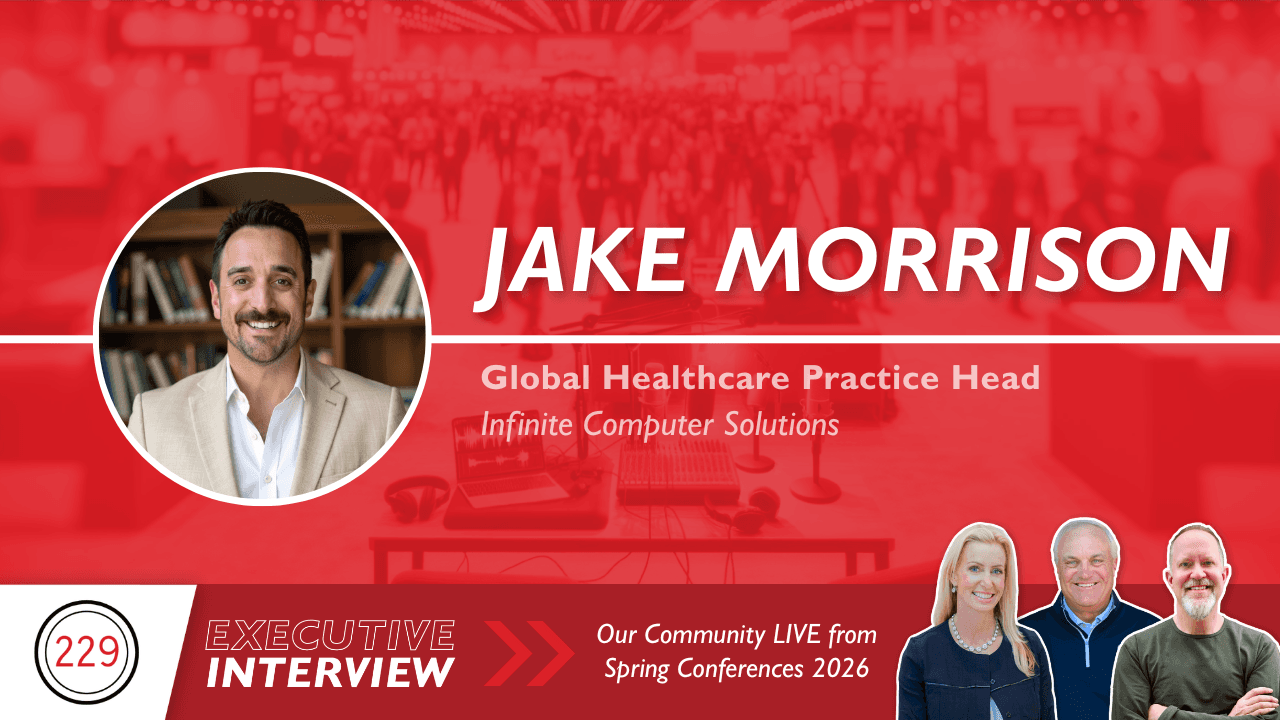
Rethinking Global IT Delivery and Co-Sourcing | Executive Interview With Jake Morrison
 Apple Podcasts
Paused
Rethinking Global IT Delivery and Co-Sourcing | Executive Interview With Jake MorrisonExecutive Interview
Questions Answered in This Episode
- How can health systems balance AI innovation with keeping foundational infrastructure stable?
- What transformation happens when you co-source IT instead of pure offshore outsourcing?
- Why is software-defined infrastructure now the perfect foundation for AI deployment?
- Where should healthcare IT leaders focus AI impact first: clinical, revenue cycle, or back office?
- How do global delivery centers reduce total cost of ownership without sacrificing service quality?
About This Episode
May 13, 2026: Jake Morrison, Global Healthcare Practice Head at Infinite Computer Solutions, joins Bill Russell for a candid executive conversation about what's really driving healthcare IT today. From the promise of AI to the surge in managed services demand, Jake shares why the old "outsource your mess for less" mindset is failing health systems. With 28 global delivery centers and half of Infinite's work in healthcare, Jake brings a uniquely global perspective on where the industry is headed.
Keep up to date on the latest in health IT:
https://thisweekhealth.com/news/
Key Points:
01:16 Shared IT Challenges Worldwide
05:18 AI in the IT Backyard
08:02 Managed Services Market Shift
10:42 Final Thoughts and Subscribe
Donate: Alex’s Lemonade Stand: Foundation for Childhood Cancer
Thank You to Our Episode Partner


Transcript
📍 📍 📍 📍 📍 📍 📍 If you're a health system CIO juggling infrastructure integrations and AI adoption, you know how stretched that gets. Most managed services firms charge you for time and effort. Infinite charges for results. They're a healthcare focused global systems integrator with deep expertise, and they're on the hook for what actually gets delivered, not just keeping the lights on. It's worth a look if you're evaluating your total cost of ownership. Find out more at THEekHELTE.com/infinite. 📍 📍 I'm Bill Russell, creator of this Week Health, where our mission is to transform healthcare, one connection at a time. This is an executive interview quick powerful Conversations with Leaders Driving Change. So let's get started. All right, today we have another executive interview, and today I'm joined by, uh, Jake Morrison. Jake Morrison with uh, infinite Computer Solutions infinite.com. how's it going? It is a good day. Just got off an airplane, to your point, global. So I travel a lot, but, uh, I can't complain and life is good. So thanks for having me, bill. So, uh, head of, uh, global Healthcare Solutions. I mean, that, that's a, that's a real title. Like you're calling on clients all over, all over the globe. Clients all over the globe and delivery all over the globe, right? So just because, um, you have a healthcare system in the US doesn't mean that you might not work with our global footprint in India or the UK or the Philippines or Central America. So. You name it, it's all into that purview. And thankfully, um, we've got now 28 delivery centers across the globe that all funnel into that. So it's, it's exciting. So when you guys say at scale, that is at scale, literally. It is. It is And so, I mean, that's pretty interesting. I, I guess when you get to certain solutions, the differences of how health, the, the, the problem sets become similar. So cybersecurity becomes similar at a certain, uh, no matter what, anywhere around the globe that you're practicing care delivery, even though the models are very different. Cybersecurity, cloud computing. the, just the, the infrastructure. I mean, those, those things are very similar. I mean, you have obviously the data sovereignty and those kinds of things, but for the most part, they're very similar problem sets around the world. It is. I mean, it's very much the case, you know, and, and along those examples, we do work in the UAE, um, we do work all across, um, Europe and, and obviously I. Across the US and you know, I mean a bit about infinite, I mean, over half of our focused work is healthcare. Um, but nonetheless we have a lot of best practices out of financial services, out of manufacturing. And oftentimes, um. People will say, well, healthcare is behind in certain areas. And you know, I mean, that is true for certain variables, but at the same time we've been able to take a lot of those best practices for financial services, both in the us, both across, um, I mean honestly both across Europe, both across, um, Asia. And apply that to some of the best practices we apply within healthcare and then vice versa. There's a lot of lessons learned that we have in healthcare in terms of, uh, data redundancy and access that we apply into financial services. But to your point. There is, although we don't have a good standard of care, I think across healthcare there is a good standard of formation and support, um, across cybersecurity and, um, traditional IT subsets. When you're sitting across the table, what's the, what's the problem set that you are hearing about the most? These days, is it, is it a, a race to get AI integrated or is it, or is it more foundational than that? I would love to say AI is just another buzzword. Like we were optimization and chasing meaningful use for the last 15 years. But I, this is one that I feel is a little more impactful. And so, um, obviously if you talk to any organization, you know, the New York Times, just put something out, wall Street Journal, et cetera, on, if you're not doing something with an ai, you're behind, right? Which, you know how we are in healthcare, sometimes we spend a lot of dollars to do something that is a waste. But at the same time, as long as you're fail forwarding fast. Um, but that being said, there are fundamental issues that we often incur and, you know, I, I hate to say it, but it's the keep the lights on activity that we encounter the most. But at then, at the same time, it's how does the innovation, the transformation, and the AI really, um, provide the umbrella and even plug into all those layers? Um, and that, that being said, um, AI is a fundamental component that we're going to see impact. Um, the true traditional white collar levels that we have never seen before. You know, this revolution that we're going through at this point in time. Um, and it's still obviously yet to be determined, but, um, all I can say is the work that we've done, the investments that we've made, and the, um, talent that we're bringing on board, you know, the scale that we are, we have not seen this kind of, um, push towards any innovation in the last. Dozen years, if not more. Um, even meaningful use. I brought that up. Meaningful use obviously drove a big initiative, um, and organizations took time and, and obviously supported the initiative to get on board over a. Um, five, six year period. Ai, you know, this, this buzz on AI and the impact from our space being a managed service partner and s systems integrator, you know, we had to go hire 500 people overnight, it felt like, to end up just to, just to keep pace and now the innovation in terms of the use cases and the leverage of the current platforms to. Um, not create system fatigue. , That's where we're seeing that challenge as well for the fact that, the fundamental keep the lights on is obviously gonna maintain, but now it's,, there's no shortage of solution that plugs in on the top level. But now we're seeing the orchestration, what we call the symphony of being able to stand and make sure that all the music is is, or all the musicians are playing from the same sheet of music. That's the struggle with AI now. And so. I I, I've gone down a rabbit hole, I'll sink back, but yes, long story short is AI is a big focus for us. You know, interesting because when we conversation within healthcare, we will talk, we'll talk Business operations. So we'll talk about rev cycle typ, typically. We'll, and in, in that area. Uh, we'll talk about the clinical side. 'cause we'll talk about ambient, we'll talk about imaging. Um, we'll, we'll even talk about some of the, uh, the, uh, care pathways and, uh, that are being augmented by ai. Uh, but one of the areas I'd love to talk to you about is, is our own backyard. Right? It's the it backyard. We've been doing software defined for. Uh, it feels to me like about a decade. Does that sound right? It feels software defined networks, software defined architecture, software defined data centers. it feels to me like that was a great foundation for what now you can do with AI On top of that, in terms of obviously with provisioning, which is a pretty easy first step, the, uh. You know, just in terms of, uh, using AI to defend against attacks, to lock things, I mean, it, it would seem like we have a pretty good foundation to, uh, from an IT perspective to really apply AI to our back office. I think to your point, software defined RPA plugin as well as now we are with true traditional ai. I mean, the foundation has been built and when you look at back office, the components of. Data engineering, analytics, reporting, report writing. You know, a lot of those areas are primed and ready and or we already are, are there where we were once using a team of six reporters to do certain tasks, and now we're seeing with cutting that in half. And obviously human interaction is going to maintain and not evolve into a greater capacity. But then look at, look at the same component of anthropic and cloud and writing code. Um, the, the amount of, uh, QA that we do, um. Testing AI and generative AI assigned to certain testing components. Even, you know, in the elephant in the room with Epic. I mean, there's, there's going to be a lot of, um, innovation that comes in there to streamline the releases of testing. Now, I'm, I'm not saying, quarterly releases or anything there, but the more so on the back backend scripts, um, that's where we're seeing a big impact of AI to where the engine, um. That once was very, um, eyes on glass, hands on keyboard, network operations, um, data center support, et cetera, is now functioning, functioning in a full capacity with traditional ai. So, um, we see these areas, um, making a clear component, well, clear and straight, ROI and then you mentioned the back office as well. They see supply chain, right? I mean, you know, there's no shortage of. Inaccuracies with, um, items, lists, and, um, time spent by operators chasing, um, physical supplies and the availability that AI is providing to streamline those components is just amazing. And use cases left and right to do so. you guys services provider, we see this ebb and flow, and. When economic times are, are tight, we seem to have a lot of health systems that are looking at that going, all right, does this provide us the opportunity to, uh, improve our service levels, reduce our costs in some way? Uh, are, how, how are you seeing the market right now? Are you seeing a lot of, uh, a lot of interest towards, uh, pure managed services? Are you seeing more selective outsourcing? What, what are you, what are you hearing? What are you seeing? No, that's, that's a good question, bill. And so I, I frame it as, um, we in healthcare, you know, the time. Is for us to be obviously accountable. Um, we're a non-for-profit, you know, and I say we, I mean, I, I've lived on the healthcare side of the house many times, and so putting myself in the provider's shoes, the time for us to be accountable and to look at the organization is to how do we look towards the future? Um, and that's a combination of lift and shift, you know, traditional outsourcing for a lot of the commoditized type opportunities. Um, it's a, it's an opportunity for us to do a co-sourcing where. You're not just passing your team off or you're not just passing the responsibility off, but let's design this together with the right transformation in mind. Ai, um, the right investment where potentially we can provide you with X percentage of cost savings and then by doing so, it's reinvesting those dollars and what the future looks like. Maybe it's a solution, uh, maybe it's an innovation in terms of, um, streamlining services or maybe there's some rationalization there. We're seeing. In the last 18 months, more interest in managed services around it. Um, KTLO, you know, keep the lights on activity and total cost of ownership than I've seen in the last 15 years. Just, I think in particular, I. There was always this traditional mindset of, oh, hey, I've just gotta push it to India or push it off shore to really find those cost savings. And that's not really the case anymore. There are so many different levers that you can pull to find and transform and reduce cost amongst North America, south America, Europe, and Asia, that you can, um, find the right service level that matches the right culture, find the right solution and transformation that also sprinkles that in and give you the right managed service that is genuinely aligned to the culture of your organization rather than just, Hey. Outsource your mess for less. Let's, let's reduce costs. Outsource your mess for less. yeah, and I, that's the space. seen those and had to clean some of those up over the years. Um, it takes as much care, uh, if you're gonna run it yourself, if you're going to manage it externally, it takes as much care. It takes as much. Discipline and, uh, attention to detail. No, no matter what direction you're gonna go, uh, you want to, you wanna be successful either way. It just, it, it really does require that. Yeah, I feel like I'm, feel like I'm preaching now. I don't, I don't wanna be preaching, but I've cleaned up, I've cleaned up too many of these. Uh, just wanna make sure people go in with the right mindset. Yeah, Jake, I, I really appreciate you guys, appreciate what you're doing and, uh, look forward to catching up again soon. no. Thank you for your time, bill, and look forward to the partnership. Thanks for joining us for this executive interview with me, bill Russell. Every healthcare leader needs a community they can lean on and learn from. Subscribe at this week, health.com/subscribe and share this conversation with your team. Together we're transforming healthcare. Thanks for listening. That's all for now.