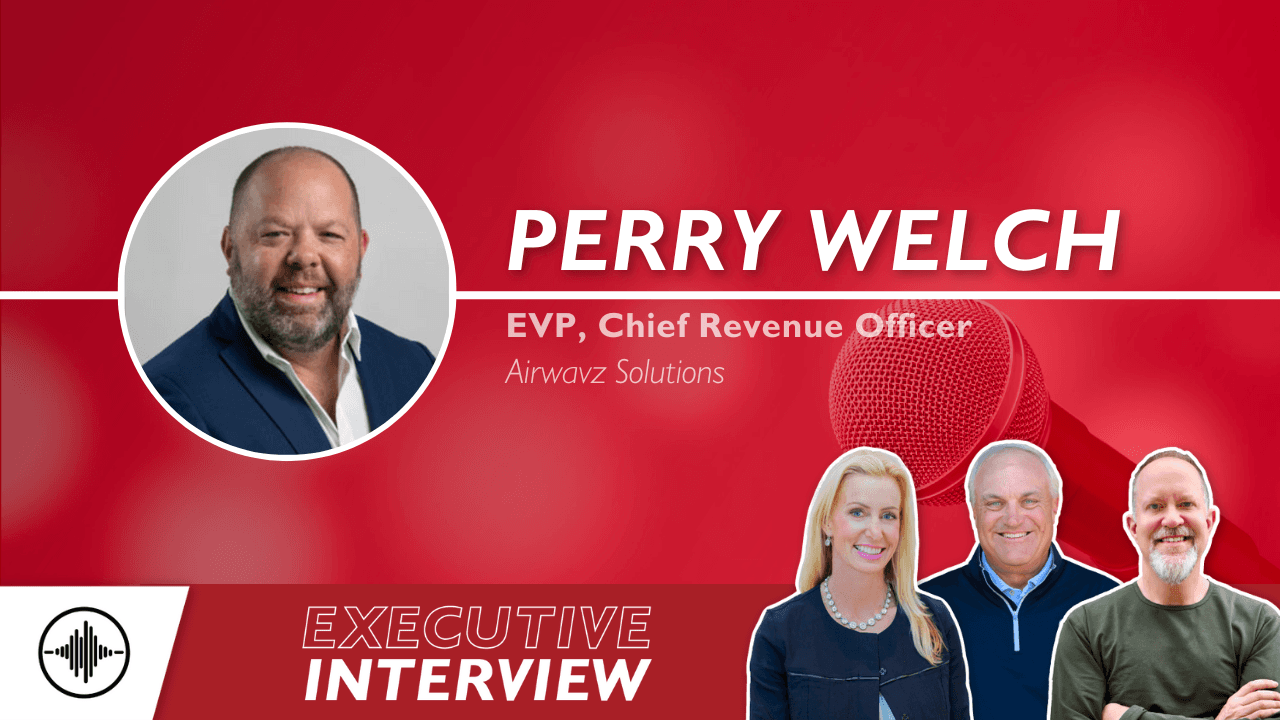
Executive Interview: Empowering Healthcare with New Age Networks with Perry Welch
 Apple Podcasts
Paused
Executive Interview: Empowering Healthcare with New Age Networks with Perry WelchExecutive Interview
Questions Answered in This Episode
- Why do hospitals struggle with cellular connectivity more than typical office buildings?
- How does DAS differ from relying solely on WiFi networks for clinician communications?
- Can hospital IT teams manage distributed antenna systems without specialized telecom expertise?
- What financial models let CFOs choose between owning or leasing in-building cellular infrastructure?
- How does 5G indoor capability specifically benefit critical patient care devices in healthcare?
About This Episode
October 29, 2025: Cellular networks are transforming healthcare delivery, but what makes 5G truly different from its predecessor? Perry Welch, EVP and Chief Revenue Officer at Airwavz Solutions, discusses creating a robust network infrastructure that can handle the demanding requirements of modern medical technology. As healthcare systems begin exploring what's possible with this upgraded network, the question shifts from "can our phones work?" to "what new capabilities can we unlock?" Discover why focusing on your network is becoming essential for healthcare environments.
Key Points:
- 03:20 WiFi vs DAS in Healthcare
- 06:21 The Future of 5G and Beyond
- 09:47 Implementation and Coverage Challenges
- 15:34 Airwavz's Healthcare Focus and Conclusion
Donate: Alex’s Lemonade Stand: Foundation for Childhood Cancer
Thank You to Our Episode Partners


Transcript
This transcription is provided by artificial intelligence. We believe in technology but understand that even the smartest robots can sometimes get speech recognition wrong. Executive Interview: Empowering Healthcare with New Age Networks with Perry Welch [00:00:00] This episode is brought to you by Airwavz. Ensure your healthcare facility is always connected with secure, seamless, and future ready 5G wireless infrastructure. Our in building solutions guarantee robust mobile connectivity, enhancing physician satisfaction, patient care, and operational efficiency. With Airwavz, you'll benefit from scalable fiber, cellular, Wi Fi, Private 5G and smart building technologies. The best part? We make wireless simple. Visit thisweekhealth. com slash Airwavz dash solutions today and transform your healthcare environment with the power of 5G. I'm Bill Russell, creator of this Week Health, where our mission is to transform healthcare, one connection at a time. This is an executive interview quick powerful Conversations with Leaders Driving Change. So let's get started. Bill Russell: All right. Today we are doing an executive interview. I have Perry Welsh with me, with airwaves, [00:01:00] airwaves Solutions. Perry, welcome to the show. Perry Welch: Hey, thank you Bill. Glad to be here. Bill Russell: so you guys are in the in the wireless space within health systems. Why do hospitals and healthcare facilities struggle with cellular connectivity more than other buildings? Like why is healthcare a target for these kinds of solutions? Perry Welch: they struggle with it for the same reason most buildings do. The wireless carriers, this macro network that they build, all these cell phone towers that you see everywhere. It's meant to provide service outdoors. It's actually not designed to penetrate buildings. Some buildings, it can penetrate, some, it struggles because of steel, glass, concrete. So it creates this inherent problem in building where. If you want a cell phone to work, depending on where your building's at, it may or may not work too well. So that's why it's an issue. Specifically in healthcare, why are healthcare systems kind of choosing to solve for this [00:02:00] more and more each and every day? The, there's a few reasons. The first one is to improve. Clinician and patient satisfaction. That's the number one reason customers partner with us in healthcare is they want to make everyone's phone work. I think as we move forward with these technology changes, cellular's becoming a pretty big deal and clinician communications throughout the facility. Are increasingly more critical to patient care. They're doing more on their devices. And so if you've got weak signal indoors for cellular devices, that doesn't work too well. They're getting a lot of complaints about that. And then the third one is these are just really complex systems. They're difficult to stand up. There's a lot of scar tissue in the healthcare systems where they try to do this on their own. They're very expensive. You've gotta deal with all the carriers. And so it's a headache. Bill Russell: I'd love for you to explain DAS to me like I'm a hospital, [00:03:00] CEO, not necessarily somebody that you're a telecom engineer. Yeah. And you know, I have wifi across this thing. Why are we talking about DAS? Perry Welch: Yeah. For a few reasons. So, in the simplest form, DAS is we're just building you a cell phone tower in your building to make sure everyone's phone works. Regardless of carrier. So that's the solution. But why is wifi not enough to the heart of your question? Wifi networks are great. It's been our experience. I think most healthcare, CTOs and CIOs would agree those networks are over leveraged. They're kind of piecemealed together. They're a little underfunded at times depending on where you find the healthcare system in a budget cycle. But most importantly, they're not ubiquitous networks, meaning wifi is meant to help you in this location where this wireless access point is. As you traverse through the facility, that signal can't carry a cellular call like it's meant to. You're gonna drop that call from. [00:04:00] The physician's lounge to their office, to the patient hall, to radiology as you go through the building, to the parking garage. So you've gotta have a separate network, a commercial grade, cellular network to stand up cellular. And actually they're finding when they do that. It actually helps the performance of the wifi network. You're taking a lot of traffic off of wifi. Bill Russell: For a CEO or CFO DAS is a little bit more complex than your standard wide area network, local area network that most of these people oversee. I think there's this belief that. If you put DAS in the networking team should just be able to start playing around with this and make it run and make it function. But that hasn't been my experience. Why? Why is that? Perry Welch: You're Rebroadcasting licensed spectrum that's owned by each of the three carriers. So you've got three other partners involved here. You gotta use their radio sources. You have to meet their in-building cellular requirements from network [00:05:00] design. And then you gotta manage all that day-to-day, month to month, year to year. This is long-term digital infrastructure. It's not a three year kinda wifi network, and you kind of update it. And so when you've got all that complexity there. To have a team internally, just to stand that up and kind of keep it going. It's a really tall ask and we're seeing a lot of healthcare systems come to us and say we want to de-risk, de-risk this for us, take it off our plate entirely with a really heavy set of guarantees and KPIs that it's gonna work. And that's what we provide 'em. Bill Russell: Who owns this device? I mean, you said three carriers and signals. Yeah. And earlier you said build a tower within the hospital. Yeah. That's gotta scare people. You're not talking about an actual tower. But, Perry Welch: Yeah, it doesn't look that way. It, that's essentially what it is. It's hidden. Who owns it? Depends. So we have several different models that our customers can purchase. This guaranteed service. From us. One model, we own it and we just charge [00:06:00] 'em an operating expense monthly, no capital required. Another model, they own it and they can capitalize it and put it on their books, and we just maintain and monitor and design it and guarantee the service. And we've got several healthcare systems today, bill, that depending on the specific site, they may choose one or the other based on their plans for that site. Bill Russell: So 5G infrastructure, I assume, are we talking about six G yet, or we're still talking about 5G at this point. But that's part of the, that's part of the thing here, right? So it went from 4G to 5G and a bunch of stuff shifted and we have to keep an eye on the future 'cause there will be a six g. Perry Welch: There will, and so over this agreement that we put in place to provide this service to the healthcare system. We're on the hook for managing those technology updates so that this network never becomes obsolete. And a lot of them find themselves in a situation today where they haven't cared for that network. [00:07:00] It's kind of just been working and it's quiet. They don't have the team in house to take care of it. And now they can't get parts. It's not being monitored appropriately. It's not functioning the way it should. We're gonna eliminate all that for them, and that's what they mean by de-risk. This for us. Like make sure it works. 5G is happening now indoors, finally. But it's just happening indoors. It's been outdoors for a while now. You've seen all the commercials but indoors, it's starting to really go life. Bill Russell: Well, what changed between 4G and 5G that makes, you know, that has made a difference? 'because we have seen a awful lot of discussion and adoption of 5G in the medical space. Perry Welch: It's a more robust network. It's 10 times faster, stronger, more robust than the 4G network. You can do more with your cellular device at a faster rate of speed. Now outside of healthcare, maybe big manufacturing, there's not a lot of need for 5G indoors. True [00:08:00] need, you know, for me and you just walking around all we need is 4G and it works great. But if you're putting critical patient devices that depend on the connectivity of cellular to function that's what 5G is meant for healthcare indoors. So it's a really powerful upgrade from 4G to 5G. It's got its place in healthcare. Many are starting to dip their toe in there and not just solve for can the cell phone work? What can we do with this robust network? Bill Russell: So CFOs they're gonna ask, you know, what's the ROI story? I mean, one of the things I just heard is a lot of flexibility. I can capitalize it, I can make it an opex expense. I can protect against essentially tech debt because you're gonna, you're gonna keep that thing moving forward. I mean it what other things are we saying on the financial side? Perry Welch: There's this whole scenario in healthcare systems that we've learned very well build versus buy, and some of them really want to build it and own it, and some of them want to buy it and lease it. And so we have [00:09:00] both models available or even a hybrid in some cases. A lot of it depends on their capital situation and what capital projects they have planned and budgeted for. We've got some healthcare systems in the Southeast today. They're flush with capital and they want to own it, and they want us to just build it, design it, maintain it, and make sure it works. We're happy to do that. It's on their books. They own that asset. We have some others that are being asked to cut that budget, and they're being asked to do more with less capital. And that's where our operating OPEX model comes into play, where they don't have to put any capital up front and they can just pay us a monthly service fee once it on. So the CFO comes into play on how they like that to look after we agree that we're the right partner with the business team, with the CIO or the CTO. Bill Russell: So, I mean, what does this look like going forward? I mean, do you suspect that every hospital has a need for this? Is it enabling, some, some new capabilities Perry Welch: I would say for the majority of healthcare [00:10:00] systems today. They're still trying to solve for just cell phone coverage, make everyone's device work so that calls, texts, messages that you know, physicians and patients alike are happy. That's ro. That's the satisfaction. There are a few healthcare systems. Boston Children's was in the news last year. With a big ride up in the Wall Street Journal. There's a few others that are going down that path today that I won't name that are really looking at a 10, 15 year plan and cellular. And 5G is the core network that they're utilizing to make sure they meet their technology needs of Linux 10 or 15 years. Whether it's within the walls of their facility or outside of the walls of their facility for their patients. So they're creating apps and there's a lot going on there that's exclusive to them, but they need a really robust 5G network to make that happen. Really big commitment Bill Russell: Is this considered a private 5G network or is this [00:11:00] public? We're just essentially broadcasting the Verizon and T-Mobile and other. Perry Welch: So that question comes up a lot. These are very, I wanna make the point really clear. These are very secure networks. These are commercial grade, encrypted carrier networks. So there's not a lot of risk there from security, which is why they're starting to lean on it more. But it is public that it's public cellular companies that own the license spectrum that you're using as your gateway to connect. But Bill Russell: Am I tying myself to any specific carriers or do I have to select carriers? Perry Welch: You do you do have to select everyone in healthcare today is saying just solve for all three, because they don't know. They've all gotten away from an exclusive carrier in-house where they're providing devices to their staff and clinicians and faculty. They're doing that for budget reasons. So they kind of cut the cord there and they're giving everyone a stipend or they're saying as a requirement here, you have to have a cell phone that works. And when they do that, they open the door [00:12:00] for, well, now we've gotta solve for all three carriers. So everyone we're solving for today is just checking the box. I wanna solve for at t Verizon and T-Mobile alike. They're not picking just one carrier, but you may have seen a lot of that maybe 10 years ago where they just solved for one. Bill Russell: there a, a common misconception healthcare leaders have about in building wireless? Perry Welch: It's becoming less and less, but there is still a good bit of healthcare executives that feel like it should just work and why aren't the carriers paying for this? There was a time in our business where carriers would fund these networks on behalf of the healthcare system, and there actually are a lot of kind of. Older networks living in the walls of some of these healthcare systems and hospitals. The cares did fund, but it's only one carrier. They only have service for at and t and that network's end of support can't really function well anymore and it's gotta be updated. And now the carriers aren't funding [00:13:00] these networks anymore, and so those healthcare systems are having to find a partner like airwavz. Bill Russell: Yeah. Do you ever, I mean, one of the misconceptions I would imagine, do you ever get a hundred percent coverage or are there just. Natural dead spots in hospitals. Perry Welch: Yeah, we guarantee 99% coverage. It's hard to say a hundred percent. There are some areas elevator shafts, the shaft itself, mechanical rooms and kind of stairwells, fire, exit stairwells. The, we're not guaranteeing service in those necessarily because the way they're constructed a lot of metal and stuff, it's hard to guarantee service, but for the most part. The phone will work everywhere in the bowels of the system, Bill Russell: Quite frankly, some of these hospitals have been built over time. I was taken to, into a hospital once and as a prank, they had somebody meet me at the front door and they, and I was just going to the boardroom. They took me the long way through. They took me through the morgue. They took me like all over the hospital and I was just like, [00:14:00] I felt like I was in Disney World. Like I had just walked through this wild maze and I think I ended up pretty close to where we started at the front door. But I may have put in I don't know, close to a thousand steps, but by the time. Perry Welch: Some really large facilities, and to your point, they're, some of 'em are over a hundred years old, a lot of expansion. And so, you know, we have to account for that when we're designing these networks and still ensure quality service. So yeah, it's not easy. Bill Russell: It's an interesting space. I'm curious, you know, is there it's been a while since I had to e evaluate these kinds of things. I mean, is there anything I, I didn't ask about this space that you normally, a question you normally get? Perry Welch: You know, I think one of the biggest things that's out there is just can you guarantee all three carriers, and there's a lot of folks in this space that can design you, a DAS, that can build you a DAS. There's very few vendors in our space that are nationwide that have a master license agreement and a master service agreement with all [00:15:00] three carriers. Allowing them to fully guarantee on air dates for all three carriers. That's a big kind of aha moment when we're educating executives within the healthcare system. Other than that it's really just how much. Them evaluating the pain level and the cost to solve for this. You know, do they do it this year? Do they do it next year? We're having less and less of the conversation of, is this a need? It's now more of a conversation is how do we buy and when do we buy? So it's it's really pivoted becoming this fourth utility. Bill Russell: Yeah. I'll close with this. Do you guys have a healthcare vertical? I mean, 'cause you obviously you can go outside of healthcare with what you do. Perry Welch: We do actually, airways started 12 years ago. We were just class A office and in 2020 we started in healthcare. And today healthcare represents actually half of our business. So it's grown really fast. It's our fastest growing vertical. And we're in a hundred hospitals. 20 healthcare systems covering 30,000 beds [00:16:00] today. And it's a really big part of our business going forward. Bill Russell: So, fantastic. Perry, I want to thank you for your time and I look forward to seeing where this goes. And I'll call you back when six G becomes available. Perry Welch: Yeah, well hopefully we'll talk before that Bill, but thank you. Yeah. Bill Russell: So six G, how long does it take for one of these things to go through the system? So we'll hear, talk of it, then , it has to go through the. Comment and approval and all. So it's like five plus years, isn't it? Perry Welch: It's more than that. It's more closer to 15, 20 isn't really Wow. An idea. The carriers just sunset the 3G network and now it's 4G and 5G and things are moving to 5G. That transition will take, call it 10 years and then we'll live on 5G for a while as six G comes to life. So you're talking 10, 15 years easy. Wow. Bill Russell: It's amazing. Well, again, Perry, thank you for your time. Really appreciate it. All right, thank you, bill. Thanks for joining us for this executive interview with me, bill Russell. [00:17:00] Every healthcare leader needs a community they can lean on and learn from. Subscribe at this week, health.com/subscribe and share this conversation with your team. Together we're transforming healthcare. Thanks for listening. That's all for now.