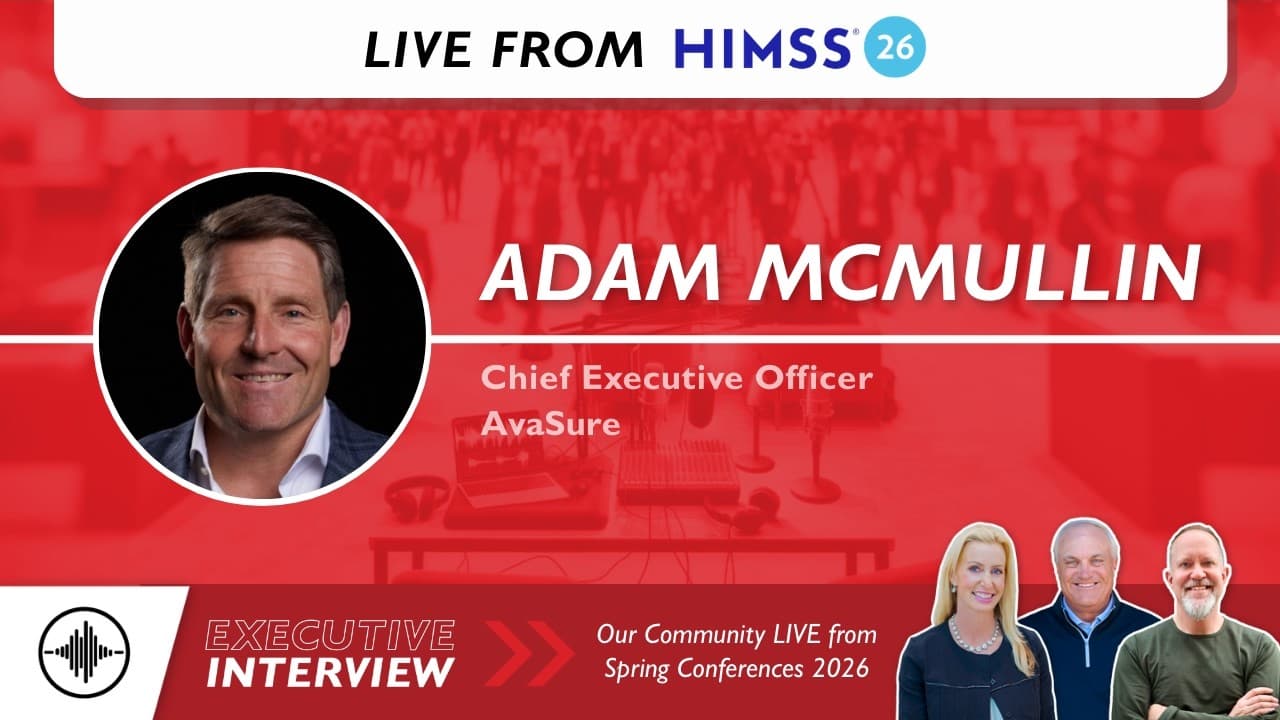
Executive Interview Live From HIMSS 2026: The Smart Hospital Room Is Becoming Real with Adam McMullin
 Apple Podcasts
About This Episode
March 20, 2026: Healthcare leaders have been talking about the “smart hospital room” for years. Now it is starting to become real. In this live conversation from the floor of HIMSS 2026, Bill Russell speaks with Adam McMullin, CEO of AvaSure, about how virtual care platforms are evolving beyond patient monitoring into a foundation for the hospital room of the future.
With deployments across more than 1,200 hospitals, AvaSure built its footprint through virtual safety monitoring, helping health systems reduce fall risks while dramatically lowering costs. Now that same infrastructure is expanding into physician access, computer vision, and AI driven patient monitoring that could detect deterioration hours before a patient crashes.
Adam shares how health systems are rethinking the hospital room as a connected care platform. Virtual nursing, family engagement, Epic integrations, and emerging capabilities like contactless vital monitoring are all becoming part of the same environment. The result is not simply new technology. It is a shift toward safer rooms, better staffing models, and new ways to extend care from the hospital into the home.
For health system leaders navigating workforce shortages and rising costs, the question is no longer whether virtual care will scale. The real question is how quickly the hospital room itself will transform.
Key Points:
The Evolution of Virtual Safety Monitoring
Building the Smart Hospital Room
Computer Vision and Early Patient Intervention
Thank You to Our Episode Partner


Transcript
This transcription is provided by artificial intelligence. We believe in technology but understand that even the smartest robots can sometimes get speech recognition wrong.
Executive Interview Live From HIMSS 2026: The Smart Hospital Room Is Becoming Real with Adam McMullin
[00:00:03] Over,200 hospitals rely on Avashir's AI enabled virtual care platform to enable their smart hospital strategy. It's the eyes and ears in the room. Scalable, clinically grounded, and built for enterprise impact that translates into smarter labor optimization and improved throughput where it matters most. Find out more at thisweek.com/havishure.
[00:00:32] Health, where our mission is to transform health care one connection at a time. This is an executive interview. Quick, powerful conversations with leaders driving change. So, let's get started. All right, here we are from the HIMS floor, another executive interview.
[00:00:47] I am excited to be joined by Adam McMullen with CEO. You're CEO, right, of >> As far as I know, you know, everyone's a member of the team. You all have a role to play.
[00:00:58] >> The good news is I think people feel like, "Oh, Bill is so polished and whatnot." I have to remind myself if you're CEO or president, I don't remember systems, but you uh Aperture is doing great.
[00:01:10] >> Yeah, it's a really exciting It's a very exciting space we're in right now, right? We get to really help our health systems improve safety and reduce costs. We get to improve access by bringing physician services to market. And with computer vision, there's more and more that's happening in this smart room and smart hospital arena. And it's really a lot of the things that have been talked about for a while are starting to become
[00:01:32] real. So it's exciting. >> I think most organizations have an averure of footprint of some kind. I mean that's one of your advantages. >> We do have the largest footprint across the entire market. We're known most for virtual safety and that's where 10 to 20% of patients need monitoring for fall risk or behavioral health and we can take something that generally costs maybe $30 down to three. So there's a
[00:01:57] phenomenal cost savings but also and critically importantly you're going to get much better results falls rates cut in half. But what's actually been almost hard to do is to reintroduce the company in all of the rest of the things we're doing around physician services and computer vision and hospital at home.
[00:02:17] That's actually our customers have these great relationships with us and we have these great relationships with them with sort of re reintroducing yourself is it's been it's been fun but it's it is a lot of work because you got to go you know we're in,200 hospitals go almost meet with every one of them. So, >> well, is that is that the conversation?
[00:02:35] Is that the story? It's like, hey, maximize your footprint. Like, you're doing this, but did you recognize we can layer these other things on top of it and really drive an ROI? >> It is the thing that I think we do better than anyone else is get to those financial results. And we are a technology company, but really importantly, we're 20% clinicians. and the workflows, the support level, the
[00:03:00] usability, but we'll take risk with our customers to say, "Hey, you might have a 30 or $50 million net savings opportunity. Let's go let's go at risk with this because we're that confident that we can deliver those results together with our customer in partnership." And we've seen some really interesting things happening because this is a market where Averure started and you're only covering a small percentage of rooms. And now
[00:03:25] increasingly people are saying, "Hey, I want to I want smart room type technology. I want that safety value proposition, the care access value proposition. I want that tech consolidation on the platform in every room. How do we fund that?" And for example, we're in the process of opening a new tower with UPMC. It works. You're running the epic footprint with being able to have Epic TV there seamlessly.
[00:03:49] You're providing almost a cocoon of safety around the patients that they're serving and then you're add you're allowing nursing, physician services, ministry and family to engage and then we're adding and augmenting that with computer vision.
[00:04:01] >> Well, let's let's talk about that a little bit. I mean, it does it have to be a green field scenario or can you come back in and retrofit what they have? No, the device is really generally it just it's power and an Ethernet port, but increasingly we're doing uh we got some customers that are going to be driving it across 5G to have an even lighter deployment footprint where they've put in their own proprietary
[00:04:23] systems and we're adding the adding in the same capabilities. You can do it across 5G. We can >> interesting. I would think they >> we can go across a Wi-Fi as well, but you need a very high quality Wi-Fi and a 5G is an interesting way to sort of separate that and provide more dedicated >> and you have a DA solution across the >> for customers that are looking at or investing in the DAZ
[00:04:47] >> is proprietary equipment does that end up being a concern or a conversation? Everyone asks us could you use any camera and >> but they don't really want to use every any camera do they >> they get asked the question and the answer that we always give is the platform is fully open whether there's aure software running on epic software running on even competitive software we have standard APIs it's secure but in
[00:05:10] order to support virtual care at scale to provide utility like performance there's things we do in the camera to make sure it can be supported and that we need to know and how to character ize them in our support desk. So, if a customer had 2,000 or 3,000 something, maybe we would look at qualifying it.
[00:05:27] But there's also some unique proprietary features in there from alerting, alarming, how the night vision works. So, what we say is we'll give you utility like platform performance, but then you can integrate with anything else you want. And then because of our large customer base, many of the other technologies want to work with us anyways. And we've pre-wired a lot of it. And that's the benefit of a platform, right? And whether you're
[00:05:50] looking at safety or virtual nursing or telesroke or telescu we've adding one of our partners is we just lit up with computer vision vitals.
[00:06:02] It's wild. But think about having a level of surveillance on every patient at a very low marginal cost so you can avoid a failure to rescue or you can intervene with a patient that might be 8 hours away from crashing and the solution is electrolytes versus a trip to the ICU.
[00:06:19] >> I I think if I were negotiating with you, I wouldn't want to be able to use my old cameras, but I'd want access to your feed. I'd want to take your feed and take it to your stuff, but I'd also want to be able to take it to some other stuff that I might develop or >> and that's what the API does. And something else that's really important though is arbitrating use to that. If someone was in the middle, you know, if
[00:06:41] they're being monitored for safety, you want to make sure if someone else is going into the room that they're knowledgeable of that and they're not disrupting the safety monitoring. Or if you're in the middle of a discharge planning event and the family's in there, just like you would enter a room physically and you're knocking, you'd want to know, hey, maybe this isn't the right time to dial in and do patient education or something like that.
[00:07:04] >> I would think in the next 3 years, if I were, we all have this season we have to go through where we have to care for our parents and that kind of stuff. I'd want my parents to be in a hospital room that has that is one of the hospital rooms of the future that's monitoring them 744 365 knowing what I know about how busy nurses are and how much they have to do.
[00:07:26] I don't think it's a I think it's a huge value ad as somebody who's caring for somebody to say, "Look, I know your staff's busy. I know they're doing a lot of stuff, but I want to know that they're being monitored 724 365 if they go to get out of bed." That's the easy use case, but I want them to be able to do a call where they're not pressing the button every 5 seconds and nobody ever comes back.
[00:07:47] >> We have these amazing great catches and we share them at every town hall and often so everyone in the company can feel the impact that we hope to make with with our customers. But I'll share a story. You know this guy, Jerry Lewis, a CIO for Ascension. So, he was going to help us with some advisory work and I called him up to ask him if he would do this and he just pulled out his phone and he held up a picture of our
[00:08:09] technology in a room. He said, "When my dad was going through end of life, your technology was there and it just gave us peace of mind and we felt we could go home and and that we knew that there was always a level of safety and observation that was there." And he said, "Anything you want, Adam. Anything you want. I love it." And like I'm getting almost like I get the passion bumps just even thinking about it because those are the moments that
[00:08:35] really matter when you're that the technologies are really interesting but bringing it into real use cases making a difference for care teams. Care teams don't want to think or worry about patients that are unmonitored or aren't getting access to nursing or physician services. They want to make sure patients are served and returned back to into their communities and we can help do that. Well, Adam, I appreciate you guys ushering us into this this future.
[00:09:01] I think it's I think it's really exciting and quite frankly, I don't think it ends in the hospital room. I think at some point, I think it's going to be in our houses. Hospital at home. >> We've got an offering for hospital at home as more of our customers are experimenting with those models and we're providing solutions really across the continuum and there's a lot of components of the platform that make a lot of sense in those different care
[00:09:24] settings. Fantastic, Adam. Thank you. >> Hey, always appreciate it. >> Thanks for joining us for this executive interview with me, Bill Russell. Every healthcare leader needs a community they can lean on and learn from. Subscribe at team. Together, we're transforming healthcare. Thanks for listening. That's all for now.