Burning Man and the Tardigrade: When the Bad Thing Happens | Unhack the Podcast with Sarah Richardson
 Apple Podcasts
Questions Answered in This Episode
- What does a microscopic animal that survives fire, ice, and space have to do with hospital downtime?
- If your hospital is the cornerstone of its community, what happens when the bad thing hits?
- Why does Drex haul a backup generator to the desert?
- How do 60,000 people build a city with no money except ice?
- What did three people in the New Orleans room actually come for?
About This Episode
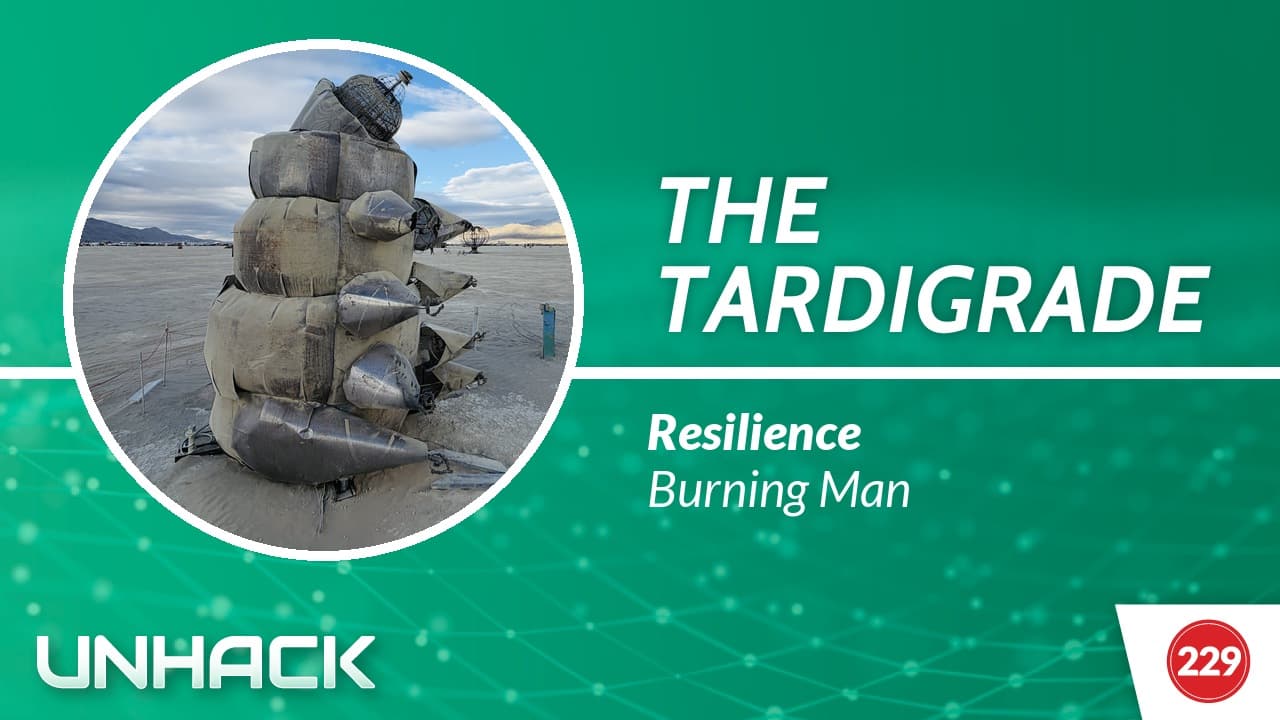
September 22, 2026: Sarah Richardson sits down with Drex DeFord for a special UnHack. No CISO guest this month. Drex is 24 hours off the Black Rock Desert and into the New Orleans regional staff roundtable, where three people told him they were there for the Burning Man stories. He answers how the city actually works. Then the picture he sent Sarah: a tardigrade on the playa. Heather Costa made that microscopic survivor the mascot for healthcare IT resilience. Same question the RSR afternoon is built on: what do you do when the bad thing happens, so patients, families, and staff still get care.
Key Points:
00:06 A Special UnHack
02:56 Fortified Health
03:30 How the City Works
08:38 Art, the Man, and the Temple
12:42 The Tardigrade
15:03 When the Bad Thing Happens
Keep up to date on the latest in health IT:
https://thisweekhealth.com/news/
Donate: Alex’s Lemonade Stand: Foundation for Childhood Cancer
Thank You to Our Episode Partner



Transcript
This transcription is provided by artificial intelligence. We believe in technology but understand that even the smartest robots can sometimes get speech recognition wrong.
Burning Man and the Tardigrade: When the Bad Thing Happens
[00:00:06] Drex: You know, this is kind of an odd and different and special show, a special version of Unhacked Podcast. One of the things that happens, and I have Sarah with me here. Say hi, Sarah.
[00:00:17] Sarah: Hi, Sarah.
[00:00:19] Drex: One of the things that happens always every year at this time is I go to Burning Man. And I literally, we just came back from New Orleans. We had regional staff roundtable. I had probably three people who essentially said to me when they saw me, I'm just here for the Burning Man stories. So I mean, obviously, they were there for the event and all the cool things that happened in the morning session,
[00:00:41] Drex: in the afternoon session, we talked about AI and resilience. But it's funny, everywhere I go, that has become a thing. And I love that people know us more now from some of the things we talk about in the podcast and other stuff. But one of the things I get is a lot of questions about Burning Man. So you asked me about Burning Man. I said, we should just record this as the Unhacked Podcast. I could talk a little bit about Burning Man
[00:01:05] Drex: and how Burning Man relates to a lot of the work or some of the work that we do in health care. So I'm here, man. I'm ready for your questions.
[00:01:16] Sarah: All right. I've got questions about Burning Man. Nothing that will implicate you in any way that you wouldn't want to be public knowledge. Yeah, yeah, sure, sure. All right. So you just got back from Burning Man. Yeah. Straight out, obviously, you just mentioned to our regional staff roundtable in New Orleans. So I'm amazed that you had less than a 24 hour turnaround. It was quick. And you were on. I mean, you had it going on in New Orleans. What a great event that we had.
[00:01:40] Sarah: And you did the resilience portion of the day. But I have to start with asking you, how was the desert?
[00:01:47] Drex: I mean, it was great. So for folks who have never been, and I know that's probably most people. And that's probably a good thing. I mean, some people are kind of built to do this and want to do it. And some folks just like, I just want to hear the stories. And I want to kind of live vicariously through friends who go. But for me, it's about 10 or 12 days.
[00:02:11] Drex: It takes a couple of days to drive down from Seattle, 700 miles down there. I have a little camper that I take with me and kind of haul stuff down there. And, you know, my wife goes with me. I've been this is this was my seventh Burning Man. It was her fifth Burning Man. And and it was a it was a great time. It's always super fun and interesting.
[00:02:34] Drex: The trip down and the trip back is always interesting and fun, too, because we sort of drive through rural back back desert Oregon to get down there. And we always have a good time. So I get to see all my friends and all that kind of stuff, which is that to me, as much as anything else, is the the big deal of of Burning Man.
[00:03:30] Sarah: How does it all work? I mean, there's a clock and there's some villages and the different things I've heard over periods of time. But if you were just to literally explain to our audience, how does Burning Man work?
[00:03:41] Drex: Yeah, kind of a little interesting. You know, there's so many things I could tell you about it. But kind of the nutshell version of it is probably there's this year. They haven't released the numbers yet, but there's usually around 60 or 70 thousand people who show up. Many of them show up early. The the actual event itself is about a week long. But there are people out there a couple of months ahead of time
[00:04:05] Drex: helping to lay out the design of the city and the infrastructure. There's so many things that happen. You know, 60,000 people show up. That means there are thousands of camps or thousands of folks who create their own gifting business as part of what they do at Burning Man. For our part, we have an espresso bar and we
[00:04:29] Drex: espresso martini bar and we are open like three days of the week. And we have a DJ and we have inversion tables. It's it's called the Guano Loco Lounge. And we have inversion tables. People hang upside down like bats. Which actually everyone seems to love because it takes stress and pressure off your back and let you stretch out a little bit. That we have hippity hot balls.
[00:04:52] Drex: Like when you were a little kid, you had those hippity hot balls that you sat on and bounced around a little ring on top with a little ring on top that you hold onto. Yeah, yeah. So we have we have a whole rodeo layout for that. And this is the craziness that I love of Burning Man, too. It's super creative. People do all kinds of amazing stuff. It is a lot like being a little kid again, right?
[00:05:15] Drex: You show up, you don't worry about being anywhere because there's no appointments, really. You get on your bike, you ride around different neighborhoods. You eat at other people's houses or drink at other people's houses. There's music and art and stuff you can climb on. And it's and in my head, it's a lot like being a little kid again. So it's great fun. It becomes the third largest city in Nevada behind Las Vegas
[00:05:40] Drex: and Reno during that week. The city has real infrastructure. NV 88 is an airport. They open up an airport. They're volunteer air traffic controllers. They literally run an airport. There's a hospital there called Rampart, and there are clinics. And I've spent time in those clinics looking around and talking to folks. Those are all volunteers, volunteer docs.
[00:06:02] Drex: I think there are a few paid physicians that may actually come in and and and work in the hospital. The hospital is kind of a field hospital. It's not, you know, a bunch of super, you know, modern MRI and all that kind of stuff. But it's it's plenty good for most of the kinds of injuries that happen there. What else can I tell you? It's a gift.
[00:06:25] Drex: I'm ensuring IV bags and Narcan for that.
[00:06:29] Drex: And there's a lot of folks who carry Narcan around with them, too. You know, just in case. It's a gifting kind of society. The way the city is built, so there's no money. The only thing you can really buy is ice. You buy ice at the ice stations that are around the city. Otherwise, everything is just a gifting society.
[00:06:50] Drex: We bring and serve, I don't know, 400 or 500 espresso martinis that week. Nobody pays us anything for that. This is all part of our, you know, our team all has camp dues and we all make a donation and it helps put all the cost away for all of the things that we do as part of our camp. And of course, the artwork I've talked about, the artwork like the man
[00:07:13] Drex: was incredible this year, a huge man built up on this giant stand that looked like a tree and it had roots that went out into the desert. Just super cool. And there's a temple every year. The temple is a place where people really go to kind of mourn the people and the things that maybe their pets, other things that they've lost over the course of the year.
[00:07:36] Drex: And they put in notes and they bring items. And on Sunday, the temple burns. And the idea is that all of that messaging goes into the sky and up to heaven or whatever you believe as as part of as part of that Sunday night ritual. So it's just it's an it's an amazing and crazy city.
[00:07:57] Drex: And there's so many things I could tell you and you can read about online. Many of the pictures you're going to look at probably are not going to be safe for work, so you might want to look at this if you want to look up pictures, look at those up probably on your on your home machine. But the great fun, always really amazing, good fun.
[00:08:16] Sarah: It reminds me, since we've just come from New Orleans, of all the work that a crew puts in before Mardi Gras every year and all the things that you buy and save up and prepare and get ready for. And you give almost all of it away. That's right. You do off a float for Mardi Gras. And it's all in the spirit of just celebrating and giving and just the good naturedness of bringing so many humans together. So you mentioned the artwork.
[00:08:39] Sarah: But I'm curious about two things, a your favorite piece this year. But then also you sent me a picture of the tardigrade and it looked cool in the picture. And then I went and looked it up online. And I was completely grossed out by this little creature, except for the fact that apparently it can withstand fire and ice, literally.
[00:08:59] Drex: Yeah, I'll talk more about the tardigrade in just a minute, because that really was one of my favorite pieces. And the original tardigrade connection to cybersecurity and resilience came through Heather Costa, who's been to who's who's, you know, one of the folks who is a leader in resilience in health care, I.T.
[00:09:23] Drex: And we had this conversation about tardigrade and she is all about tardigrades and her her her kids are all about tardigrades and the amount of resilience and capability that they have to kind of overcome anything and just keep right on going. And I'll again, I'll talk more about that in just a little bit. But yeah, that was definitely one of my favorite pieces.
[00:09:47] Drex: Obviously, for me, the man in the temple this year, you know, having been to seven of these, there's always a man and there's always a temple and they're always different. Different artists create those and then build those every year. The man in the temple might have been my favorite man and my favorite temple of all the Burning Man events that I've been to. There are these crazy things called art cars, and they're really fantastic.
[00:10:11] Drex: One of my favorite that comes back every year is this thing called El Pupo. And it's a big octopus that has tentacles that move around and fire shoots out of the tentacles. And there's music that blares out of this thing. And it's really amazing to see. Very creative. The same crew comes back with that machine every year and they always put on a great show.
[00:10:34] Drex: And it's unique amongst all of the things that you see on the playa. And there are great music camps, too. Great music camps like Opulent Temple that we, you know, we always wind up our our crew in our camp always winds up making time to make our way over to Opulent Temple for shows. And then, you know, big cars that are sort of classic cars like Robot Heart
[00:10:58] Drex: and DJs that play on Robot Heart. If if if you're into electronic dance music at all, the guys, there's a guy named John Summit. John Summit played on Robot Heart. Robot Heart just kind of drove around the playa. And there were literally thousands of bicycles kind of following this car while John Summit played. So, yes, the the art is incredible. The art cars are incredible.
[00:11:24] Drex: And again, there's tons of great pictures. You can you can check that out.
[00:11:28] Sarah: Quick follow up question before you give us some deeper tardigrade info is who designs and builds the man every year?
[00:11:35] Drex: So the man is usually created through a contest that happens. The Burning Man Organization, who's kind of the if there is a lightweight infrastructure of how this all comes together, there's something called Burning Man Organization that that kind of puts this whole event together. And they do a lot of the stuff like the permits with Bureau of Land Management and all those things
[00:12:00] Drex: that allow us to be in the Black Rock Desert. But there's a contest every year. Some of the money that the org has goes to helping to fund many of these kinds of things. And so there are sort of design submissions and then there are committees who kind of look at those submissions and decide like, we really like that one. That's going to be the man for this year. That's going to be the temple for this year.
[00:12:22] Drex: They get some funding, but still a ton of the funding comes from the people who are involved or others who make donations so that that art piece can be created and built in. And that's the those are a lot of the people that show up early and spend time building long before we really even start creating the city. So pretty cool. That is very cool.
[00:12:42] Sarah: All right. So tell me about the Tardigrade.
[00:12:46] Drex: The Tardigrade. So, yeah, I mean, it's really interesting. So the Tardigrade and I'll include in this episode will include a link to a picture of the Tardigrade on the playa. But the Tardigrade is this crazy little critter kind of microscopic in size. But there's been a lot of study that's gone into this thing
[00:13:08] Drex: because they've sent it to space and it in a vacuum. It continues to live. They burned it with fire. They've thrown it in chemicals. They've done all kinds of things. And the Tardigrade just has a great way of being able to continue when all the bad things happen to it. And I think Heather Costa then has kind of gone through this process of like
[00:13:30] Drex: that has become the mascot for the resilience programs that she's built in the various places that she served around the country. And I actually have a little stuffy Tardigrade that I've sent to her over time. I was really blown away when I rolled out onto the playa that day and I did not expect to see a Tardigrade. And there it was. And I'm like, holy cow, Heather is going to love this.
[00:13:53] Drex: But this idea of always, you know, having a backup plan. What do you do when the bad thing happens? How do you keep on going? And we do a lot of this at Burning Man, right? I take a generator, but I take a backup generator. Even inside of our camp, there are people who over time have developed kind of like the camp skills that we have a small engine mechanic, somebody who's gotten really good at small engine mechanics,
[00:14:17] Drex: somebody who's good at working on RVs and water pumps and things like that that might need to be repaired. We have folks who are brilliant at figuring out the
[00:14:30] Drex: what's the right strap down process to keep things from blowing away when you have tents and all these other things that are set up. And sometimes the weather surges to 40, 50, 60 miles an hour winds. And we had all the weather this year, too, you know, the mud and the the dust storms. And it was hot and it got really cold at night. And again, being prepared for that so that when the bad thing happens,
[00:14:55] Drex: it's just like everything just goes on. It's it may not be optimal, but you have the opportunity to just like keep on running. And we talk about this at the regional staff roundtables, too. Half of the day is actually spent talking about resilience. And what do you do when the bad thing happens? How do you prepare for it? How do you do tabletop exercises? What are all of the things that you do
[00:15:19] Drex: to make sure that you're in a position so that when the bad thing happens, you can continue to provide for patients and families and the staff. And, you know, most of these health care organizations that come to regional staff roundtables or any of our events are the cornerstone of their communities. And they need to be there even when the bad thing happens.
[00:15:41] Drex: So so the Tardigrade, I was really surprised to see it. And I loved it. And I think it's a great representative for a lot of the work that we do in cybersecurity and privacy and a lot of the work that we just do in health care in general. We're always looking at if this doesn't work, what's our next course of treatment? If this doesn't work, how do we resubmit that claim? There's always there's always a backup plan and that's the Tardigrade.
[00:16:05] Drex: And yeah, one of my favorite one of my favorite pieces ever on the play of this year.
[00:16:11] Sarah: I've got respect for a critter that I probably don't want to find in my salad. But I don't even know if I would know that because they're awfully tiny in real life. Yeah, they're really the microscopic. Yeah. Well, we know it 10 years from now, we're going to find that ground Tardigrade is one of our new peptide things, but they'll then they live and live in the land. I don't know. It might be good for us. Might be good for us. Thanks for sharing all your stories about Burning Man.
[00:16:34] Sarah: I mean, really, I imagine that at some point when you retire from H.I.T. life, you're going to end up being the guy that's that loose, you know, society that runs the back end. Yeah, I don't. I already got your own camp like completely dialed in. It's time to expand your capabilities.
[00:16:55] Drex: I appreciate that. I can't imagine that that actually would happen. One of the things I would really love to happen is that you and Dan would come to Burning Man at some point.
[00:17:06] Sarah: So what would be up our alley? It really is because when we plan for like a scuba trip, you plan for a plan for I mean, you have like 50 backups. Absolutely. You know exactly what exactly what we do and the heck out of that. That whole gym. The one thing I worry about is like doing a couple espresso martinis and then doing a hippity hop rodeo or the inversion table. I got to do my martini after that.
[00:17:30] Drex: Well, one of the things for Burning Man is one of the burning man is it's saying is safety third. And so, yeah, there's a lot of, you know, you do you are doing some risky stuff out there in the name of fun. But yeah, everybody tries to be careful and we all take care of each other.
[00:17:48] Sarah: So hey, we dive with sharks literally. So I'm pretty sure I can now I'm like want to go get a hippity hop and practice. So I would show up at an event with some like road rash. It's because I probably did a header in my front yard. Yeah, my driveway trying to get ready for a future. Fantastic.
[00:18:04] Drex: You got to watch out for those kids next door. They're probably smashing. They'll probably steal my hippity hop for sure.
[00:18:10] Sarah: But I would love it. Although it's Halloween. Thanks for doing this too. This is a ton of fun.
[00:18:15] Drex: It's always fun. Your stories are awesome. I'm glad we get to share it. Tie it back into the work that we do every day. And you know, we've got 11 more cities to tackle this year for our regional staff roundtables. And I feel like as always, we're just getting started. Yeah, we are. All right.
[00:18:31] Sarah: I'll talk to you soon.
[00:18:32] Drex: I'll see you soon. I'll see you in Portland probably before this airs. Probably before this airs. Then we'll be on our way to San Diego.
[00:18:39] Sarah: So ideally whoever hears this, we're coming soon to a city near you.
[00:18:45] Sarah: And that's it.