"Technology as a Strategic Enabler": How UC Health Is Building the Foundation for What’s Next

Kate Gamble
Managing Editor - This Week Health
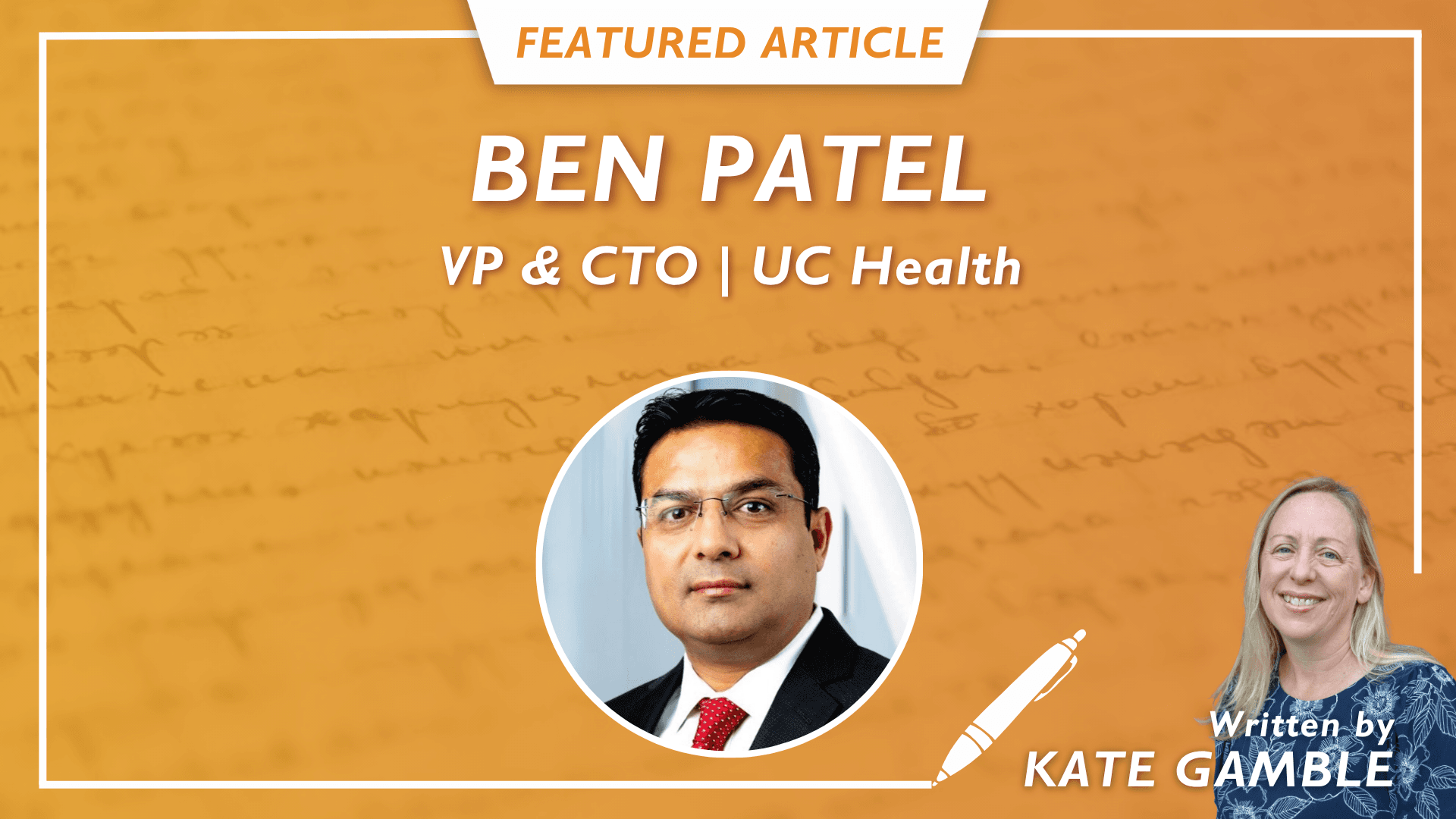
Ben Patel, CTO at UC Health, talks about how modernizing the IT infrastructure can pave way for innovation, the need to be "constantly in touch with vendors," and why anticipation is becoming a more pivotal aspect of leadership.
So much about the healthcare IT landscape is evolving, and the CTO role is no exception. While it is still a tech-focused position, it’s taking on different forms as organizations embrace agile digital platforms, according to Ben Patel.
“The ultimate goal is to make sure technology supports better patient care, operational efficiency and innovation across the health system,” he stated. “As CTO, my core objective is to make sure that the technology becomes a strategic enabler of the business strategy.”
For that to happen, a solid foundation must be in place, which has been a key priority during his first year at UC Health, an academic health system based in Cincinnati, Ohio. Recently, Patel spoke with This Week Health about the approach his team has taken to establish a roadmap, what they look for in vendor partnerships, and the questions that must be asked with AI solutions.
Start With the Assessment
When Patel took on the CTO role, the first task was modernizing the technology foundation, which included infrastructure, resilience, cloud strategy, cybersecurity, and other components. But rather than taking quick action, he chose to spend the bulk of his early months listening – to clinical leaders, to IT staff, to business stakeholders – and building a realistic picture of where UC Health’s technology stood before writing a single line of a roadmap.
The evaluation covered three dimensions: the existing technology landscape, the organization’s business strategy and direction, and the talent and technical depth of the IT function itself. From that foundation, he built a multi-year roadmap addressing cloud migration, cybersecurity certification (specifically HITRUST), infrastructure resilience, and a technology application rationalization effort to eliminate redundant systems and reduce complexity.
“It started with the assessment,” he noted. “We looked at our business strategy, where we’re trying to go, our current operational needs, and our talent and technical depth. And using that, we created a roadmap.”
One of the immediate takeaways was that UC Health, so many large systems, had experienced platform sprawl. And so, Patel has launched a rationalization effort focused specifically on the 4-5 competing communication platforms operating across the clinical enterprise. Each one adds load to the network infrastructure, requires integration work, and generates support burden.
“Aligning these systems will help reduce complexity and improve our clinician and patient experience,” he said, while helping to produce the clean, reliable data needed to be able to leverage AI and machine learning capabilities.
Getting Strategic With AI
That, of course, leads to another area that’s top of mind for all healthcare leaders: how and when to utilize AI. Complicating the matter is the fact that the AI market is extremely saturated.
“Everybody is selling AI,” Patel noted. The question is, “how do you identify the right partner?”
His team’s approach has been to look first at the AI capabilities already embedded in their platforms – including Oracle’s ERP, ServiceNow, and Microsoft Copilot Studio – instead of building a strategy around net-new standalone vendors.
As part of that, they’re running targeted pilots with tools like Palantir, moving from proof-of-concept work to evaluating broader applications across the health system. “We’re using that as part of our strategy to see which tools we should be using, where and how do we not only upgrade ourselves from a technology foundation, but use those in our day-to-day workflows to make our clinicians and staff more productive?” he added. “We want to make sure we’re using vendors strategically, and that they’re embedded in our strategic plan.”
A “Different Operating Model”
Another core component of the roadmap is cloud computing. Like digital transformation, it’s a significant lift that requires a fundamentally different way of running the IT function. Patel is frank about this: moving toward cloud and infrastructure-as-code means moving away from the traditional plan-build-run model and toward DevSecOps and product-oriented teams – a shift that is often harder than the technology migration itself.
UC Health is working through those organizational implications by partnering with HR to model a two-to-three year staffing trajectory, recognizing that the headcount will likely increase before it comes down. New capabilities – such as cloud engineering, DevSecOps, product management – require talent that traditional healthcare IT organizations may lack with sufficient depth.
“Once you get into the cloud and digital, you need a different operating model than the traditional plan, build, run model,” he said. “We need to look at what that means to us in terms of project management” and how teams are structured. “All of that is being worked on now.”
Vendors as Partners
One area that always seems to be a work in progress is vendor partnerships, noted Patel, who believes that health systems that treat vendor relationships as transactional are leaving value on the table.
At UC Health, vendors are expected to function as business partners who are aligned with the roadmap, held accountable through customer success managers, and engaged in quarterly reviews that surface issues before they become crises.
More interestingly, he is actively trying to influence vendor R&D pipelines, sharing UC Health’s strategic direction, flagging gaps in existing products, and pushing vendors to build toward the capabilities the health system will need.
“We’re constantly in touch with our vendors,” he said. “We want them to be more business partners than sales reps. We want to make sure that we understand what they’re trying to do. They’ll even come in and show us what they’re doing in terms of R&A. And so, in some ways, we’re trying to influence their pipeline.”
For health system CIOs and CTOs navigating a market where every major vendor is repricing and repositioning around AI, this brand of strategic engagement is increasingly important, he said.
The CTO’s Moment
It lends further credence to the fact that the CTO role is indeed evolving to incorporate responsibilities that were once reserved for CIOs. Now it isn’t so much about the title, but the vision of the organization. “Healthcare technology leadership requires perspectives, operational execution, and a forward-looking technology strategy,” noted Patel, whose resume includes CIO positions with Cone Health and Sinai Health System.
In fact, he believes the experience gained while overseeing technology and digital transformation initiatives “provided a very strong understanding of the operational realities of healthcare.”
It also taught him how to “introduce new technologies, whether it’s cloud, cybersecurity, or emerging AI tools, in a way that’s reliable, secure, and aligned with the needs of the clinicians and the organization,” Patel added. “Ultimately, that background helps balance the digital transformation innovation with the operational discipline, which is especially important in healthcare.”
What’s also important is being able to see into the future – at least, to some extent. “Anticipation management is going to be key, both from a technology and an organization standpoint,” he said. “You need to be able to read into where things are going so that you’re ready.”
For example, embracing cloud technology can help organizations become more nimble, allowing them to “pivot and bring things up within minutes or maybe within hours versus days and weeks.”
Major implementations, he added, take time to plan and carry out effectively. “That’s not something you can do overnight.” What leaders can do is collaborate closely, noted Patel, adding that he often meets with business leaders to brainstorm about “what’s coming and what they’re seeing to make sure we have a joint vision.”