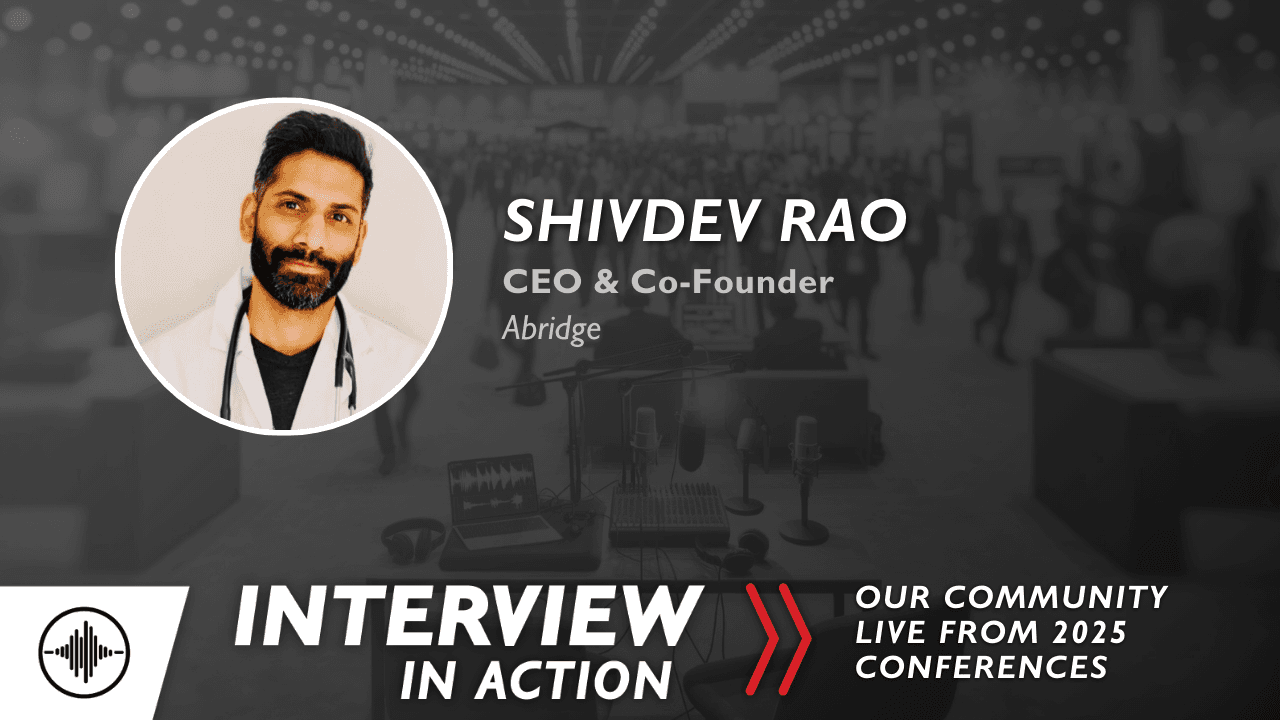
"A Better Way of Doing This": Shiv Rao on Abridge's Landmark Partnerships and the State of the Clinical Note
Abridge Partners With Aetna, Cigna, NVIDIA, and Eli Lilly: What It Means for Health Systems
TOPICS: Breaking Tech Partnerships · Clinical Documentation · Revenue Cycle · Value-Based Care · Payer Integration · AI Infrastructure
BEST FOR: CIOs, CMIOs, CFOs, Revenue Cycle Leaders
Abridge just announced partnerships with Aetna, Cigna, NVIDIA, and Eli Lilly. Taken together, they represent a bet that the clinical conversation can become the source system for how health systems document, code, bill, and get paid. Shiv Rao, Founder and CEO of Abridge, joined the 229 Podcast to explain what that means in practice and why it matters for health system leaders now.
The Party Trick Problem
The ambient documentation market is crowded and getting more crowded. Rao argues that most of what is being sold is not actually solving the hard problem. "It's so easy to create a party trick," he said, "and it's a totally different endeavor to create an enterprise-grade, healthcare-grade product, or much less platform."
A developer with access to today's tools can demo something that looks convincing. The distance between that demo and a product that satisfies the clinician, the coder, the auditor, the payer, and the CFO simultaneously is where most vendors fall short. Getting the note right means pulling in prior visit diagnoses, payer-provider contract language, medical decision-making criteria, HCC coding requirements, and more. "The last thing we want," Rao said, "is to create a note that the doctor loves that actually loses the health system money."
Controlling the Economics
Rao is direct about why Abridge is building its own conversation foundation model in its new partnership with NVIDIA. His concern is cost predictability. "The cost per token for these companies is gonna go through the roof," he said, referring to frontier model providers. A platform processing more than 100 million clinical conversations a year has real exposure to that shift.
The response is to reach further down the stack. "Given that we own and control our stack," Rao said, "it allows us to own and control our destiny, our P&L, and give psychological security to all of our health system partners that we're not gonna be ratcheting up costs in the future."
Where the Real Redesign Happens
The Aetna and Cigna partnerships are where Rao's upstream thesis gets its most concrete test. He described the current revenue cycle process in plain terms: note to visit diagnosis to ICD code to claim to clearinghouse to payer adjudication to denial back to the health system basement, where a revenue cycle team looks at a note a clinician wrote weeks ago and tries to fix it. "That's hundreds of billions of dollars of expense, of cost," he said, "and there's just a better way of doing this."
The better way, as Rao frames it, is to get the documentation right at the point of care so the claim is clean before it leaves the building. With Cigna, the goal is real-time payment when that standard is met. "We've been talking about real-time payments in healthcare for, I don't know, decades," Rao said. The difference now is scale: more than 300 health systems live, more than 250 million patients covered.
With Aetna, the focus is on value-based care documentation. Primary care physicians managing patients with a dozen chronic conditions cannot keep up with every HCC requirement or care gap standard that auditors will examine after the fact. "What did we really do?" Rao said. "We just helped clinicians deliver better care that they wish they had time to do."
The Second-Order Benefit
The first-order benefit of ambient AI is visible and measurable: clinicians are more present with patients, and less time is lost to documentation after the visit. Rao argues that the second order is larger. "The health system can start to organize itself around what actually happened instead of reconstructing it afterward through all the fragmented data and workflows that are out there," he said. "And that means we can redesign the business model."
The conversation is not a documentation shortcut. It is, in Rao's vision, the source system for how a health system understands what it did, what it should be paid for, and who its patients are. The more consequential question any health system leader can ask an ambient vendor is not whether the tool writes good notes. It is what the platform does with the conversation after the note is written.
Thank You to Our Article Partner