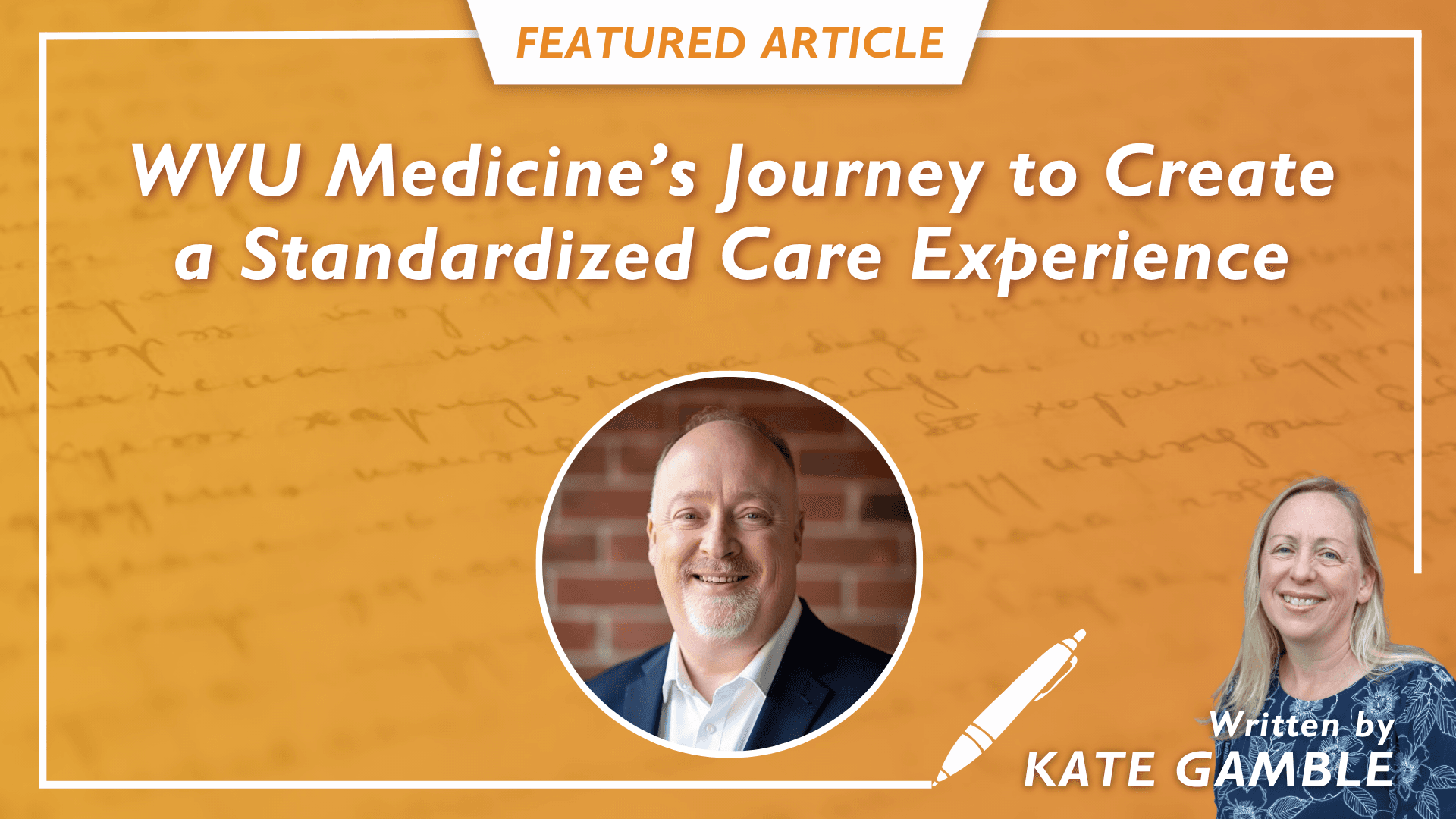
One Standard, 25 Hospitals: WVU Medicine’s Mission To Provide “The Best Possible Care”

Kate Gamble
Managing Editor - This Week Health
Chuck Barkey has spent nearly a decade building and refining a health system-wide IT model at WVU Medicine. From midnight Epic go-lives to a stroke AI protocol deployed across 25 sites, his work is grounded in a single question: what does the patient need right now?
When Chuck Barkey joined WVU Medicine in January 2017, the health system had four managed hospitals, two of which were on Epic.
Today it’s a completely different picture according to Barkey, who oversees applications across the rapidly growing system (WVU Medicine currently stands at 25 hospitals, with plans to expand to 33 by the end of 2027).
As VP of IT for the Northern Region and VP of IT Ancillaries, Enterprise Imaging and Hospital IT Operations, his objective is simple: to establish “one workflow” across the system. Of course, there are bound to be some exceptions when the range includes the 800-bed Ruby Children’s and a 25-bed critical access hospital, but for the most part, the user experience is consistent. “There could be an additional software package here or there, but for the most part, the workflows are the same.”
It’s all part of the ultimate goal to “provide the best possible care for our patients,” he said. Recently, Barkey spoke with This Week Health about the steps WVU is taking to achieve that, from standardizing IT systems to deploying an AI-driven stroke protocol across the organization.
The Go-Live Machine
The belief that “all patients deserve the same care” is a driving force at WVU Medicine – and not just when it comes to the EHR. According to Barkey, enterprise imaging and cardiology PACS are also standardized across all 25 hospitals. As for Epic, the migration process is down to a science, he said, adding that go-lives are scheduled at midnight on the last day of the month. As soon as the clock strikes, “a message goes out saying, ‘please log into Epic,’ and the entire hospital has a brand new workflow”--all without ceasing operations.
The difference maker? An all-hands-on-deck approach in which all IT staffers are required to show up and provide support.
“You might have a hospital that’s staffed at around 500 people for the day, and 200 of them are coming in from IT for these implementations.” And it’s not just for 24 hours; at-the-elbow support is provided in every wing to meet the mark of educating all users within 90 days of go-live.
“I don’t know if we’re ever going to get to the point that on day one there isn’t an incident called in,” Barkey said. “But through cooperation, patience, and calmness, you get through it.”
Part of that patient involves a willingness to make changes – particularly when it comes to training physicians. When feedback showed that long classes were a dissatisfier, his team began offering on-demand classes that are customized to meet individual needs and comfortability levels. “We do two hours of optimization sessions one-on-one with them specifically asking, ‘what do you want to know? How can we optimize this experience now so that you are more ready?’” he said.
Outside of the classroom, his team has also made it a priority to listen and observe. “You can tell when a nurse or a tech is struggling. It’s asking them, ‘what can we help you with? Or what would you like to learn? Let me teach you.”
That level of attention, he added, can go a long way toward building buy-in.
Ambient, Imaging AI & Epic
Another initiative that’s been received positively is ambient documentation. After a successful pilot that saw significant boosts in satisfaction (77 percent) and face time (78 percent) and a 61 percent drop in cognitive load, WVU Medicine is ramping up its deployment of Abridge’s AI platform.
“We expected to be somewhere around a thousand deployed in 2025, and we’re over 3,000,” Barkey said. “It went much faster than we thought and the adoption has been extremely positive for the majority. It’s been one of our better projects.”
The organization has also seen success with its recent system-wide implementation of Brainomix 360 Stroke, an AI-powered imaging platform for stroke diagnosis. The clinical impact has already been felt; according to early analyses, “we can shave off 28 minutes, which is very impressive to me,” he said.
One of the keys to realizing quick success is the organization’s laser focus on establishing governance and standardized processes. “Getting 25 different ED departments and neuro divisions on the same page to deploy one system with one protocol across the entire health system was difficult, to say the least,” Barkey noted. “This was a major win.”
What has made it possible for his team to successfully roll out projects is having a solid platform, which they’ve achieved by adhering to a rigorous upgrade schedule–and holding themselves to high standards.
Those efforts, he noted, haven’t gone unnoticed, as WVU Medicine has been named to Epic’s high honor roll for nine consecutive years. And while the recognition is gratifying, it’s by no means the end goal. “There’s a lot to this,” he said. “We have to make sure we’re protecting our nurses, our doctors, and that we’re implementing what makes sense. It’s not just to get an accolade.”
Patients at the Center
Indeed, the end game that has always mattered most is patient care.
For Barkey, that focus crystallized early in this career. Three days into an enterprise imaging and radiology role, the health system at which he worked experienced a downtime in the ED.
“The entire time I kept thinking to myself, what if my mom was going through the ED and needed a lifesaving CT for a stroke? During that downtime, you’re asking the doctor or the radiologist to run over to the modality and make a phone call. That was the driver,” he said. “It wasn’t financial. It wasn’t someone saying, ‘my internet’s down.’ It was literally life or death.”
He has carried that philosophy into how he orients vendor partners, making it a point to invite them to the Children’s hospital or ED to observe technology in practice. During one visit, a child came in on a stretcher following a bike accident. “I told them, ‘that’s your patient right there. When your app goes down, that’s the person who could live or die. Now imagine if that’s your kid. That’s your mom or dad. Every time we call in and you say, why are they so abrupt? I want you to think of that situation right there.”