Summary
Fostering Innovation with UT Austin CIO Aaron Miri

Kate Gamble
Managing Editor - This Week Health
Aaron Miri, CIO for UT Health Austin and Dell Medical School, joined host Bill Russell to explore the evolving role of a healthcare CIO, the strategy and innovation model for UT Health, and the future of digital healthcare. [caption id="attachment_14020" align="alignright" width="240"] Aaron Miri,
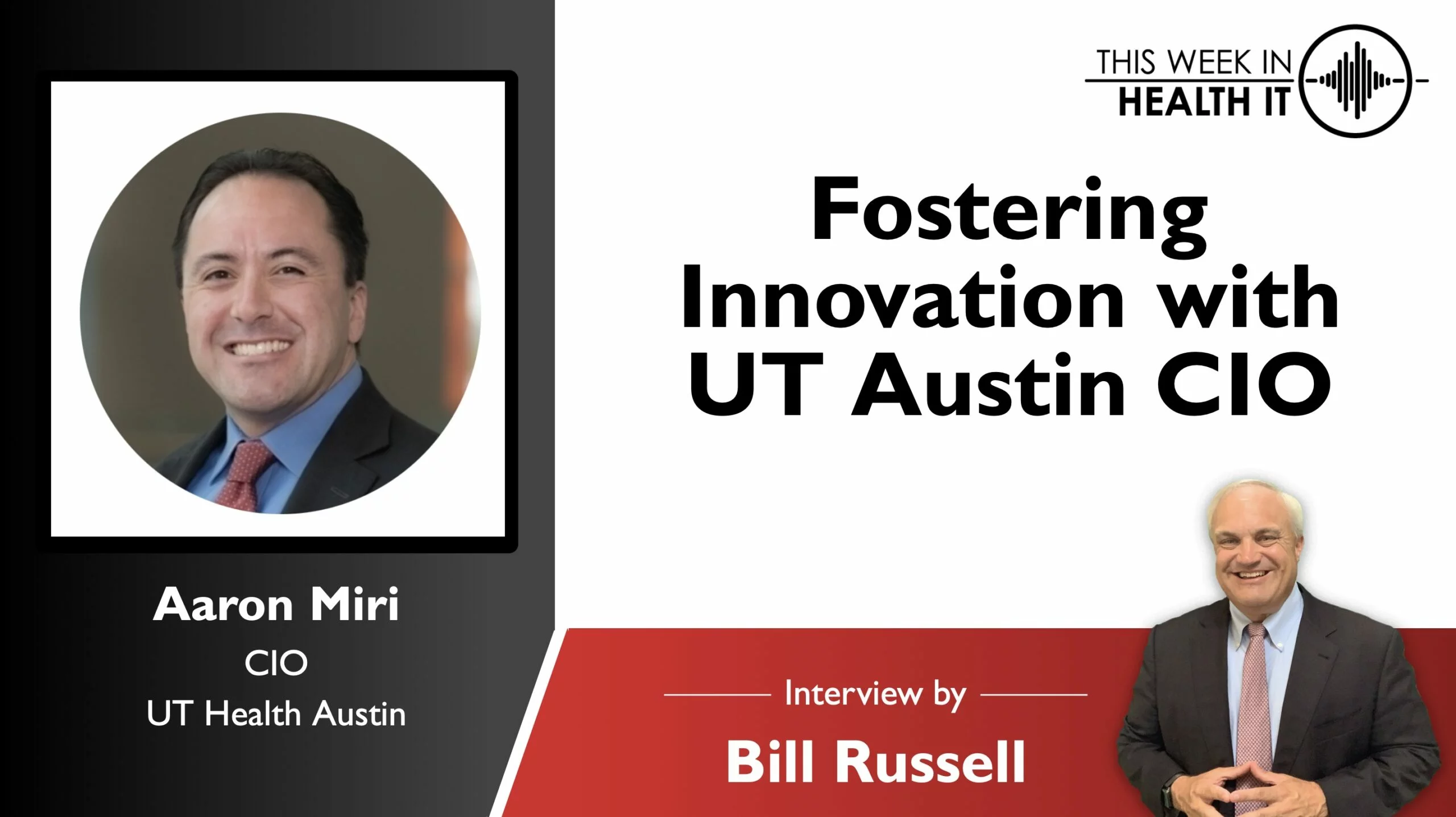
Aaron Miri, CIO for UT Health Austin and Dell Medical School, joined host Bill Russell to explore the evolving role of a healthcare CIO, the strategy and innovation model for UT Health, and the future of digital healthcare.
[caption id="attachment_14020" align="alignright" width="240"] Aaron Miri, CIO at Dell Medical School and UT Health Austin[/caption]
What Does CIO of Healthcare Mean in 2021?
As CIO, Miri is in charge of the clinical delivery perspective, the medical school research divisions, the community health workers, and the events they do with the city of Austin.
In addition to his role as CIO, he explained how he takes on additional roles and responsibilities as needs arise. He is incredibly passionate about his position and works to do whatever he can to help. In the next generation of this position, Miri foresees healthcare companies looking for someone who also understands business, strategy, marketing, patient experience, digital tools, and collaboration.
“It's that dynamic individual that can sit at the board level, have a discussion, go multiple directions and then bring it all home with how tech can be the enabler,” Miri explained.
His position focuses on the digital, with analytics, insights, and other traditional functions. Additionally, he collaborates with team members and leaders to ensure their wants and needs are met. Regarding innovation, according to Miri, he innovates side-by-side with leaders. In the IT team, he has organized this process into DevOps, insight innovation, clinical informatics, and customer success teams.
His goal is to have the team move towards innovating on the fly rather than acting as a client-server 2.0. According to Miri, they have a model for innovation that encompasses VC, private equity, and accelerating startups.
“What I think fundamentally I appreciate about UT Austin is they're all about taking those bets. We tend to take a lot of it,” he explained.
According to Miri, the nature of innovation internal to UT Austin and Dell Med is to iterate and fail fast.
“There's a lot of things that we do that we trial them out. Think of UT Austin as a contained ecosystem, where if something is a really good idea, we want the world to be able to see that…It is going to be something where if you can share it. You can teach it, and you can change what starts here, then that's what the ethos of UT Austin is all about,” he said.
UT Vaccine Equity Initiatives
UT recently received an endowment for a homeless initiative, which has been influenced by their Population Health Department; specifically, Dr. Tim Mercer, who has led numerous initiatives in Austin's Red Cross homeless shelters. Last year, they utilized analytics and contact tracing to determine hotspots and proactively dispatch teams to Austin homeless shelters, according to Miri.
Mercer partnered with Miri's analytics team to determine how to provide masks and now vaccines for these isolated individuals. According to Miri, part of the endowment is to take lessons and codify them into practice across their clinical care delivery modalities.
“What we have found is the community that's sort of disenfranchised like that, whether they're disconnected or whatever else, they just want to be heard. They want to be engaged...What UT Austin has done generally has always been to say, how can we level the playing field and open access to all?” he said.
However, this is influenced by data, which they are tracking through the pandemic. By having these demographics, they can stay informed and not leave out sections of the population.
“We're constantly evolving and learning from the data and helping people to better understand the importance of a lot of this preventative wellness and care,” he said.
The Future of Telehealth
Addressing the future of healthcare, Miri believes telemedicine is an aspect of this. Currently, he encourages his clinicians to do as much telemedicine as possible. According to Miri, telemedicine allows better access for most primary care needs, as it cannot always be at one location. Its success can only be tested once more of these capabilities are extended into homes.
With Uber announcing its prescription delivery partnership with SureScripts, Miri sees this as the future.
“Something like that is what's coming down the pipe, and it's going to take technology, it's going to take a willingness in the healthcare community. And last but not least, it's going to take reimbursement where I do feel that now our officials and others are listening and seeing that this actually saves a lot of money,” he said.
Despite the pandemic, UT Austin and Dell Medical School did not stop growing. According to Miri, they opened up an ambulatory surgery center. They developed several new operating rooms with robots, new computational health clinics, second opinion services, a post-COVID clinic, pediatric hospitals, and partnerships. The public will see a continued expansion.
Two major healthcare concern