Inside Job: Michael Hasselberg On How Nebraska Medicine Is Flipping The Script With Innovation

Kate Gamble
Managing Editor - This Week Health
Nebraska Medicine has deployed 25+ in-house AI tools — adding the equivalent of 31 hospital beds without construction. Learn how their health system AI development model works
For years, health systems have largely played the role of customer – waiting for vendors to provide a solution, then adapting their workflows to fit. Michael Hasselberg, Chief Transformation and Digital Officer at Nebraska Medicine, believes that model is outdated.
In fact, he believes that academic health systems now have everything they need to build their own AI tools in-house – and that doing so can yield better-fitting and more scalable results than buying from outside.
Recently, Hasselberg shared his thoughts on how Nebraska Medicine is applying that theory in practice, why executive alignment is the hardest part of any transformation, and the surprising ways in which ambient tools can benefit nursing.
Keeping It In-House

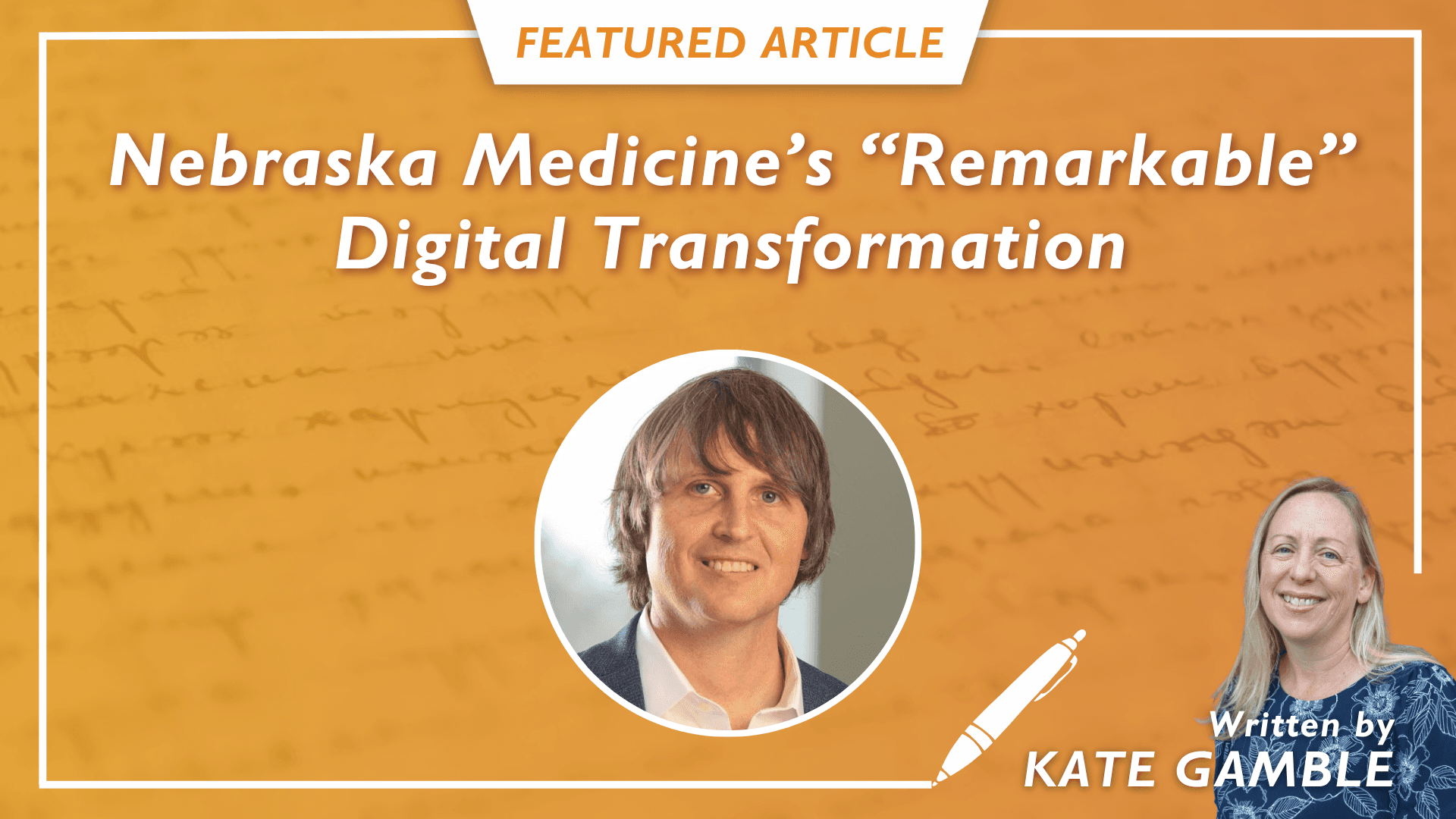
Michael Hasselberg, PhD
Hasselberg has spent several years championing the idea that healthcare organizations don’t have to take a back seat when it comes to innovation and development. “It’s never been easier for health systems – specifically academic health systems – to develop their own AI tools in-house and not have to be reliant on vendors,” he said.
The logic is straightforward: health systems now have access to the same foundational AI models as their industry counterparts, along with the data, the clinical domain expertise, and the specific problem sets that vendors sometimes lack. “We have the data, we have the problems, and we have the content expertise,” he said. “It’s easy for us to fine-tune these models and spin off tools to solve problems in our system.”
Nebraska Medicine has leaned hard into this approach. The organization has deployed more than 25 generative AI use cases built entirely in-house, releasing roughly one new tool per month. The team responsible – made up of data scientists and data engineers who have been relocated from IT into the strategy office – works through a rigorous prioritization process that scores potential projects on strategic alignment, safety impact, speed to execution, and return on investment.
“Alignment and Rigor”
That willingness to build rather than buy isn’t a new trend at Nebraska Medicine. It started in the 1950s, when the University of Nebraska partnered with the Bell Telephone Company to conduct virtual psychiatric grand rounds, leading to the birth of telemedicine.
A few decades later, the organization became the first in the U.S. to pilot ambient documentation on the provider side. “We were at the bleeding edge of the two biggest transformative technologies in healthcare,” Hasselberg noted. “It’s part of our ecosystem.”
That pioneering spirit is baked into the institution’s physical infrastructure as well. Current initiatives include a $2.2 billion hospital that’s under construction, an innovation design unit with smart modular rooms, a simulation center testing holograms, and a program that brings vendors in to test technologies before they ever reach a patient.
“There’s a lot of knowledge sharing happening there,” he added.
Where the true magic happens, however, isn’t so much in the technical work. “That’s the easy part,” Hasselberg noted. “The hard part is actually scaling that technology and successfully engaging your operational and clinical stakeholders around that technology. That’s where I think most folks fall down.”
Nebraska’s approach to this challenge is deliberate and top-down. Use case candidates go through process engineering, enterprise architecture review, then AI team scoping before ultimately being presented to the full executive team for a vote. The chiefs of finance, operations, medicine, nursing, HR, and legal are all at the table, alongside the CEO.
After identifying which use cases will move forward, “we then make sure that we resource it adequately from an operations and clinical standpoint,” he said. “It’s that level of alignment and rigor that allows us to have the success that we’ve had.”
Adding Beds Without Construction
The most powerful example of this approach in action is capacity management. By using AI to automate discharge workflows, predict bed availability, and match patient acuity to transfer timing, Nebraska Medicine has effectively created the equivalent of 31 additional hospital beds – without building a single new room.
“Five years ago, I would’ve never thought that was possible,” Hasselberg said. Beyond capacity, the team has built AI tools across revenue cycle automation, prior authorizations, OR scheduling optimization, MRI scheduling, quality registry reporting, and clinical trial matching, the last of which is a board-level metric for the organization.
The common thread across these use cases is that they sit in what Hasselberg calls the “back office” of the business – areas where AI errors can be caught and corrected before they affect patient outcomes. “If the AI gets it wrong, we still have a human in the loop,” he noted.
Vision-Based AI
The same rigor and diligence that have driven the organization to success with other initiatives is being applied to ambient documentation – or more specifically, why the version that works for physicians doesn’t simply transfer to nurses. Hasselberg speaks from experience, having gained experience as a nursing aide, floor nurse, and a nurse practitioner before becoming a PhD researcher.
The challenge, he explains, is structural. Physician documentation tends to be narrative in form, which makes sense as physicians are already trained to “walk the patient through a head-to-toe assessment,” he said. Nursing documentation, by contrast, flows into structured flowsheets with discrete data fields, and nurses aren’t typically trained to verbalize their assessments.
Although some vendors are offering ambient documentation tools for nursing, Hasselberg is skeptical, noting that “it’s more of just speech-to-text translation. There’s a lot more development that needs to happen.”
What he’s genuinely excited about? Vision-based AI. Nebraska already has cameras deployed for virtual nursing and has begun building AI models that can observe patient rooms directly. A fall-detection vision model is already live. “I’m excited about the vision side,” he noted. “I think that’s where the future opportunity for ambient nursing is going to be – a combination of vision and language.”
It’s just one of many areas in which Nebraska Medicine has benefited from its strong emphasis on having the right infrastructure and people in place to push innovation forward. “The transformation that we’ve been able to do in a short period of time is remarkable.”