A few years ago, AI dethroned cloud as the biggest buzzword in healthcare IT, and it shows no signs of relinquishing the crown.
And as advanced AI continues to emerge as a strategic chip for leaders, Tanya Townsend believes it’s time for another term to reach ‘hype’ status: operational transformation. “We want to enable. We want to enhance. We want to continue to invest in AI and technologies, but we also have budget constraints because of all the headwinds happening,” she said. CIOs, she noted, are being asked to balance cost savings while managing inflation and growth, and still find ways to invest in the future.
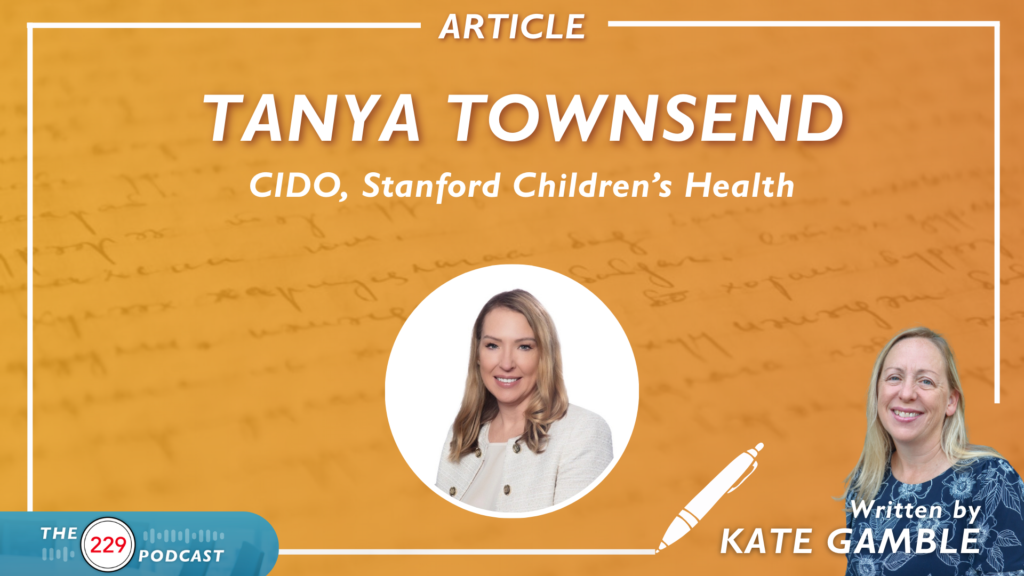
During a recent 229 Podcast, Townsend, who serves as Chief Information and Digital Officer at Stanford Children’s Health, talked about the momentous task leaders face in “getting our arms around that,” the need to refine how organizations view ROI, and the success her team has seen with ambient listening.

Tanya Townsend
When Townsend arrived at Stanford in August 2023, she had already racked up two decades of experience in leadership roles (most recently as system SVP and CIO at LCMC Health). This, however, was her first foray into both the academic and pediatric worlds. “Every organization I’ve been part of has had a little bit of a different personality and culture,” she said. “My leadership style is to come in and observe.”
What she observed at Stanford was a “very mature” organization that had a solid foundation of technology and strong culture, and was positioned well for growth. Her team’s role was to determine how – and where – to pursue that growth.
“We’re live on Epic and we have several other tools that intersect or integrate with our digital front door,” Townsend noted. “But we found that the utilization and adoption weren’t where we wanted them to be.”
To that end, they’ve focused heavily on creating a standardized experience, particularly when it comes to digital engagement. “Nothing is more frustrating than when patients want to use the tool but there isn’t anything available to schedule,” she said. Their solution? To set realistic expectations with operations – and make sure they’re being communicated.
As a result, Stanford has seen a significant boost in online scheduling, with some areas increasing by 36 percent. They also saw a 20 percent spike in wait list acceptance, an increase in online bill payments, and a decrease in no-shows – driven largely by the use of real-time messaging.
Another critical move was the implementation of ambient listening, which yielded results almost immediately. “I didn’t expect it to explode as quickly as it did,” Townsend said. “It’s everything from clinicians getting home on time for supper, to reducing our use of scribes, which was significant. We’re improving our ability to close charts faster, which hopefully will lead to more revenue.”
What was critical, she noted, was the decision to start (somewhat) slowly by piloting ambient listening in a few select areas. When the results started coming in – and teams were able to show value – they rolled it out further, eventually encompassing all ambulatory sites.
“There are so many pieces and parts to it, but it’s really a fun story to tell,” she said.
What isn’t fun, however, is dealing with the perception of IT as a cost center – something that has plagued leaders for years. Her strategy? Face it head-on and create a new narrative. “The reality is that oftentimes IT departments are cost centers. And if you don’t get your arms around what’s involved in those costs, you forget about it, and then it looks like this big number just keeps increasing,” Townsend said.
By reassessing how they look at the budget, her team is hoping to uncover areas for potential savings; for example, reducing the use of scribes after implementing ambient listening. Leaders, she said, need to be thinking about how to capture those types of wins and show how it translates into ROI.
“How do we tell that story? That’s what we need to focus on,” she noted. “It’s also about reassessing staff structure. Do we have the right people? Do we have the right skill sets? Do we have them operating in the right place? And as we’re balancing all of this, we have to make sure we’re prioritizing.”
Part of that, she believes, is bucking what has become a common trend and taking the time to really evaluate an initiative before moving onto the next. “We have to get really good at telling our story,” Townsend noted. “We tend to just move on to the next project. And so, as we’re putting together our digital transformation strategies, I’m really focused on making sure each one has a goal, and that we’re holding ourselves accountable to tracking toward that goal.”
And while the ambient rollout “hit it out of the park,” that isn’t always the case, which makes it all the more critical to reflect on what went wrong and find ways to pivot going forward.
It’s a mindset that she feels will serve organizations well, particularly as advanced analytics continues to dominate the conversation. Although it has certainly shown potential to improve efficiency and boost satisfaction (among both patients and providers), it’s important not to put AI on a pedestal, she cautioned. “It’s just another tool in the toolbox. We shouldn’t think about it differently than other technologies that we need to assess, govern, and prioritize.”
And in fact, she believes leaders should apply a healthy amount of skepticism to AI, while simultaneously putting in place the necessary framework to enable success.
“On the clinical side, it’s going to get better and become more trustworthy, and it’s going to get there fast.” And on the patient-facing side, “it’s going to become an expectation of how we do business going forward. It’s here to stay,” Townsend concluded. “We have to embrace it and learn to use it in the best, most effective and safest way possible.”






Questions about the Podcast?
Contact us with any questions, requests, or comments about the show. We love hearing your feedback.

© Copyright 2024 Health Lyrics All rights reserved