There’s no question that artificial intelligence is transforming healthcare. Few strategic discussions happen without it being mentioned (or more realistically, dominating the conversation). And yet, despite the overwhelming interest in AI across clinical, operational, and administrative domains, one key area is being neglected: governance.
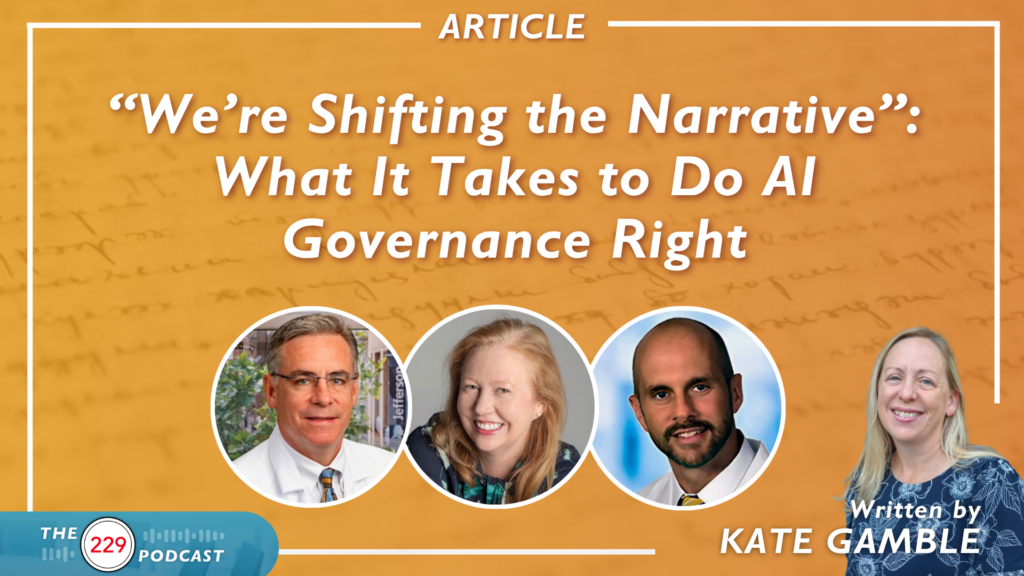
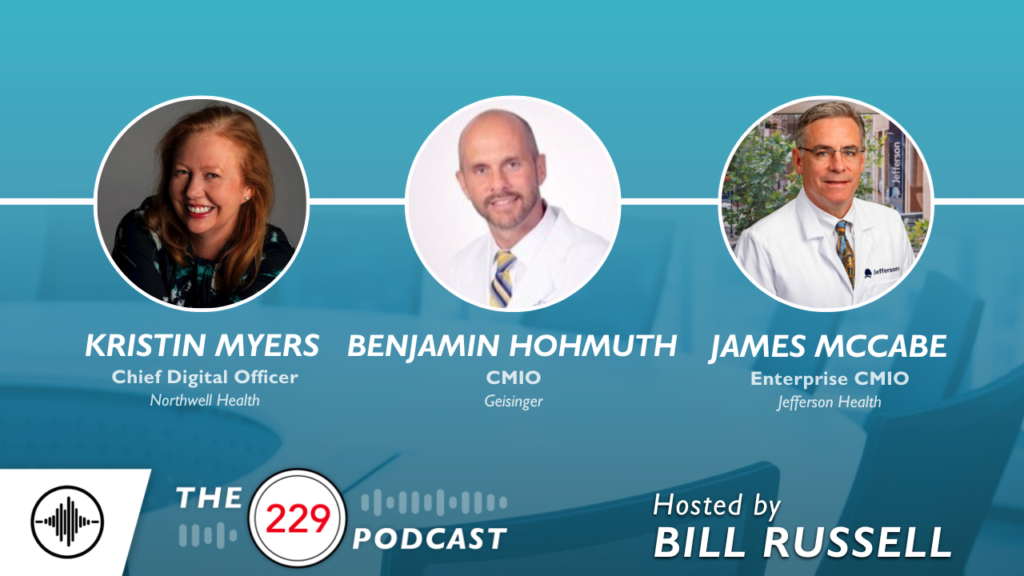
It’s a gap that must be filled if organizations want to fully reap the benefits of the technology, according to James McCabe, MD (CMIO, Jefferson Health), Benjamin Hohmuth, MD (CMIO, Geisinger) and Kristin Myers (Chief Digital Officer, Northwell Health). During a recent webinar (which was sponsored by Abridge), the panelists shared perspectives on what it takes to build governance structures that can scale, manage executive expectations, and measure ROI in a world of soft-dollar savings.
For all three leaders, the prospect of overseeing AI governance has become a challenge given the level of enthusiasm with which healthcare executives are leaning into the technology. For instance, Jefferson’s executive team has set a target to save 10 million hours of clinician time over three years, McCabe noted. Similarly, AI has been framed as a strategic imperative at Northwell tied directly to patient experience, clinical operations, and operational efficiency, while Geisinger’s CEO views the technology as critical to the health system’s long-term viability.

James McCabe, MD
But enthusiasm and execution are different things. “This has come at light speed through a fire hose, and there’s an over assumption of the magic that’s available,” said McCabe.
His team’s response has been to shift the language. “We’re trying to shift the narrative from magic to more augmentation,” always leading with a problem-first approach. “Rather than what can AI do for us, we ask, what problem are you trying to solve?”
Hohmuth concurred, noting that he constantly pushes back on the concept of AI as peanut butter that can be spread broadly over undefined issues. Instead, his team focuses on specific use cases, one of which is analyzing Geisinger's cardiology referral queue to prioritize patient needs.
The next step is to establish a solid foundation, taking into account key factors such as culture and existing processes.
At Geisinger, Hohmuth has woven AI governance into the existing intake infrastructure rather than building a parallel system. Requests, which come through ServiceNow, are filtered based on possibility for an AI component; analyzed for potential benefits and risks; and tiered accordingly. “If it’s low risk – and a little more than half of them are – it’s pretty light touch,” he explained. Higher-risk use cases, particularly those involving patient-facing decisions or reduced human oversight, go through a more rigorous evaluation and require a defined monitoring plan.
Northwell has integrated AI review into its broader technology intake, but with two notable additions: a security and ethics group that brings together leaders from legal, compliance, cyber, and risk; and an executive committee that keeps the COO, CFO, and CHRO engaged at the strategic level.
Jefferson has built the most elaborate structure of the three. What began as an AI steering committee and an imaging AI committee has expanded into 10 subcommittees covering clinical AI, imaging, technical review, responsible AI and bias, KPI tracking, education, and community knowledge exchange, among others. “When a request comes in, we make sure it makes sense to whatever service line is interested and that there’s enterprise agreement that we should take a look at this,” McCabe said. Only after clearing that multi-committee process does a request move to the PMO for implementation.

Benjamin Hohmuth, MD
What comes next – monitoring and maintaining – is one of the most challenging aspects, according to Hohmuth.
“The tools we have to govern and monitor are lagging behind the tools we have in use,” he noted. And while that may be acceptable for the time-being, it isn’t sustainable over time, and can’t be scaled successfully without involving humans. “We need to get to a point where technology is doing the audit, and we need to get more help from our vendors.”
Epic has earned relatively high marks from all three for transparency and built-in monitoring dashboards. At Jefferson, McCabe’s team tracks ambient speech outcomes through Epic Signal data, monitoring time in notes, pajama time, and even Press Ganey scores tied to CSN numbers. In doing so, “we found a significant jump in patient experience,” he said. “When we’re using ambient speech with a patient, we’re able to look at them face to face.”
What has proven more challenging, not surprisingly, is demonstrating a hard-dollar ROI. Revenue cycle remains the clearest path through capabilities like denials management, coding assistance, and HCC capture, the leaders stated. But for the growing category of AI tools aimed at clinician experience and administrative burden reduction, the ROI conversation is more nuanced.
When Geisinger rolled out ambient documentation, the principle KPI wasn’t financial, which was a deliberate decision. “Our strategy around a lot of these tools that are aimed at wellness and decreasing cognitive burden is that we have to do that,” Hohmuth said. “We have to make it easier for doctors and nurses to take care of patients.”
Critically, the health system has kept productivity expectations separate from the experience benefit. “We’ve said very specifically we don’t want it to be a quid pro quo where, hey, you can have this tool if you see two more patients.”

Kristin Myers
At Northwell, Myers has brought finance into the ROI evaluation process directly, requiring that any measures presented to the executive committee be pre-vetted by the CFO’s office. Even so, some tools have achieved a different kind of status. “From even our CFO’s perspective, they’ll say, look, ambient is now just a foundational technology, and if we don’t implement that, we’re not being competitive.”
Hohmuth offered one practical strategy for navigating the hard-versus-soft ROI divide: piggybacking. When a use case with clear hard-dollar ROI, such as a revenue cycle AI tool, reaches the threshold where it tips the economics from à la carte to platform pricing, it can pull other experience-focused use cases along with it. “All of a sudden the financial barrier to implement some of those other non-hard-dollar use cases goes down,” he noted.
In terms of what’s next, all three leaders pointed to agentic AI as both the most promising development on the horizon and the most consequential governance challenge ahead. The tools currently in use – ambient documentation, clinical summarization, decision support – have managed to keep a human meaningfully in the loop.
That’s about to change.
For Hohmuth, the most exciting near-term opportunity is the aggregation of multiple information streams: what comes from a patient conversation, what lives in the chart, and what evidence-based guidelines say should happen next – all brought together into actionable clinical recommendations. “Synthesizing what comes from the conversation with what comes from the chart, informed by what we know about the patient and from society guidelines or other knowledge resources, into sort of next best actions – that’s something I’m really excited about.”
Myers sees patient access as an area that’s ripe for potential, whether it’s streamlining scheduling, personalizing care connections, or reducing the friction that prevents patients from getting to the right place at the right time. Just as impactful, however, is the promise of reducing the administrative burden. At Northwell, “our ambition is grounded in realistic value-driven transformation. We want to embed AI into the culture, strategy, and day-to-day operations that advance quality, access, and long-term sustainability,” she added. AI “can transform the way we operate, deliver care, and innovate as an organization.”






Questions about the Podcast?
Contact us with any questions, requests, or comments about the show. We love hearing your feedback.

© Copyright 2024 Health Lyrics All rights reserved