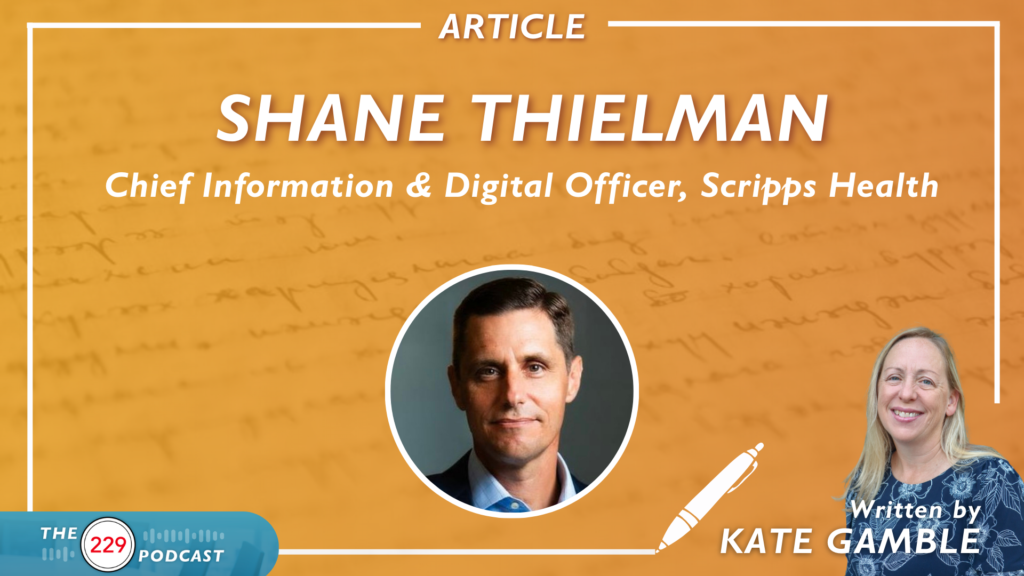
Like many healthcare leaders, Shane Thielman makes it a point to attend user group meetings whenever possible, as he finds them to be extremely informative.
Almost too informative.
As a result, he usually comes back feeling “very excited and enthusiastic,” and at the same time, “drained,” he said in a recent 229 Podcast interview. “It’s so much information.” And as much as AI tools have become ingrained into healthcare and dominated strategic conversations in recent years, there are still significant gaps, according to Thielman.
“My fear with AI is that we don’t unlock the power and the potential because we fail to bring our workforce along in a way that they understand how to be successful working with it,” he noted. For that reason, Scripps Health – where he has served as CIO since 2019 – has made it a point to establish a strong business case for any initiative, and ensure steps are in place to build literacy and share knowledge. They’ve also adopted a stepwise approach with implementations, ensuring a solid foundation is in place before advancing to the next level.

Shane Thielman
“Our philosophy is that IT itself is not a strategy,” he noted. Rather, “IT should help enable the strategy, along with operations.”
During the interview, Thielman spoke about how Scripps is leveraging technology to improve the digital experience for both patients and staff, as well as their “methodical” approach to selecting and prioritizing initiatives.
It’s not a new concept; in fact, when Scripps initially began rolling out Epic in 2017-18, leadership opted for a phased implementation over the highly recommended big-bang strategy, and it turned out to be the right call. “I’m appreciative that we had the opportunity to deploy the way we did,” he said. “We took the lessons learned in the first deployment and applied those to the second and third in a way that made those successive rollouts much more palatable for the organization.”
Since that time, there has been a concerted effort to remain closely aligned with the foundation, ensuring that Scripps can “stay current and benefit from all the latest features, workflows, and code that’s available from Epic,” Thielman added.
With that core in place, his team is better positioned to determine which initiatives to move to the front of the queue.
One of those is the use of digital and virtual assets to improve the navigation process and reduce friction for patients. “A big part of our focus has been around appointment availability,” he noted. “We’ve been on a journey since our initial deployment to activate a lot of the self-service features, both through the portal and website.”
Although it may seem “very simplistic” to allow self-scheduling, it’s part of a larger strategy to empower patients and caregivers, which in turn can improve outcomes. “It’s about how we make ourselves accessible and available to patients and give them alternatives from the traditional phone call to the physician’s office or into a contact center,” Thielman stated, adding that around 40 percent of appointments can now be scheduled online.
And while the response from the community has been encouraging, Scripps still has a long way to go. “It’s going to become increasingly important to distinguish ourselves as a provider of choice, and that extends well beyond online scheduling,” he said. “It’s everything from enabling visibility into wait times in our EDs and urgent care centers, to being able to hold a place at our lab draw stations.”
That functionality has been extended to specialty and subspecialty areas where providers are in short supply, and will continue to expand, he said. “There’s unlimited potential for growth.”
Another area of focus? Operationalizing a command center to provide co-located services across all five hospital campuses. By automating support services like EVS and transport, Scripps has seen a decrease in the time between admission and bed placement. Providers are also able to monitor patients’ progression through their episode of care.
“We’re using the command center as a mechanism to leverage our human capital and talent differently,” Thielman said, while also thinking differently about “how we leverage our technology assets to be more effective and efficient.”
And while it certainly helps to show specific metrics such as improved length of stay, his team is more concerned with how initiatives translate to overall improvement. “We’re looking holistically across the episode of care at all of the white spaces where patients are waiting,” he said. “We have a high demand for our ED services and we need to be able to turn beds over efficiently. And so, anything we can do to attack that white space is critical. We can hardwire our performance standards and expectations. We can train to standard work and we can embed that within our digital footprint and provide feedback performance on a real-time basis.”
Another key step has been adopting a set of milestones around discharge that create visibility by alerting care teams of delays, and enabling them to see which activities are still pending. “That was our first step in addressing flow,” Thielman said.
The second was having physicians document information such as the expected date of discharge into the EHR. “The concept there is to help manage expectations and understand where we have variants,” he noted. “By understanding those outlier cases, we move closer to continuous improvement, and create awareness across the care team that can be built into our daily operation huddles.”
That same tried-and-true methodology has been applied to Scripps’ use of AI, particularly ambient documentation. Despite being early adopters of DAX, Thielman’s team has taken a stepwise approach, moving incrementally toward a more full-scale deployment. And while there isn’t a roadmap that can guide all organizations, he did recommend some steps that have proven effective, including the following:
These guidelines, he believes, helped build a strong foundation that will guide the organization as AI use expands beyond administrative tasks, eventually being leveraged to personalize patient care and inform diagnosis and treatment decision making. In order for that to happen, however, organizations need to remain laser-focused on solving the most pressing issues.
“What’s going to add the most value? What’s going to help move the needle for Scripps and for our patient community? That’s where we need to be,” said Thielman, who believes IT leaders have been given a tremendous opportunity. “I see this as a defining moment from an IT standpoint as to how we can further enable the organization, help improve workflows, quality, and patient/provider experience, but also identify ways in which we can use technology to reduce cost structure. ”






Questions about the Podcast?
Contact us with any questions, requests, or comments about the show. We love hearing your feedback.

© Copyright 2024 Health Lyrics All rights reserved