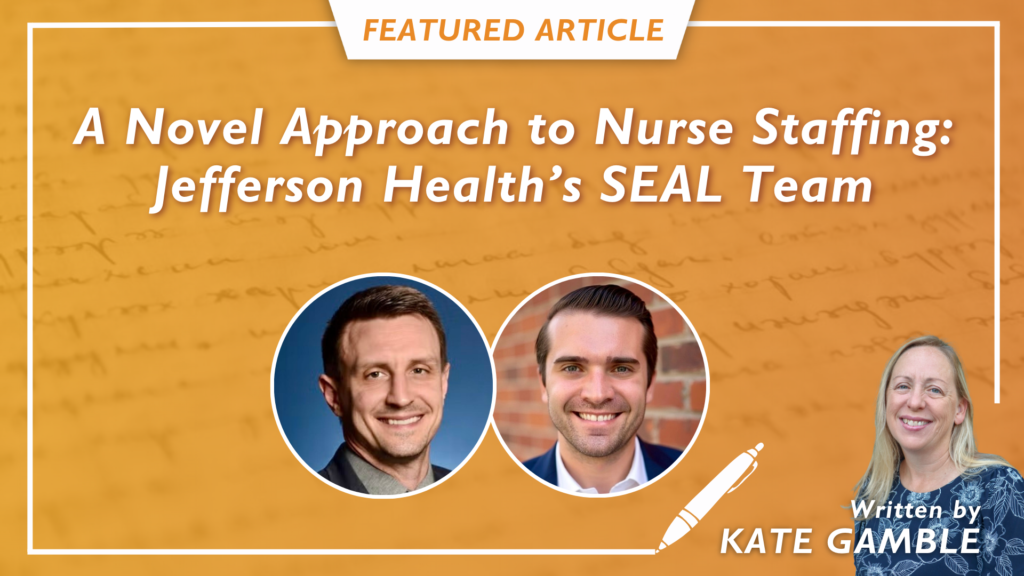
More than three years ago, Jefferson Health launched an initiative to help fill vacant shifts while decreasing reliance on costly travel nurses. The idea, according to Andrew Thum (AVP, Nursing Operations), was to “leverage internal resources that could fill the demand.”
Since then, the Philadelphia-based system has reduced its use of agency nurses by 75 percent. But the Nursing SEAL Team program has accomplished more than that; it has generated spikes in engagement and satisfaction among nurses, and enabled teams to more proactively manage staffing challenges.
“It’s helping us understand where the needs are so that we know in advance where we can have the most impact,” noted Thum.
Recently, he and Daniel Hudson (SVP, Nursing Operations and CNO, Ambulatory Nursing) shared their story with This Week Health, including why the program was conceived to how it’s constructed, and discussed both the results they’ve seen so far, and the effect they hope it will have on healthcare.

Daniel Hudson
The obvious catalyst of an initiative like the SEAL program is the nursing shortage – a problem that has existed for years but was exacerbated by Covid. Filling those roles, as leaders learned, required more than a competitive salary; increasingly, nursing candidates craved flexibility. “The newer generations in the workforce had different expectations around work and life,” said Hudson.
The other motivating factor – one that’s equally significant – is the “unsustainable” cost of temporary labor such as traveling nurses, which run around $120 to $130 per hour. “We had to do something,” he noted, particularly given the fact that Jefferson spanned 16 hospitals at the time (it now has 32 hospitals after a merger with Lehigh Valley Health Network).
The solution? Create a flex team that could serve a geographically dispersed network without having to incur travel and lodging expenses.
Of course, there were some questions that had to be addressed. “We needed to think about the frequency and cadence of deploying resources that were beneficial to us as an organization, while also keeping in mind the well-being and fatigue management of our people,” Hudson said. “How are we using the technology that we have to know how many resources we need, and when to move them?”
Part of that comes down to having the right framework, which starts with governance.
According to Hudson, there are two structures in place, each representing different facets of nursing leadership. Through these groups, they’re able to solicit feedback from regional CNOs and share information before making decisions, which helps build alignment.
It also provides a framework to review data, said Thum. “That structure helps to inform our procedures so that our staffing offices are functioning in the same standard, best-practice way and leveraging the technology and tools that we have across the system.”
Having consistent scheduling and payroll tools, he added, is a “foundational piece” in building and maintaining a successful staffing initiative. “Without that, it isn’t possible.”

Andrew Thum
On the other hand, with a solid structure in place, Jefferson’s teams can analyze data to identify the most significant gaps. “Our core teams build their schedules on every unit at every hospital across the health system,” he said. Once those are published, “we can then see where the needs are greatest, and deploy the SEAL nurses into those units.”
They’re also able to detect high rates of turnover, and adjust the numbers based on those findings. In that respect, “we’re still being proactive, because staffing is so dynamic and can change drastically,” Thum stated. “Especially at some of our smaller hospitals, where one vacancy can be the difference in a unit’s ability to provide safe care.”
To that end, Jefferson also utilizes local resources for unexpected absences (for example, calling in sick). But the ultimate objective is to think long-term, he reiterated. “Our goal is to use tools like our scheduling system, along with feedback from unit leaders, to forecast vacancies so that we understand in advance where we can be most impactful.”
What the data can also do is help identify variations in nursing practices across the system, which can “help inform opportunities for standardization, optimization, and best practices” he noted.
Of course, none of this can be done in isolation, according to Hudson. Along with nursing – which includes senior nursing executives as well as frontline managers – other key areas must be part of the discussion, including operations, finance, and legal. “You need all the right people building it together, you need a structure that supports decision-making, and you need accountability to measure progress and continually improve,” he said.
Tying all of this together, according to Hudson and Thum, is a multi-pronged strategy that revolves around three core premises.
“It’s not one thing alone that’s helped us to get where we are,” Hudson said. “It’s an integrated workforce strategy, and we’re going to continue to evolve that.”
It’s not just about making sure the right amount of nurses are available, but also that those nurses are engaged. Since the launch of the SEAL program, Jefferson has seen notable boosts in satisfaction, Thum noted.
The reason? It enables nurses to experience different environments – much like a traveling nurse does – while still reaping the benefits of being part of a system. “They feel a sense of belonging because they are Jefferson nurses,” he said. “As a result, they tend to be more reliable and are able to respond to situations more effectively. And our patients can expect to receive higher quality care.”
The initiative has also yielded another critical benefit: mentorship. In some of Jefferson’s units, as many as 75 percent of nurses have less than two years of experience, according to Hudson. That’s where SEAL nurses come in.
“When we have experienced nurses in a unit for six weeks, that’s invaluable,” he said. “They’re bringing that mentoring and support along with clinical knowledge. That’s really important, and it has been so advantageous for us.”
Since the program’s inception, Jefferson’s leaders believe it has lived up to the ‘SEAL’ moniker, providing “an elite team that is highly skilled and can be dropped into any situation and perform at a high level of expertise,” Thum noted. “That’s exactly what this team is. We can move them to the hospital of greatest need and expect the same level of expert nursing care.”
No contributors linked to this article.

Questions about the Podcast?
Contact us with any questions, requests, or comments about the show. We love hearing your feedback.

© Copyright 2024 Health Lyrics All rights reserved